 “Welcome to the Axis of Evil”—Bolivian President Evo Morales to Paraguayan President-Elect Fernando Lugo
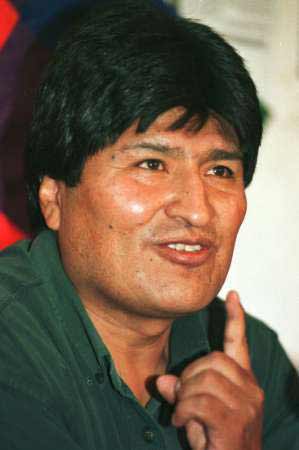
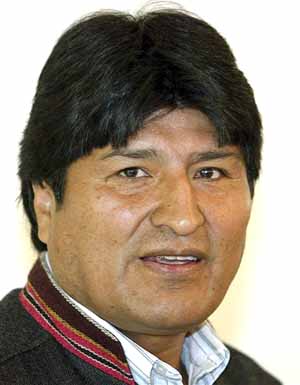
Bolivian President Evo Morales came to New York this week to deliver the keynote address at the UN Permanent Forum on Indigenous Issues. Morales became Bolivia’s first indigenous president when he was elected in 2005 with more popular support than any Bolivian leader in decades. Democracy Now! co-host Juan Gonzalez had a chance to sit down with President Morales at the Bolivian mission in New York for an interview. Morales discusses issues of world hunger, biofuels and climate change, relations with Paraguayan President-Elect Fernando Lugo, his push to introduce a new constitution in Bolivia, his accusations that the US ambassador is leading a conspiracy against his government, his thoughts on the US presidential elections, and more. [includes rush transcript]
JUAN GONZALEZ: Bolivian President Evo Morales opened this week’s UN Forum on Indigenous Issues. An Aymara Indian, Evo Morales became the country’s first indigenous president when he was elected two-and-a-half years ago with more popular support than any Bolivian leader in decades. During his keynote address, President Morales raised criticism about the impact of climate change on indigenous peoples, especially the use of biofuels and how it was affecting world hunger.
I had a chance to sit down with President Morales at the Bolivian mission here in New York for an interview. I began by asking him about the comments he made at the UN.
PRESIDENT EVO MORALES: [translated] Thank you very much for the invitation and for this kind interview. I’m very pleased, as always, to talk with you and share our proposals on behalf of life.
I’ve come at the invitation of the Permanent Forum of Indigenous Peoples of the United Nations. I was, as a union—to share experiences on climate change, first as a peasant union leader and second as a president. Unfortunately, the so-called developing countries are the hardest hit by natural phenomena. These natural phenomena are a result of the unbridled industrialization of the Western countries. I think that the countries of the West are under an obligation to see how they can pay the environmental debt to reduce harm to the planet earth. The planet earth has suffered a death warrant and must be saved, and that means saving planet earth is to save life and to save humankind.
But there are other factors that are leading to the inflation in prices for some agricultural goods, particularly biofuels and programs implemented by some presidents for some movements called biofuels or agrofuels. They are setting aside millions and millions of hectares to produce agricultural goods which are earmarked for biofuels. And it’s not possible to understand in this new millennium how there are governments, presidents, institutions that are more interested in a heap of metal than in life. They’re more interested in fueling luxury cars than in feeding human beings.
That’s where we raise a question. First, land is to be for life and not land for scrap metal or a heap of metal. And while some presidents and some international organizations want to implement measures of this sort, well, I believe very much in the social movements. So, for example, the Free Trade Area of the Americas, well, there’s been an international movement, and we’ve put a halt to it. In addition, there are major movements against biofuels or agrofuels, and we need to wake up some presidents and international organizations before this problem of hunger that’s suffered by families and hectares of land being earmarked to cars rather than people goes any further.
JUAN GONZALEZ: You have raised some criticisms of some other Latin American leaders. You didn’t name any, but it’s obvious to many that some of your questioning is directed at presidents like Lula of Brazil, who has pushed biofuels. Have you talked to President Lula about this? And what’s been his response, if you have?
PRESIDENT EVO MORALES: [translated] We have had discussions at summits of heads of states, sharing some of our experiences. I am certain that these presidents will understand the cry of the people of Bolivia, of the people of Latin America and the whole world, which wants to have more food and not more cars. First food, then if something’s left over, more cars, more automobiles. I think that life has to come first.
But the most important thing—and this is the first time that I find I’m in agreement with the World Bank and the International Monetary Fund—they’ve publicly stated that if food prices are going up, it’s precisely because of the biofuels question, and it has a major impact. So if we have these points of agreement, then we have an obligation to together explain and persuade these international organizations, together with the social movements, so as to be able to change the policies of some governments or some presidents.
JUAN GONZALEZ: There’s been another important event happening this week in Latin America, the elections in Paraguay, and a new populist leader was elected, former Bishop Fernando Lugo. And one of the first things he said was that he would like to improve relationships between Bolivia and Paraguay. Your response to his victory and how your country and his country could cooperate or build better relations?
PRESIDENT EVO MORALES: [translated] Well, first of all, I would like to tell my colleague, brother, President-Elect Fernando Lugo, welcome to the Axis of Evil. But I am so sure that it is an axis for humankind, liberating democracies that are not subjugated. They should continue to grow in Latin America. The next will certainly be in Peru and Colombia, that there be governments or presidents who are subordinated to their peoples and not to the empire. So I am very pleased at his election.
And certainly, the small—so-called small countries like Paraguay and Bolivia are going to have a major correlation or coincidence. We’re going to improve our relations. What better than for the small countries of the region to propose and to propose together that we go forward in finding solutions with the countries of the region that are more recognized, such as Brazil and Argentina, who have a great deal of leadership, Venezuela? But they always listen to us, and we will listen to them to see how we can work out problems as in a framework of complementarity as presidents of the region.
JUAN GONZALEZ: You mentioned with the smile “Welcome to the Axis of Evil.” Have I missed something? Has President Bush added Bolivia to the Axis of Evil in recent months?
PRESIDENT EVO MORALES: [translated] Well, first, the Axis of Evil was Fidel and Chavez, and then they included me, and then they draw the president of Ecuador into it. And I’m almost certain, after having heard information—well, many would tie me and Chavez to President-Elect Lugo.
You know, what’s happening in Latin America, any aggression or provocation by President Bush improves the image and the acceptance of candidates to the presidency. I feel that there’s a rebellion in the Latin American people, especially in the South American people, vis-a-vis the empire. Before, they were dictatorships at the service of the empire. And I don’t want to hide this. You know me. That’s why we’ve had so many interviews. And democracies are coming about as a result of people’s struggles and vis-a-vis democratic movements. There were dictatorships and dictatorships in the last twenty years. There have been neoliberal governments that have been pro-capitalist. Now, as they’ve not resolved their social or structural problems, the social movements are growing with their own sentiment of dignity, of sovereignty, of development. And at this juncture, they’re growing. The liberating democracies in South America are on the rise. It’s very striking.
That doesn’t mean ending diplomatic relations with the United States or others. We want to improve diplomatic relations, our trade relations, cooperation relations and credits, but in the framework of mutual respect. I recognize the world leadership exercised by the United States. One must recognize it, but not because—just because it’s a big country. It can’t subjugate, humiliate and conspire against those governments that don’t accept and that don’t agree with some errors and some policies of the US government. I’m not talking about the people of the United States, and we have good relations. I just had a great meeting with the indigenous movement of the United States. There was applause. Everyone was very pleased. Sometimes it’s with the governments that we want to have better relationships. And I have no reason to get involved in the internal matters of the United States. We respect them. But they also shouldn’t meddle in my country, even though at this time there is a permanent conspiracy against the government.
JUAN GONZALEZ: I’d like to ask you about the situation domestically in your own country. When last we talked, there was a movement toward a new constitution, and there was also some discontent among some of the departments. And recently, Santa Cruz and some of the other departments have moved to call for a referendum on autonomy that the courts have ruled illegal. Your understanding of why the constitutional reform has been delayed and what the crisis with Santa Cruz and the other three departments represents?
PRESIDENT EVO MORALES: [translated] It’s not Santa Cruz. It’s some families in Santa Cruz. And it’s not in other departments. Some politicians or those who play at politics—well, who are those who play at politics? Those who live off of politics and don’t live for politics, former national authorities—they’ve turned to the regions in order to put up resistance against my government—former neoliberals who want to recoup the national government or take back the national government with pretexts, such as autonomy, private property, so many things that they turn to to figure out how they can weaken President Evo Morales.
Now, speaking of autonomy, the national government is going to guarantee autonomy for the peoples, not autonomy for the small elite cliques. And therefore, in this new constitution, new political constitution of the Bolivian state, which still needs to be put to a popular consultation, there is a guarantee for autonomy, not just autonomy of the departments, but also autonomy for indigenous peoples as the United Nations proclaims in its Declaration on the Rights of Indigenous Peoples, regional autonomy as well.
But those opposition groups who lost their control over the national government want to use the autonomy question to damage or divide Bolivia. First, the autonomy statute that they’re holding a vote on is illegal and unconstitutional. Why? Because under the current constitution, there is no provision for autonomy. But here, we are guaranteeing autonomy. Second, any referendum must be called by the national congress. And here, the governor decided illegally and unconstitutionally, and all because they are in agony, the historical enemies of the indigenous movement, of the people and the social movements, and, I should say, the pro-capitalists.
JUAN GONZALEZ: And why are they in agony?
PRESIDENT EVO MORALES: [translated] Because the space for them is ever more limited. And in the face of their desperation, they try to cause confusion with these kinds of calls for a vote on an autonomy statute. So, as it’s illegal and unconstitutional, it’s really like an opinion poll. And they have—they’re fully in their right to have an opinion poll. But it’s not a referendum on the autonomy statute.
But I repeat, we are going to guarantee—well, to better explain, first the mother and then the child. So, first the new constitution and then a decision on autonomy statutes. How can you have a child without the mother? And from that point of view, they’re not respecting the rule of law or legality. In my first year of government, these groups always said the president doesn’t respect rule of law or legality. Now, the people can see and the whole world can see how these sectors don’t respect the rule of law.
JUAN GONZALEZ: And finally, Mr. President—I know you’re pressed for time—I’d like to ask you a question about the United States. As you may have heard, we’re having an election for president this year, and there are two Democrats, Hillary Clinton and Barack Obama, vying for the Democratic nomination to run against McCain, the Republican candidate, John McCain. Your sense of whether—which of these candidates has shown a policy that would be more friendlier to the people of Latin America and the aspirations of the people of Latin America and of your country?
PRESIDENT EVO MORALES: [translated] I have no reason to get involved in the internal politics of the United States. I very much respect that there are democratic elections and primary elections within each party, Democratic and Republican. I fully respect that, and similarly, I would hope that they not meddle in Bolivia.
There’s a conspiracy headed up by the US ambassador, and I hope that it can be withdrawn or put to a stop by the government and the people of the United States. Processes of change are healthy everywhere seeking equality and social justice, the most important thing that us presidents can do or that candidates can do. But I have no reason to give an opinion in respect of one party or another or in respect of the candidates who are vying for the candidacy in the primaries. So, out of respect for the people of the United States, I don’t have any opinion to share or any candidate to favor.
AMY GOODMAN: Bolivian President Evo Morales speaking to Juan Gonzalez at the Bolivian mission here in New York, as he opened the Permanent Forum on Indigenous Issues at the UN. Juan, your reflections on this interview?
JUAN GONZALEZ: Well, the interesting thing once again is that there was almost no coverage here in the United States of his visit here. And I don’t think that many people in the press here understand that Morales has become a hero to indigenous peoples around the world, not just in his own country of Bolivia. For instance, our guest who just left said that she would like to nominate him for a write-in for president, because that’s how indigenous people around the world are seeing the kinds of issues and the kind of message that Morales is bringing to the UN and to people around the world.
AMY GOODMAN: If you missed any part of the interview, you can go to our website at democracynow.org for a transcript, video and audio.