How the Friars Club roasts expanded the First Amendment
Greg Beato(http://www.reason.com/news/show/135072.html)
On Sunday night, eight of the most medium-sized names in showbiz convened in Studio City, California to roast Joan Rivers and her anatomically approximate face sculpture. When the event airs on Comedy Central on August 9th, and the insults commence, you may forget there was a time in American history when it was not considered appropriate to crack jokes about a 76-year-old grandmother's toxic vagina. Lucky for us, that time is long gone, and for this, we owe a debt of gratitude to Milton Berle, Henny Youngman, and all the other mid-century yuk-meisters who practiced the art of speaking the unspeakable at Friars Club roasts years before Lenny Bruce got busted for subjecting audiences to obscene grammar lessons or George Carlin compiled his list of seven words you can never say on television.
Roasts are the Rodney Dangerfields of free expression: They don't get any respect. When we credit the iconoclasts who believed that the freedom of speech granted by the First Amendment should be as expansive as Sasha Grey's fun tunnel, we turn first to literary sorts, like H.L. Mencken, Henry Miller, and Larry Flynt, and second to more cerebral funnymen like Bruce and Carlin. In part, this is because the Friars Club roasts, along with similar events held at The Masquers Club and other locales, were private affairs, with no women or waiters allowed. But we also snub roasts, one suspects, because they had no greater goal than coaxing horse laughs from filthy-minded drunks. Which of course is why we should value them all the more: How free is free speech when the only way you can unleash masturbation gags upon the public is to write a masterpiece on the order of Ulysses?
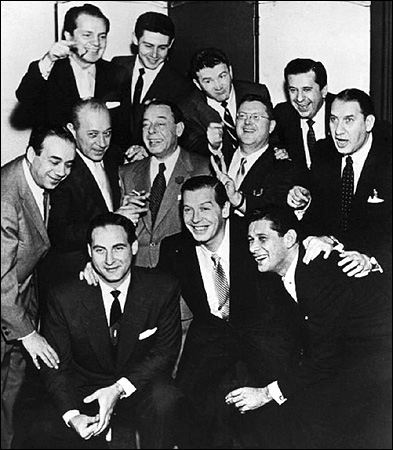
The Friars Club was established in 1904 and began holding rowdy testimonial dinners for prestigious pinatas shortly thereafter: "Veteran Theatrical Manager Butt of Jokes at Dinner," reported one newspaper article from 1910. But as Friars Club historian Barry Dougherty recounts in the book A Hundred Years, A Million Laughs, it wasn't until the 1950s, when Milton Berle started choreographing these bashes, that they turned "vicious beyond belief" and started using language that could make a statue of Freud blush.
"The biggest shock of my life was to hear Jack Benny, who was on the microphone, telling a story about George Jessel, and he used very, very salty language... " Ed McMahon told Dougherty. "It just blew me away." Larry King, reminiscing in David Weddle's Amongst the Mansions of Eden, was similarly traumatized. "Seeing someone say ‘fuck' is nothing now, but when I was thirty years old and went to my first Friars roast in New York and I heard Maurice Chevalier say, ‘Fuck,' I thought I'd die."
Apparently, the transgressive, take-no-prisoners approach that characterized the Friars Club roasts back then was enough to send these nascent cathode conformists scurrying toward the mainstream. But others were no doubt more inspired. The Friars Club roasts may not have been open to everyone, but they were formal performances before sizable crowds—and if you could tell dirty jokes with such gleefully offensive candor in that almost-public setting, with none of self-censorship that public discourse required, well, what was the next obvious step? While Berle and his Friars Club brethren are generally regarded as Borscht Belt joke-mongers whose mercenary approach to comedy would soon be superseded by revolutionary upstarts like Mort Sahl and Lenny Bruce, they were actually engaged in a little radical action of their own.
"Erotic humor is far & away the most popular of all types, and an extremely large percentage of the jokes authentically in oral circulation, in this and apparently in all centuries and cultures, is concerned with the humor—often unwilling, unpleasant, and even purposely macabre—of the sexual impulse," wrote folklorist G. Legman in his encyclopedic analysis of smutty humor, Rationale of the Dirty Joke. Finally, thanks to the Friars Club roasts, America's comics were acknowledging humanity's intrinsic comic baseness rather than ignoring it. Finally, they were using their comic skills to push against the bounds of propriety, instead of merely tickling the public with childish euphemisms and coy innuendo. Cursing with abandon, reveling in their unconstrained crudity, erstwhile Catskills tumlers elevated themselves, at least temporarily, from jokers to truth-tellers by way of the completely liberated dick joke and their willingness to turn a roastee's pretenses and peccadilloes into comic fodder, no matter how squirm-inducing the process.
In the 1970s, the public got its first prolonged exposure to Friars-style mayhem via Dean Martin's celebrity roasts. Airing on NBC, these specials may have resurrected the euphemisms and innuendos the Friars had abandoned decades earlier, but they were also besotted with the casual, self-conscious irreverence that pop culture would eventually adopt as its lingua franca. Compared to, say, Saturday Night Live, Martin and those who populated his dais were incredibly visionary. While the Not Ready For Primetime Players stuck with characters, narrative, and all the traditional tools of live theater, the roasters sailed by on a wave of lightly rehearsed, heavily liquored up verite. Never had so many mediocre one-liners prompted so much feigned laughter, and yet in those instances where the show's sloppy spontaneity trumped its black-tie professionalism, Martin and his aging, nicotine-stained pals emerged as the slapdash forefathers of gonzo porn, Jackass, and YouTube.
By the early 1990s, public expression was both freer than it had ever been and also highly proscribed. In 1992, the world's biggest star, Madonna, sold 1.5 million copies of Sex, a glossy slab of coffee-table eye candy that offered a softcore take on hardcore porn. A hip-hop album that didn't warrant a Tipper sticker was artistically suspect. But bragging about the size of your slide rule to a co-worker could result in a sexual harassment lawsuit, and hundreds of U.S. colleges and universities were micro-managing student discourse via speech codes that banned everything from "insulting sounds" to "faxes sexual in nature."
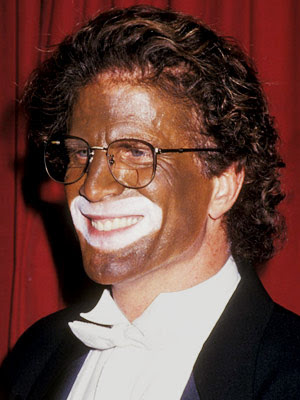
In 1993, Ted Danson donned blackface, said the word "nigger" more than a dozen times, and ate a watermelon at a Friars Club roast for Whoopi Goldberg, his girlfriend at the time. Talk show personality Montel Williams stormed out of the event, and for weeks afterward, the news media reported on the fallout as Goldberg tried to explain the caustic traditions of the club's roasts and why she wasn't offended by Danson's performance. (According to Jet magazine, Goldberg also wrote much of Danson's material for the event, and set him up with the make-up artist who painted his face.)
The Friars issued a public apology, but the descriptions from Goldberg and others about the club's everything-is-fair-game atmosphere apparently piqued people's interest. Over the next few years, subsequent Friars Club roasts got more coverage in newspapers than they had in years, and in 1998, Comedy Central partnered with the organization to produce a televised roast of Drew Carey. "Ladies and gentlemen, Drew Carey is to comedy what Mariah Carey is to comedy...[He] looks like Buddy Holly and Barney Rubble had a baby and then peed on it," first roaster Jeffrey Ross exclaimed, setting the tone not only for the rest of the show, and all the televised roasts that have followed in its wake over the last decade, but also for cyberspace at large.
Emphatically blunt, hyperbolically caustic, eager to slaughter sacred cows, or really, any animate creatures that wander into their cross-hairs—is there any better way to describe the voice that speaks from the Web's message-boards and online comments sections than the voice of a comic in full-blown roast mode? At exactly the same time millions of people were venturing online and experimenting with how best to express themselves in this medium, Jeffrey Ross, Greg Giraldo, Lisa Lampanelli, and all the other heirs of the mid-century Friars were offering up a template to emulate on Comedy Central's roasts: Be ruthless, be shocking, and don't shy away from speaking the unspeakable.
Naturally, lots of dreary material results from this approach, especially as anonymous verbal snipers try to one-up each other. But while the Web's endemic snarkiness—and the outright contempt that is regularly expressed toward gays, minorities, Christians, atheists, Republicans, liberals, conservatives, Muslims, and journalists on countless online comments sections and messageboards—can be tiresome, it's also the Web's rude, unfettered, no-holds-barred mentality that makes it the most vital medium we've ever known, and the one that offers the most accurate and expansive portrait of humanity to date. As a bonus, it features an extensive collection of dick jokes.
Contributing Editor Greg Beato is a writer living in San Francisco.
Sunday, August 02, 2009
As Nasty As They Wanna Be


Wednesday, July 23, 2008
The good humor man
The good humor man
Who invented jokes, and why do we laugh at them? Jim Holt discusses the history of funny.
By James Hannaham
July 21, 2008 | A few years ago, wiry, loquacious New Yorker writer Jim Holt scrapped an ambitious philosophy book about "the puzzle of existence" when more practical matters caught up with him -- he was broke, having spent his big advance. Paradoxically, he decided to get out of that jam the same way he'd gotten into it -- by proposing another book. This time he chose not to pursue the cosmic joke of existence, but the history and philosophy of jokes. But the joke was on him. He thought it would be a "quick and appealing" book to write, and that he'd find a solid base of similar books about the history of jokes to use as source material, but there was, well, nothing. "Being terribly lazy, this was extremely irksome to me," Holt grumbles.
Somehow he overcame his indolence and wrote "Stop Me If You've Heard This," an entertaining and informative, if too-brief, overview of what we know about the setup/punch line anecdote throughout history, including a biography of its supposed inventor, the legendary Greek Palamedes, who is also credited with inventing "numbers, the alphabet, lighthouses, dice, and the practice of eating meals at regular intervals." Holt also introduces us to the 14th century Italian Poggio Bracciolini, who served as secretary to several popes during the Western Schism and wrote Europe's first joke book, the "Liber Facetiarum." Full of lascivious comments about virgins and bald female flashers, the "facetiae" also managed to escape papal censorship, proving how good it is to have friends in high places.
The second half of the book tackles deeper questions about humor: How does it work, and why? Though he could easily wax dry and analytical, Holt peppers his discourse with ribald and/or offensive riddles -- "Why should we feel sorry for the atheist? Because he has no one to talk to while getting a blow job" -- that prove his points and leaven his methodical approach to frivolity.
Salon sat down with Holt in New York for a rapid-fire low-residency seminar in hilarity, history and chimpanzee comedy.
Which theory of the evolution of humor do you find most convincing?
Well, there are these three theories of humor. The Superiority Theory -- that you laugh when you realize that you're better than someone else, so nasty jokes, racist jokes, jokes about gays and cuckolds and drunkards and henpecked husbands conform to that theory. Then there's Freud's Release Theory, which says that jokes are about ventilating forbidden impulses. The setup gets the forbidden material past the censor, and the punch line liberates your forbidden impulses for a moment. All of the psychic energy you used to repress them gets released and you laugh, expressed in chest-heaving, spasmodic laughter.
But then there's the one that makes the most sense to me, the Incongruity Theory, that jokes are about the pure intellectual pleasure we take in yanking together things that seem utterly dissimilar and perceiving similarities. In the 17th century, "wit" simply meant intelligence. As the meaning evolved, it came to mean the ability to see resemblances between apparently dissimilar things. Today it means the ability to see, to perceive or to take pleasure in absurdities or incongruities. That's the highest form of humor. As jokes get funnier, they rely more on incongruity and less on hostility and superiority or on sex and naughtiness.
So you think of humor as having evolved? In that case, what would a prehistoric joke be like?
A lot of what we say about prehistory is speculative. I gave a talk at the New York Institute for the Humanities a couple of months ago on the future of humor -- what jokes would be like in the year 1,000,000 -- and I used something called the Copernican principle, which is a way of predicting the distant future based on the distant past. Listen, if you want to know what's going to last for a long time, look at things that have already been around for a while. The Seven Wonders of the World -- when the list was drawn up in the third or fourth century, the oldest one was the Pyramid of Cheops. The Hanging Gardens of Babylon, the Colossus of Rhodes, the Lighthouse of Alexandria, etc. -- and so what's the only one that has survived? The Pyramid of Cheops. All the other ones that were much newer when the list was drawn up disappeared. So I figured out what jokes looked like a million years ago by looking at what chimps find funny, because whatever's oldest is most likely to last, based on the Copernican principle.
So what's a good chimp joke?
Chimps laugh, and the lineage between us and them spread about 5 million years ago, so we can assume that unless laughter evolved separately, it did so before the two lineages split. Chimps who have been taught sign language not only laugh, but they can be taught to sign "funny." And they like incongruity. Washoe, the chimp who was taught sign language by Roger Fouts, thought it was really funny to present one of the researchers with a rock and call it food. Another chimp, Mojo, thought it was really funny, say, that a purse was a shoe and put it on her foot. So this is delight in sheer absurdity. It's only with civilization that you get sexual repression, hence the possibility of sex jokes, or in-groups and out-groups for ethnic jokes, and so on. Civilization is relatively recent -- it's only existed for about 6,000 years. And I define civilization as cities plus writing plus sexual repression. So in our humor, sexual repression will go away, in-groups and out-groups will go away, and in the end we'll be left with sheer absurdity, and it'll be purely intellectual.
Monty Python fans, rejoice!
But then you have to ask yourself -- why should a purely intellectual stimulus cause laughter, this gross physical response?
How about I ask you. Why?
The best theory I know of is the False Alarm Theory. You're out with some of the members of your extended group in the African savannah, and there's suddenly an apparent threat. There's something that looks like a snake in front of you. Suddenly tensions rise, and you and the other members of the band go into fight-or-flight mode. Then someone realizes, "Oh it's not a snake, it's just a big piece of thing hanging down from a tree." And so he emits this stereotyped signal that tells everyone else what seemed to be a threat is actually nothing. Laughter is the stereotyped reflex or signal, and it's also contagious, so the information quickly spreads through the band. So what happens is that a strained expectation suddenly dissolves into nothing.
That's bizarre. How is a joke like being afraid you'll get attacked in a rain forest?
It isn't exactly the same, obviously. But the process of tension and release has a similar rhythm. Even a really stupid joke has that same pattern: Why is it so hard to find the composer of the "Surprise Symphony"? Because he's Haydn! When I first heard that, I really wracked my brain -- what could this mean? You start to think about it and you're tense because you're not quite getting it, then suddenly the ambiguity is revealed by the punch line, and it turns out to be trivial. You release all your pent-up energy. That's the best theory I know of.
I have a special fondness for those jokes that are jokes only in terms of form, where the setup makes you expect something clever, and instead the punch line is shockingly mundane, or crude. For instance, Why did the monkey fall out of the tree?
I don't know.
Because it was dead. Why can't Marilyn Monroe eat M&M's?
Why?
Because she's dead.
That conforms to the classic joke paradigm, though. You think there's a semi-serious query in the setup, and it dissolves into nothing, and there's that sort of tension -- even after you told me the one about the monkey being dead, I still tried to solve the Marilyn Monroe one, and laughed partly to cover up my own obtuseness.
That's another terrible thing about jokes, they function as a test for social inclusion. If you're among friends and someone tells a joke and you're the one who doesn't get it, you're doubly excluded -- first of all, you miss out on the fun of it, then everyone looks at you. This happened when Dan Quayle was vice president, and a friend of mine was invited to a luncheon he had for the press. The idea was that Quayle's handlers would prove to the press that he was actually a fairly clever, interesting guy despite all appearance to the contrary. Quayle rarely seemed to laugh at the jokes they told, but every once in a while he would laugh after a slight delay, and then he would proceed to explain the joke to everyone.
The joke they'd already laughed at.
Right.
Do you think that joke telling suffers during times of repression?
Well, there are periods when the art of joke telling disappears for centuries at a time. But in some cases, jokes have flourished under authoritarian regimes. In the former Soviet Union, there was a very lively joke-telling culture. Actually a guy has just published a book of Soviet jokes, with the unfortunate title "Hammer and Tickle." The book tells the story of the dissolution of the Soviet Union by retelling jokes from different eras. They have a really satisfying bitter humor: A guy needs a car, so he goes to a dealer in Moscow who shows him two models. He chooses the one color they have and he pays for the car. The dealer says, "Your car will be ready in exactly 10 years." And the guy says, "Oh, in the morning or the afternoon?" And the dealer says, "What does it matter?" and he says, "The plumber's coming in the morning." It doesn't exactly get to the heart of what was wrong with the Soviet economy, but it's socially therapeutic.
Laughter is a permanent critique of all values, a way of exposing cant and hypocrisy and social injustice in the swiftest possible way before even actually formulating an argument. In a way, you don't even need to formulate an argument, because if the humor is sufficiently good, the system eventually collapses.