Showing posts with label Dalai Lama. Show all posts

Wednesday, February 06, 2008

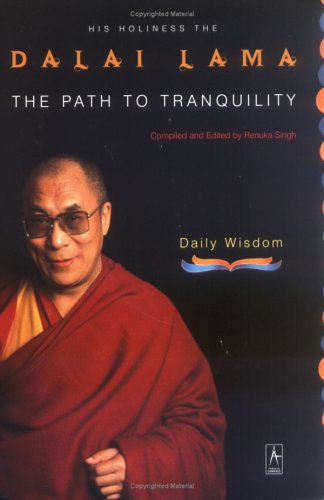
The Dalai Lama - The Path to Tranquility [Full Audiobook]


Path to Tranquility


Wouldn't it be nice to have a handy collection of highlights from the Dalai Lama's writings and teachings? Renuka Singh, a student and friend of the Dalai Lama, brings together a sampling of his words for each day of the year in The Path to Tranquility. In her selections you can sense the intimate encouragement of the student-teacher relationship. The Dalai Lama's words are not distant platitudes or profound proclamations but rather small insights and patient exhortations to keep trying. "We can deny everything except that we have the possibility of being better." "As a spiritual trainee, you must be prepared to endure the hardships of being involved in a genuine spiritual pursuit." "Nothing is more important than guarding the mind." These thoughts are germane to practical cultivation, and pondering a daily passage is a great way to keep the mind coming back to its center. Take a page from the Dalai Lama, and set yourself on the path to tranquility. --Brian Bruya

The Path to Tranquility - 01
The Path to Tranquility - 02
The Path to Tranquility - 03
The Path to Tranquility - 04
The Path to Tranquility - 05
The Path to Tranquility - 06
The Path to Tranquility - 07
The Path to Tranquility - 08
The Path to Tranquility - 09
The Path to Tranquility - 10
The Path to Tranquility - 11
The Path to Tranquility - 12
The Path to Tranquility - 13
The Path to Tranquility - 14

Monday, December 31, 2007

HH Dalai Lama::New Year's Thoughts

Within less than fifty years, I, Tenzin Gyatso the Buddhist monk, will be no more than a memory. Indeed, it is doubtful whether a single person reading these words will be alive a century from now. Time passes unhindered. When we make mistakes, we cannot turn the clock back and try again. All we can do is use the present well. Therefore, if when our final day comes we are able to look back and see that we have lived full, productive, and meaningful lives, that will at least be of some comfort. If we cannot, we may be very sad. But which of these we experience is up to us.

The best way to ensue that when we approach death we do so without remorse is to ensure that in the present moment we conduct ourselves responsibly and with compassion for others. Actually, this is in our own interest, and not just because it will benefit us in the future. As we have seen, compassion is one of the principal things that make our lives meaningful. It is the source of all lasting happiness and joy. And is the foundation of a good heart, the heart of one who acts out of a desire to help others. Through kindness, through affection, through honesty, through truth and justice toward all others we ensure our own benefit. This is not a matter for complicated theorizing. It is a matter of common sense. There is no denying that our happiness is inextricably bound up with the happiness of others. There is no denying that if society suffers, we ourselves suffer. Nor is there any denying that the more our hearts and minds afflicted with ill-will, the more miserable we become. Thus we can reject everything else: religion, ideology, all received wisdom. But we cannot escape the necessity of love and compassion.

This, then, is my true religion, my simple faith. In this sense, there is no need for temple or church, for mosque or synagogue, no need for complicated philosophy, doctrine, or dogma. Our own heart, our own mind, is the temple. The doctrine is compassion. Love for others and respect for their rights and dignity, no matter who or what they are: ultimately these are all we need. So long as we practice these in our daily lives, then no matter if we are learned or unlearned, whether we believe in Buddha or God, or follow some other religion or none at all, as long as we have compassion for others and conduct ourselves with restraint out of a sense of responsibility, there is no doubt we will be happy.

Why, then, if it is so simple to be happy, do we find it so hard? Unfortunately, though most of us think of ourselves as compassionate, we tend to ignore these common-sense truths. We neglect to confront our negative thoughts and emotions. Unlike the farmer who follows the seasons and does not hesitate to cultivate the land when the moment comes, we waste so much of our time in meaningless activity. We feel deep regret over trivial matters like losing money while keeping from doing what is genuinely important without the slightest feeling of remorse. Instead of rejoicing in the opportunity we have to contribute to others' well-being, we merely take our pleasures where we can. We shrink from considering others on the grounds that we are too busy. We run right and left, making calculations and telephone calls and thinking that this would be better than that. We do one thing but worry that if something else comes along we had better do another. But in this we engage only in the coarsest and most elementary levels of the human spirit. Moreover, by being inattentive to the needs of others, inevitably we end up harming them. We think ourselves very clever, but how do we use our abilities? All too often we use them to deceive our neighbours, to take advantage of them and better ourselves at their expense. And when things do not work out, full of self-righteosness, we blame them for our difficulties.

Yet lasting satisfaction cannot be derived from the acquisition of objects. No matter how many friends we acquire, they cannot make us happy. And indulgence in sensual pleasure is nothing but a gateway to suffering. It is like honey smeared along the cutting edge of a sword. Of course, that is not to say that we should despise our bodies. On the contrary, we cannot be of help to others without a body. But we need to avoid the extremes which can lead to harm.

In focusing on the mundane, what is essential remains hidden from us. Of course, if we could be truly happy doing so, then it would be entirely reasonable to live like this. Yet we cannot. At best, we get through life without too much trouble. But then when problems assail us, as they must, we are unprepared. We find that we cannot cope. We are left despairing and unhappy.

Therefore, with my two hands joined, I appeal to you the reader to ensure that you make the rest of your life as meaningful as possible. Do this by engaging in spiritual practice if you can. As I hope I have made clear, there is nothing mysterious about this. It consists in nothing more than acting out of concern for others. And provided you undertake this practice sincerely and with persistence, little by little, step by step you will gradually be able to reorder your habits and attitudes so that you think less about your own narrow concerns and more of others'. In doing so, you will find that you enjoy peace and happiness yourself.

Relinquish your envy, let go your desire to triumph over others. Instead, try to benefit them. With kindness, with courage, and confident that in doing so you are sure to meet with success, welcome others with a smile. Be straightforward. And try to be impartial. Treat everyone as if they were a close friend. I say this neither as Dalai Lama nor as someone who has special powers of ability. Of these I have none, I speak as a human being: one who, like yourself, wishes to be happy and not to suffer.

If you cannot, for whatever reason, be of help to others, at least don't harm them. Consider yourself a tourist. Think of the world as it is seen from space, so small and insignificant yet so beautiful. Could there really be anything to be gained from harming others during our stay here? Is it not preferable, and more reasonable, to relax and enjoy ourselves quietly, just as if we were visiting a different neighbourhood? Therefore, if in the midst of your enjoyment of the world you have a moment, try to help in however small a way those who are downtrodden and those who, for whatever reason, cannot or do not help themselves. Try not to turn away from those whose appearance is disturbing, from the ragged and unwell. Try never to think of them as inferior to yourself. If you can, try not even to think of yourself as better than the humblest beggar. You will look the same in your grave.

To close with, I would like to share a short prayer which gives me great inspiration in my quest to benefit others:

May I become at all times,

both now and forever

A protector for those without protection

A guide for those who have lost their way

A ship for those with oceans to cross

A bridge for those with rivers to cross

A sanctuary for those in danger

A lamp for those without light

A place of refuge for those who lack shelter

And a servant to all in need.


- an excerpt from 'Ethics for the New Millennium' by His Holiness the Dalai Lama.

Thursday, October 18, 2007

"Does the Dalai Lama still matter?"

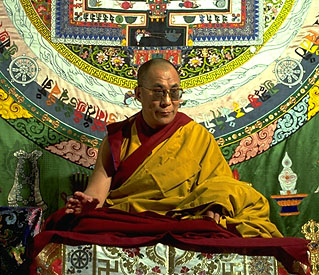
Dalai Lama MeditatingHot on the heels of the Dalai Lama's Congressional Gold Medal, Time magazine asked the above question of His Holiness. In the article the writer says:

Given the changes that are unfolding in Tibet now, it's worth wondering whether the Dalai Lama really matters any more. Beijing announced earlier this year that it will have the final say on the naming of his reincarnation, and the idea of an atheist, authoritarian government holding final say in a religious matter elicited condemnation in the West. Meetings in July between his representatives and Chinese authorities aimed at improving dialogue between the two sides produced no concrete results. State-run Chinese news organs have given heavy play in recent days to stories claiming that the Dalai Lama is a supporter of the Japanese doomsday cult Aum Shinrikyo and a betrayer of Buddhism. (source)

It is interesting to observe how the piece attacks the Dalai Lama (because that godless bastard has it coming!) and also raises its eyebrow toward Bush. The author glances at Bush, then at China then back to Bush again, and wonders why he would gamble with China as a business partner and regional carrot who acts as a counterweight to America's "big stick" for a meeting with a jolly little monk who doesn't even matter. As for Bush's motivations, I will leave that up to you. The article's intentions, however, are unambiguous.

The modernization of Tibet does not excuse the occupation of the country. And despite the Chinese government's best efforts to minimize the Dalai Lama's influence in Tibet the people still revere him, teaching their children about his involvement in their decades-long struggle and hiding illegal pictures of their spiritual leader in their homes. What is at work in the words of this writer is corporate-friendly gobbledegook. The government might be endangering international business making the Dalai Lama the business community's enemy of the day.

What the Dalai Lama represents, and the reason why he is still relevant, is the ability for the Tibetan people to consolidate their collective power and withstand the authority of China through nonviolent resistance and public demonstrations. China should fear the Dalai Lama, but Time shouldn't de-emphasize the liberating effects of compassion to maximize their bottom line.

Sunday, September 09, 2007

China claims regulatory power over reincarnation

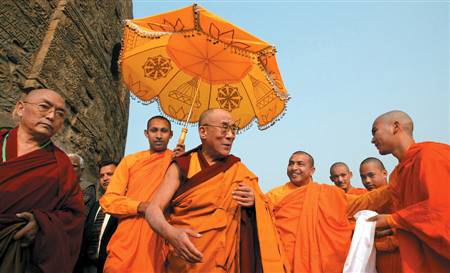
Dalai Lama with Monks


The Next Lama: The Dalai Lama says he won't reincarnate in Tibet

By Matthew Philips
Newsweek

Aug. 20-27, 2007 issue - In one of history's more absurd acts of totalitarianism, China has banned Buddhist monks in Tibet from reincarnating without government permission. According to a statement issued by the State Administration for Religious Affairs, the law, which goes into effect next month and strictly stipulates the procedures by which one is to reincarnate, is "an important move to institutionalize management of reincarnation." But beyond the irony lies China's true motive: to cut off the influence of the Dalai Lama, Tibet's exiled spiritual and political leader, and to quell the region's Buddhist religious establishment more than 50 years after China invaded the small Himalayan country. By barring any Buddhist monk living outside China from seeking reincarnation, the law effectively gives Chinese authorities the power to choose the next Dalai Lama, whose soul, by tradition, is reborn as a new human to continue the work of relieving suffering.


At 72, the Dalai Lama, who has lived in India since 1959, is beginning to plan his succession, saying that he refuses to be reborn in Tibet so long as it's under Chinese control. Assuming he's able to master the feat of controlling his rebirth, as Dalai Lamas supposedly have for the last 600 years, the situation is shaping up in which there could be two Dalai Lamas: one picked by the Chinese government, the other by Buddhist monks. "It will be a very hot issue," says Paul Harrison, a Buddhism scholar at Stanford. "The Dalai Lama has been the prime symbol of unity and national identity in Tibet, and so it's quite likely the battle for his incarnation will be a lot more important than the others."

So where in the world will the next Dalai Lama be born? Harrison and other Buddhism scholars agree that it will likely be from within the 130,000 Tibetan exiles spread throughout India, Europe and North America. With an estimated 8,000 Tibetans living in the United States, could the next Dalai Lama be American-born? "You'll have to ask him," says Harrison. If so, he'll likely be welcomed into a culture that has increasingly embraced reincarnation over the years. According to a 2005 Gallup poll, 20 percent of all U.S. adults believe in reincarnation. Recent surveys by the Barna Group, a Christian research nonprofit, have found that a quarter of U.S. Christians, including 10 percent of all born-again Christians, embrace it as their favored end-of-life view. A non-Tibetan Dalai Lama, experts say, is probably out of the question.
© 2007 Newsweek, Inc

Thursday, June 07, 2007

Takes a minute to learn, a lifetime to master

Ever since I saw the 14th Dalai Lama I've been fascinated with Buddhism and the practice of meditation. In fact, I've been dabbling in meditation on my own in short, 15 to 20 minute bursts. The experience has been profound. I'm not sure how others meditate - I'd like to hear from those of you who do - but what I do is put on some comfortable clothes, sit cross-legged, close my eyes and concentrate on my breathing. From there luminous thoughts pass through my mind like fireflies, each competing for my attention. They range from the cerebral (if the universe is an isolated system and my consciousness dwells therein then the universe and by default my consciousness are eternal) to the commonplace (did I leave the stove on?). In either case, meditation always leaves me alert and tranquil.

I'm not claiming to have achieved enlightenment as I'm just a novice. The benefits of meditation, however, reach all who practice it, regardless of class, race or gender. It's easy enough for a child of two to learn but takes a lifetime to master. Meditation, or "sitting" if you prefer, helps slow the world down, and point ones attention inward, to understand what you think about and how to let go of your thoughts, so what's left is this feeling of interconnectedness with all life and transcendence above workaday banalities. I don't claim to be Buddhist, maybe I'm too Westernized to adopt the philosophy fully, but that doesn't matter, Christians, Muslims and even Atheists (which some Buddhists technically are) enjoy the fruits of meditation. But there's one thing everyone agrees on - the universe inspires dumbfoundment. We want to understand it, put it under a microscope and box it up to show to mom. But we can't truly grasp the immensity of this place unless we first know ourselves. The journey of a thousand miles begins with a single breath.


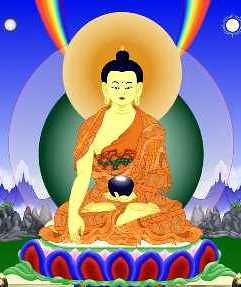
buddha_thanka

Saturday, May 05, 2007

An afternoon with the Dalai Lama

the Dalai Lama in Madison "There are not many paths to God" a man bellowed, his voice a dirty baritone, "the Bible says you must know Jesus in order to go to heaven - know him as your personal savior." A bristly mustache kept his upper lip warm on that atypically cool May afternoon, and alongside his makeshift pulpit stood a sandwich board bluntly pronouncing that homosexuality was satanic, a declaration oddly out of place for the event. A child of about eleven or twelve tried to hand me a religious pamphlet while the forty-something man spat Bible verses. I looked into the eyes of the children as they offered their literature - blank, obedient faces providing an expressionless foil to their father's lively rant.

This was the scene outside the Dalai Lama lecture I attended yesterday. I never imagined His Holiness as a controversial speaker, hell, his talk was entitled "Compassion: The Source of Happiness" that's about as innocuous as chocolate chip cookies and puppies. And his temperament couldn't be at issue either. When the man entered the room his enthusiasm radiated all the way into the upper balcony where I was seated. At one point, as the introductory speaker read the Dalai Lama's list of achievements, this man who many Buddhists see as one of the most enlightened on the planet bent down to tie his shoes.

The self-deprecating Tibetan leader, even after forwarding the cause of his occupied people, gaining international notoriety and winning the Nobel Peace prize, still refers to himself as a simple Buddhist monk. This kind of humility is evident in every word he says. Soft spoken yet confident he exemplifies the middle path. His lecture didn't contradict this feature of his personality it portrayed it. Growing up in a fundamentalist Christian household I worshiped at plenty "big tent revival" weekends complete with the preplanned sermons and staged lighting cues for maximum impact, and the Lama simply cross-legged on an over-sized easy chair speaking casually to a crowd of several thousand outshone all of that affected pageantry.

At the end of his talk the Dalai Lama took questions from the audience. The first of the series asked his thoughts on how to best raise children in this age of terrorism and violence. He began by restating the day's topic, to show them an abundance of affection, but he soon stopped, restarted and joked that kids would probably be fun for a few hours however he wouldn't want to comment on child rearing as he doesn't have any children of his own. What honesty from a holy man. Why can't Catholic priests adopt that kind of frankness and resist the urge to counsel married couples?


For years the Dalai Lama has worked with neuroscientists studying the effects of meditation on the body. There has been many documented cases where Tibetan Buddhists, while in a meditative trance, have completely dried dripping wet garments with body heat.


And his close relationship with science doesn't stop there. The Dalai Lama has said in interviews and in print that whatever science disproves all thinking people should reject. This may be one of the complaints those fundamentalist preachers on the outside have with him. He accepts evolution, studied string theory and quantum mechanics and possesses considerable knowledge of relativity. The goal of the Lama is to bridge the gap between the two fields, not deepen the gulf, and in the end arrive at a better understanding of the true nature of reality.

Saturday, February 10, 2007

His Holiness comes to Wisconsin

dalai-lama-webreadyJust a brief note, the Dalai Lama will be speaking at the University of Wisconsin - Madison and giving lessons at the Veterans Memorial Coliseum / Alliant Energy Center. The lessons take place May 2, 3 & 4 and his public speech will occur on the 4th. Tickets for his teachings are a bit pricey ($50-$175) but it's only $25 for admission to the talk and 4,000 FREE tickets will be given to UWM students. So, be sure to give a Madtown undergrad a call and get hooked up with some sweet Dalai Lama ticket action. Here's some more info on the event.