
Alvaro Vargas Llosa
(http://www.independent.org/newsroom/article.asp?id=2518)
WASHINGTON—Two years ago, the life of Manuel Mendez del Rio, general director and head of global risk management at the Spanish bank BBVA, took an unexpected turn. His fellow directors decided to entrust him with the responsibility of launching a BBVA Microfinance Foundation that would bring credit to the poor in Latin America. The conditions were simple: He would have 200 million euros (about $277 million) at his disposal, but he would have to run a profitable enterprise because the foundation would not get one more penny from the bank.
The mission fit Mendez del Rio’s own philosophy well. He believed in enterprise rather than charity and was convinced that the big financial institutions were missing the chance to serve potentially 500 million poor people in the world by placing most of their focus on their clients’ collateral and guarantees, as opposed to the merits of their business proposals. And, it could revolutionize economic development.
To be sure, a few other microfinance institutions lend money to the poor without asking for collateral. The best known is Bangladesh’s Grameen Bank, which won the Nobel Prize a few years ago. But it is funded by selling bonds guaranteed by the Bangladeshi government and operates on the principle of peer pressure—each borrower has to be part of a group that makes sure he or she manages the loan responsibly and pays it back. Mendez del Rio manages risk the old-fashioned way—by gauging the sustainability of the proposals put forth by borrowers. And he has no government backing.
The BBVA Microfinance Foundation went around Latin America buying various nongovernmental or semi-governmental organizations and turning them into small private banks obliged to survive by making a profit. From Colombia to Peru to Chile to Puerto Rico, the foundation absorbed, restructured and trained the various institutions, and then started to engage the entrepreneurial poor. In just one year, it has lent money to more than a million Latin Americans. In Colombia, the average loan, typically involving commercial activities, amounts to $870, while in Peru, where the lending relates primarily to farming and livestock, the figure is $1,600. The rate of delinquency is a mere 3 percent. The foundation is on the verge of being profitable and will reinvest all the money, expanding its reach to other parts of the world.
“We want the activities we fund to be sustainable,” Mendez del Rio recently told me over lunch, “because that is the only way to effect economic development for millions of poor people.”
The obstacles standing in the way are not a dearth of business initiatives, lack of infrastructure, or insufficient education and capital. The main problem is that government policies are inadequate and insensitive to the entrepreneurial revolution now taking place among people once considered beyond the reach of bank loans and the market.
“Current regulations,” says Mendez del Rio, “are focused on regulating the microfinance institutions themselves rather than setting a very general framework for the activity, and this has the effect of mixing up productive loans with a minimal delinquency rate with consumer loans, mostly through credit cards, in which excessive credit and high delinquency are the norm.” In other words, government rules are hurting the good guys in attempting to pre-empt the bad ones.
Mendez del Rio wants nothing from politicians—except sorting out the property registries, which are a mess, and clearly defined property rights. Because of current inefficiencies, there is no reliable registry of the credit records of most of the poor. He considers this unfair: “The greatest wealth that the majority of poor people have to start with is their honesty and fulfillment of commitments, something that, in the absence of records, is lost.”
In his book “Security Analysis,” Benjamin Graham, the legendary Wall Street figure and theoretician of “value investing,” wrote that “traditionally the investor has been the man with patience and the courage of his convictions who would buy when the harried or disheartened speculator was selling.” At a time when the world is picking up the pieces of the last speculative bubble, it is heartening to know that there are still investors out there renewing the promise of free enterprise for the excluded masses.
Showing posts with label Microfinance. Show all posts
Showing posts with label Microfinance. Show all posts
Tuesday, June 23, 2009
The Rise of the Poor


Friday, May 23, 2008
4 clever ideas that will change society for the better
 Open Source Movement: Typically referring to software, the online open source movement has brought us such gargantuan successes as Linux, Firefox, Gimp, Audacity and much more. In fact, open source software has achieved such a level of popularity that most programs offered by for-profit companies can be substituted with free (often improved) open source versions of the same applications. As impressive as open source software is on its own, it has been suggested that the concept can be extended to other features of society. Government policy can be shaped directly, allowing citizens to introduce and vote on legislation, teachers can share on an international level what has been effective in their profession and fashion curriculum accordingly, journalists and ordinary citizens can share information both nationally and locally while keeping each other honest, and copyrights and patents could be freed letting people improve and manufacture products of every sort in their own communities. This open source mentality has kept the scientific community active and would promote a thriving, nimble culture.
Resources:
List of Open Source Software
The Open Source Movement
The Free Software Story
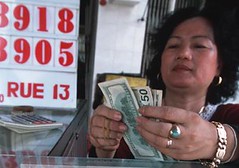 Microfinancing: The problem with the old way of supporting the third world is that money was used to buy supplies for the poor without promoting survival skills. Microfinancing relies on the “teach a man to fish” principle where donors give money, usually as little as $25, to entrepreneurs in developing countries through a proxy such as Kiva. People from these countries raise grants through this program, start local businesses such as grocery stores, repair shops and construction companies, and are then given an opportunity to generate enough money to pay back their loans. As proof of the effectiveness of this credit system the rate of repayment had just dropped from 100% to 99% only because of internal political conflicts preventing some business owners from paying back their loans. Anyone who says “if it’s too good to be true then it probably is” hasn’t heard of Microfinancing.
Resources:
Kiva
Here On Earth: Gumball Capital
 Biomimicry: When it comes down to it Biomimicry steals from Mother Nature’s design and imitates her for a more sustainable society. For example, in nature structures like coral reefs commonly assemble themselves. If we could find a way to duplicate this design technique we could take the components of a solar panel and coat our rooftops with it, allowing these pieces to self-assemble. Janine Benyus is one of the most visible and articulate spokespeople of the movement. According to her, nature accomplishes everything with only a small portion of the periodic table while human beings utilize the entire chart, including toxic chemicals. The trick is to see how we can narrow the kinds of chemicals we use to just those friendly to life. Boat manufacturers can replicate the design of a shark’s skin to clean the bottom of boats and give them better maneuverability and auto manufacturers can use a locust’s internal sensor to prevent collisions. The earth has had hundreds of millions of years to find solutions to some of the most daunting challenges of our age while humanity is only a flash in the pan. Biomimicry is just another humble reminder that nature is the ultimate engineer.
Resources:
Janine Benyus: 12 sustainable design ideas from nature (video)
Biomimcry: Nature as Model, Measure and Mentor
Biomimicry Institute
 Sustainable Communities: The power of a small cluster of people determined to change the world should never be undervalued, and sustainable communities are the expression of just that -- people who want to reduce their harmful impact on their environment, devising ways to live happily with each other and the earth. Sustainable communities often maintain large gardens which provide for all of its residents so importing fruits and vegetables from large agribusinesses is needless. The commercial district only includes small, locally owned businesses and many people are encouraged to telecommute or work at home. Buildings are powered by solar energy, driving is discouraged, and sewage and rain water are recycled into fertilizer and irrigation respectively. Residents practice cohousing where each member of the community owns a house but also share a “common house” with their neighbors. Here tools and supplies are stored, meals can be cooked and social interaction occurs. These villages already exist (over 400 worldwide) in areas as diverse as Georgia, California and New Zealand. Some of them, like the one in New Zealand, have their own currency. Clean, friendly and environmentally responsible, hopefully it won’t be long before this idea catches fire.
Resources:
How Stuff Works: “How Sustainable Communities Work”
Serenbe
Earthsong Eco-Neighborhood
Subscribe to:
Posts (Atom)
