
By Larry Jagan
(http://www.atimes.com/atimes/Southeast_Asia/KG31Ae01.html)
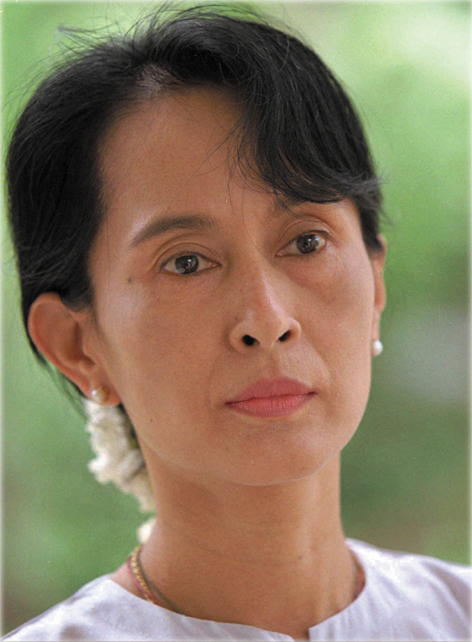
BANGKOK - The trial of Myanmar's pro-democracy leader Aung San Suu Kyi has ended amid heightened security around the area near the court, with hundreds of trucks full of armed soldiers stationed around Insein prison where the proceedings took place. The prison court is expected to announce its highly anticipated verdict on Friday, according to one of the opposition leader's lawyers, Nyan Win.
The junta's plan to hold democratic elections next year - the first since Suu Kyi's National League for Democracy (NLD) overwhelmingly won May 1990 polls that were annulled by the military - has been put on hold pending the trial's result. People familiar with the situation say that junta leader Senior General Than Shwe will announce in the wake of the verdict the formation of a civilian-led interim government that will hold administrative power until elections are held next year. It's a move, analysts say, designed to deflect growing international criticism.
In the meantime, international pressure is expected to mount, with high-pitched calls for Suu Kyi's and an estimated 2,100 other political prisoners' immediate release from detention. Several Western countries, including the United States and the European Union, have threatened to up their current economic and financial sanctions against the military regime if the pro-democracy leader is sentenced to a new prison term. Suu Kyi was first arrested in 1989 and has spent 14 of the past 20 years under house arrest. For the past five years she has been held in virtual solitary confinement and allowed only occasional visits from her doctor and lawyer.
United States Secretary of State Hillary Clinton, at a regional meeting held last week in Thailand, dangled the prospect of US investment in exchange for freeing Suu Kyi and a move towards genuine democracy. President Barack Obama's administration had earlier hinted it would review US policy towards Myanmar, but according to Clinton that review has been put on hold because of the Suu Kyi trial.
Suu Kyi, a former Nobel Peace Prize winner, is on trial for breaking the terms of her house arrest by harboring an uninvited US veteran, John William Yettaw, who swam across the lake behind her house and into her back garden. Yettaw has said that he was motivated by a vision that Suu Kyi would be assassinated and he swam to her residence to warn her. The state-controlled media has accused him of being an American agent.
Suu Kyi's la
wyers have argued that the law used to charge her to a possible five years in prison, which is based on the 1974 constitution, is no longer valid. They have also argued that the military appointed security guards posted around her residence should be held responsible for any intrusion onto her property.
She was also not officially under detention according to the government's own wording - meaning she could not have violated the terms of her house arrest, according to Nyan Win,. Rather she has officially been held in her Yangon residence since 2003 for "security reasons".
"We are confident that we will win the case if things go according to the law," Nyan Win told reporters outside the court on Tuesday. But, he added, the judges in the case may make their decision based on other considerations. She is already guilty, according to the state-run newspaper the New Light of Myanmar, which published an editorial arguing against her innocence on the weekend. "This may influence the judges," Nyan Win said.
Kangaroo court
Many critics and observers see the trial as a sham aimed at influencing the upcoming election results in the military's favor. While the prosecution was allowed 23 witnesses, of whom 14 took the stand, the defense was only permitted two of the four witnesses they requested to appear in court, underscoring rights groups' criticism that Myanmar's judiciary lacks independence.
"The trial has been entirely scripted and the end already decided beforehand," Mark Canning, the British ambassador in Yangon told Asia Times Online in an interview. Canning based that assessment on his recent attendance at one of the trial's closed-to-the-public hearings.
Regime critics have echoed that assessment. "The junta fears Aung San Suu Kyi and wants to keep her locked up forever," said Zin Linn, a spokesman for the Burmese opposition abroad and a former political prisoner now based in Thailand. "With elections planned for 2010, they cannot afford to have her free to campaign against them," he said.
"The trial is all about keeping all voices of dissent silent in the run-up to the rigged elections planned for next year," said Aung Din, a leading Burmese pro-democracy activist based in the US. "No one is in any doubt about the outcome," said Moe Moe, a taxi driver in the country's main commercial city. "Those men in green in Naypyidaw [the new capital some 400 kilometers north of Yangon] know she is the people's hero and the real leader of this country," he added.
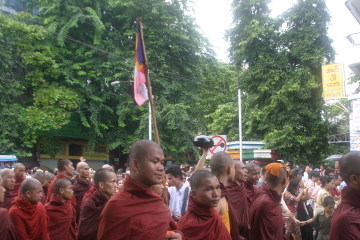
While locals anxiously await the trial's verdict, few analysts believe that a guilty verdict will spark major public protests similar to those in 2007, which started as complaints against fast-rising food and fuel prices and later brought thousands out onto the streets in broad anti-government demonstrations led by Buddhist monks. That failed attempt at people's power regime change became known around the world as the Saffron Revolution.
"There is no doubt people are angry at the regime and they will be even angrier if they sentence Daw Suu [Kyi], but they also feel powerless against the authorities, especially after the military crackdown against the saffron revolt two years ago," a Western diplomat based in Yangon told Asia Times Online. Local journalists agree that most local people are too worried and pre-occupied with day-to-day survival to take to the streets. Yet there has been a storm of international protest ever since the opposition leader was put on trial more than two months ago. United Nations Secretary General Ban Ki-moon left Myanmar in a huff earlier this month when Than Shwe declined his request to meet with the detained pro-democracy leader.
Some believe the UN could soon table a resolution against Myanmar's military regime through the Security Council, after reports emerged that a North Korean ship was angling to deliver either missile parts or nuclear technology to Myanmar in violation of a resolution passed against Pyongyang. Myanmar allies China and Russia have blocked with their veto powers recent attempts at Security Council censure against the regime's abysmal rights record led by the US.
Last week, many Association of Southeast Asian Nations (ASEAN) countries at a high-level meeting at the Thai beach resort of Phuket called for her release. US Secretary of State Clinton promised important changes in relations with the military regime if Suu Kyi was freed. "If she was released, that would open up opportunities ... to expand our relationship with [Myanmar], including investments," she told reporters.
The regime has reacted angrily to what it regards as outside interference in its internal affairs and said that international bullying would not influence the judicial process. The call for Suu Kyi's and other prisoners' release is "nonsense and unreasonable", said the New Light of Myanmar at the weekend in response to the US and ASEAN calls for her release. "She must face punishment in accordance with the law: the court will hand down a reasonable term to her if she is found guilty, and it will release her if she is found not guilty," the paper said.
"It is not a question of whether the proceedings are fair or not, she should never have gone on trial in the first place - it's a form of political and legal theater," said Benjamin Zawacki, Amnesty International's Bangkok-based Myanmar researcher. "As a prisoner of conscience, she should be released immediately." Amnesty earlier this week awarded Suu Kyi its "Ambassador of Conscience" award, which was accepted on her behalf by the Irish rock musician Bono, who has long campaigned for her release.
All indications are that the generals, unless pushed by their main patrons in Beijing, will as in the past ignore international calls for Suu Kyi's release and genuine political change. "They have completely ignored all international concerns, and gone on with their devastating, shattering repression of all dissent, with extremely heavy sentences being handed down for the crimes of democratic protest," said Paulo Sergio Pinheiro, the UN's former special rapporteur on human rights to Myanmar.
Than Shwe is believed to be waiting for the trial's verdict to further marginalize Suu Kyi and her NLD political party before announcing plans to transfer power to a civilian administration which would oversee next year's elections, say some analysts and regime insiders. "The whole country will really be surprised to see how power is handed over," Than Shwe reportedly told a high-ranking visiting foreign official according to a source familiar with the meeting.
Myanmar military sources confirm that the creation of an interim government is the next step in the junta's roadmap towards "discipline democracy". In an apparent move in that direction, all government ministries have been ordered to complete all of their outstanding work by the end of August, including the preparation of statistical information. Aung Thaung, Minister of Industry-1 and a close confidante to Than Shwe, recently told his deputies that there would soon be a new government and that he may no longer be a minister.
"According to Than Shwe's plans, all the current ministers will have to resign if they are to join a political party and fight the forthcoming elections," said the Thailand-based independent Burmese academic Win Min. So far, he says, there have been no hints as to who will make up the interim administration. Myanmar-based diplomats are skeptical that any move towards a civilian interim administration would be mostly cosmetic and still be controlled by the military. "There have been abundant signals that the roadmap is not an inclusive process and the referendum [in May last year] dispelled any remaining doubts," said Pinheiro. "This is a hyper-flawed process that will not lead anywhere - it's simply a consolidation of the military's control of the state."
Larry Jagan previously covered Myanmar politics for the British Broadcasting Corp. He is currently a freelance journalist based in Bangkok.
Showing posts with label Burma. Show all posts
Showing posts with label Burma. Show all posts
Thursday, July 30, 2009
There's military logic to Suu Kyi's trial


Monday, July 21, 2008
Friday, November 09, 2007
Will the internet help free Burma?
 Burma: Keeping the Flame Alive Over Radio, Internet
by Lynette Lee Corporal
BANGKOK - International media interest in Burma seems to have cooled down after images of the violent dispersal of pro-democracy demonstrators were splashed on TV screens and newspapers late September. But exiled Burmese journalists are determined to keep the flame going over radio and the Internet.
“While there has not been a united policy (among exiled Burmese all over the world) the struggle is going to continue, and we’re going to keep on reporting until we see a change in the government,” declared Aung Zaw, editor and director of the Chiang Mai-based ‘The Irrawaddy’ magazine, which focuses on Burma.
Along with Democratic Voice of Burma (DVB) bureau chief Toe Zaw Latt and National Coalition Government of the Union of Burma spokesman U Zin Linn, Aung Zaw faced a barrage of questions from journalists at the Foreign Correspondents’ Club of Thailand here on Wednesday.
A former student activist, Aung Zaw, pointed out that the military junta’s “clever ways” are key reasons why this quest for freedom and change in his country have been futile for decades.
“The government has been able to exploit different opinions within and outside Burma,” he said. Add to that, he continued, the junta leaders “are still united and are ready to counter domestic and international pressure”.
Gen. Than Shwe’s iron rule has instilled fear among the people, including even the Buddhist clergy. In a short video clip shown at the press club, a young monk living in a temple near the Burma-Thailand border refused to comment about the government and the recent events on-cam, fear and worry evident in his face.
In another clip taken at the height of the protests on Sep. 27, a purported plainclothes police officer was shown taking photos of the faces of reporters and cameramen, as well as other rallyists who were at the demonstrations.
According to Toe Zaw Latt, witnesses said that journalists working for state-owned media were also taking photos of people toting cameras, MP3 players, and cell phones. “They would report this back to the military,” said Toe Zaw Latt.
Needless to say, Aung Zaw feels that there is anger and depression among the people in Burma, as well as disappointment over the failure of United Nations envoy Ibrahim Gambari to settle key issues with the government.
Still, the exiled journalists remain gung-ho about the future. Especially with the huge role the Internet played in the recent events, they believe that the government is facing tough days ahead when it comes to gagging the Internet and the ‘army’ of citizen journalists, even if it has tightened control over the web.
“The Internet is the biggest enemy of the government now. The way that citizen reporters partnered with our correspondents and found ways to get the news out is a very encouraging and healthy sign,” said Aung Zaw.
In ‘The Irrawaddy’s’ case alone, the site (www.irrawaddy.org)registered 40 million hits, with over 100,000 unique visitors a month. Then, Aung Zaw related, on the same day when the government shut down the Internet in Burma, a virus also attacked the magazine site. It was a classic case of cyber-attack, he noted.
The popularity of the Internet and the people’s desperation to get the news out were such that, ‘The Irrawaddy’ got over 1,000 images from Burma, in one week in September.
Radio, too, has taken a prominent place in this quest for freedom in recent years. According to U Zin Linn, prior to the 1988 student uprising that saw more than 3,000 people killed, radio was mainly only used for entertainment purposes. “Only elderly people listened to serious news on the radio, while the younger ones listened to music,” he said.
But everything changed after the 1988 uprising broke out against the military in Burma, when students and intellectuals began using radio, shortwave radio in particular, as a way of getting independent information. Thus, the BBC Burmese service and Voice of America became popular choices.
Ironically, U Zin Linn implied how China, a close ally of the junta, inadvertently helped pro-democracy activists. “We have to thank China for selling cheap transistor radios in Burma. Now, even poor people can buy radios,” he quipped.
U Zin Linn also urged the people to support radio stations, which could, in turn, develop new ways to reach out to the masses.
“We all know that Burma is not a media-friendly country and all media outlets are state-run, so people relied on outside media, and radio is one of the easiest way to do so,” he added.
Toe Zaw Latt admits that people within and, to a certain extent, outside Burma have expectations about what the exiled media could do to help get democracy back in Burma.
“It’s normal for people to have expectations after all that happened, especially since now, more Burmese know what’s going on. But our role is the same as ever, and that is to give accurate, timely and relevant information about events in our country. I don’t think our role has changed that much,” he told IPS.
Aung Zaw also cautions against high expectations about the exiled Burmese media, intimating that they can only do so much, given the resources available to them.
“Yes, we did feel such expectations, both from the people in Burma and the international community. It’s okay to have expectations, but these have to be realistic ones. In the final analysis, it’s going to be the Burmese people who will decide (on the future),” he said. But definitely, he continued, the exiled media will be there to report on this.
© 2007 Inter Press Service
Friday, October 19, 2007
Burma: "Panties for Peace"

Activists send female underwear to Burmese embassies
Activists exasperated at the failure of diplomacy to apply pressure on Burma's military regime are resorting to a new means of protest against the regime's recent crackdown: sending female underwear to Burmese embassies.
Embassies in the UK, Thailand, Australia and Singapore have all been targeted by the "Panties for Peace" campaign, co-ordinated by an activist group based in Chiang Mai, Thailand.
The manoeuvre is a calculated insult to the junta and its leader, General Than Shwe. Superstitious junta members believe that any contact with female undergarments - clean or dirty - will sap them of their power, said Jackie Pollack, a member of the Lanna Action for Burma Committee.
"Not only are they brutal, but they are also very superstitious. They believe that touching a woman's pants or sarong will make them lose their strength," Ms Pollack told Guardian Unlimited.
So far, hundreds of pairs of pants have been posted, according to another campaigner, Liz Hilton. "One group sent 140 pairs to the Burmese embassy in Geneva," she said.
The campaign was a serious attempt to allow ordinary women to express their outrage at the regime's response to democracy demonstrations led by Buddhist monks, Ms Pollack said.
"Condemnation by the United Nations and governments around the world have had no impact on the Burmese regime. This is a way of trying to reach them where they will feel it," she said.
"The junta is famous for its abuse of women: it is well documented that they use rape as a weapon of war against ethnic minorities. This is a way for women around the world to express their outrage."
The Burmese government has claimed that 10 people were killed and nearly 2,100 arrested, but dissident groups estimate that dozens or even hundreds died during the recent crackdown and its aftermath.
A message on the activists' website reads: "This is your chance to use your Panty Power to take away the power from the SPDC. You can post, deliver or fling your panties at the closest Burmese Embassy any day from today. Send early, send often."
An official at the Burmese Embassy in London was unable to confirm if any garments had yet been delivered.
Wednesday, October 10, 2007
Why Myanmar matters
Emma Goldman, America's preeminent anarchist, believed the less organized a movement is the more violent it becomes. In Burma, the monks looked back at nonviolent movements from South Africa, India and Serbia to learn how they succeeded. The monks split into waves the first taking to the street and demonstrating, expecting to either be murdered or beaten and arrested, then sending out the second wave and then the third and so on and so forth. Also, by the Buddhist monks flipping their bowls over, one of the few possessions they have, they disconnect a military regime which gains its authenticity from identifying itself with the monks, who are considered sacred in Burma. This is why the Saffron Revolution matters. America needs this kind of organization, right now there is a lot of talk but little action. The internet is a terrific tool for talk, however, with shrinking numbers in the streets, I feel it is detracting from people's feeling of helplessness. Are blogs like mine doing more harm than good by allowing people to vent from their armchairs and not from the pavement? It is time to learn from Myanmar and organize.
For this news special, Al Jazeera’s Tony Birtley went undercover in Myanmar to report exclusively on the people’s protests and resulting bloody crackdown by Myanmar’s military government.
For this news special, Al Jazeera’s Tony Birtley went undercover in Myanmar to report exclusively on the people’s protests and resulting bloody crackdown by Myanmar’s military government.
Wednesday, October 03, 2007
The People of Burma are Punished for Dissenting
What does the Bush administration really think about the military junta in Myanmar? Publicly, it condemns the government's actions but privately I suspect our handlers are moving us closer toward a military junta of our own. In Myanmar the internet is strictly monitored going as far as taking screen captures inside internet cafes every five minutes, the rulers live lavishly while the poor is largely ignored and a substantial portion of their income is devoted to a massive standing army. The parallels are frightening.
If this administration was serious about promoting Burmese democracy they wouldn't sanction the brutal regime. We've learned from Iraq that sanctions effect the people, not the government. We need to fund the pro-democracy resistance by providing proxy servers to help organize the counter-movement and by smuggling aid into the country.
SOURCE
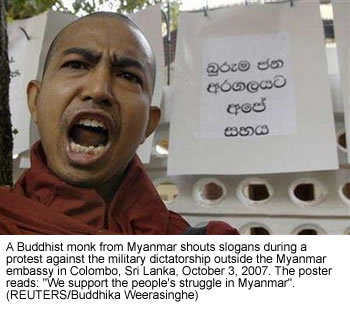 Soldiers Hunt Dissidents in Myanmar
YANGON, Myanmar — Soldiers announced that they were hunting pro-democracy protesters in Myanmar’s largest city Wednesday and the top U.S. diplomat in the country said military police were pulling people out of their homes during the night.
Military vehicles patrolled the streets before dawn with loudspeakers blaring that: “We have photographs. We are going to make arrests!”
Shari Villarosa, the acting U.S. ambassador in Myanmar, said in a telephone interview that people in Yangon were terrified.
“From what we understand, military police … are traveling around the city in the middle of the night, going into homes and picking up people,” she said.
Residents living near the Shwedagon Pagoda, Myanmar’s most revered shrine and a flashpoint of unrest, reported that police swept through several dozen homes in the middle of the night, dragging away several men for questioning. The homes were located above shops at a marketplace that caters to the nearby pagoda, selling monks robes and begging bowls.
Meanwhile, the junta pursued other means of intimidation. An employee from the Ministry of Transport, speaking on condition of anonymity, said that he was told to sign a statement saying he and his family would not take part in any political activity and would not listen to foreign radio reports. Many in Myanmar use short-wave radios to pick up foreign English-language stations - a main source for news about their tightly controlled country.
The U.N.’s special envoy, Ibrahim Gambari, declined to comment on his four-day mission to Myanmar, where the military junta last month crushed mass pro-democracy demonstrations led by the nation’s revered Buddhist monks.
Villarosa said embassy staff had gone to some monasteries in recent days and found them completely empty. Others were barricaded by the military and declared off-limits to outsiders.
“There is a significantly reduced number of monks on the streets. Where are the monks? What has happened to them?” she said. The Democratic Voice of Burma, a dissident radio station based in Norway, said authorities have released 90 of 400 monks detained in Myitkyina, the capital of Kachin state, during a midnight raid on monasteries on Sept. 25.
A semblance of normality returned to Yangon after daybreak, with some shops opening and light traffic on roads.
However, “people are terrified, and the underlying forces of discontent have not been addressed,” Villarosa said. “People have been unhappy for a long time … Since the events of last week, there’s now the unhappiness combined with anger, and fear.”
Some people remained hopeful that democracy would come.
“I don’t believe the protests have been totally crushed,” said Kin, a 29-year-old language teacher in Yangon, whose father and brother had joined a 1988 pro-democracy movement that ended in a crackdown in which at least 3,000 people were killed.
“There is hope, but we fear to hope,” she said. “We still dream of rearing our children in a country where everybody would have equal chances at opportunities.”
The military has ruled Myanmar since 1962, and the current junta came to power after snuffing out the 1988 pro-democracy movement. The generals called elections in 1990 but refused to give up power when Suu Kyi’s party won.
The military crushed the protests on Sept. 26 and 27 with live ammunition, tear gas and beatings. Hundreds of monks and civilians were carted off to detention camps. The government says 10 people were killed in the violence. But dissident groups put the death toll at up to 200 and say 6,000 people were detained.
Among those killed was Japanese television cameraman Kenji Nagai of the APF news agency. His body was flown from Myanmar to Tokyo on Wednesday.
Gambari went to Myanmar on Saturday to convey the international community’s outrage at the junta’s actions. He also hoped to persuade the junta to take the people’s aspirations seriously.
He met junta leader Senior Gen. Than Shwe and his deputies and talked to detained pro-democracy leader Aung San Suu Kyi twice.
Gambari avoided the media in Singapore, where he arrived Tuesday night en route to New York. He was not expected to issue any statement before briefing U.N. Secretary-General Ban Ki-moon on Friday.
The junta has not commented on Gambari’s visit and the United Nations has only released photos of Gambari and a somber, haggard-looking Suu Kyi - who has spent nearly 12 of the last 18 years under house arrest - shaking hands during their meeting in a state guest house in Yangon.
In Singapore, Gambari met with Prime Minister Lee Hsien Loong, the chairman of the Association of Southeast Asian Nations bloc of which Myanmar is a member.
A Singapore government statement said Lee told Gambari that ASEAN “is fully behind his mission” to bring about “a political solution for national reconciliation and a peaceful transition to democracy.”
© 2007 The Associated Press
Wednesday, September 26, 2007
Everything you need to know about the Burmese Protests
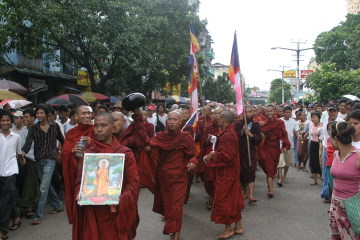
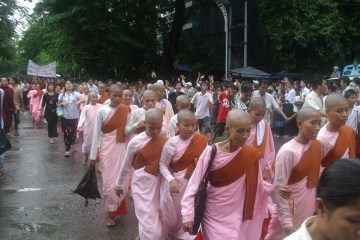
Q&A: Protests in Burma
As demonstrations in Burma turn violent, Mark Tran looks at the background to the most significant challenge to the junta in decades
How serious are the protests?
After days of largely peaceful demonstrations, the military government is taking a tougher approach. It has imposed curfews and banned gatherings of more than five people. But the monks have continued to march in the streets. Burmese police have responded with baton charges and by firing tear gas and warning shots. Reports say some 7,000 demonstrators, led by 3,000 monks, turned out in Rangoon, Burma's biggest city in today's protests.
Q&A: Protests in Burma
As demonstrations in Burma turn violent, Mark Tran looks at the background to the most significant challenge to the junta in decades
Wednesday September 26, 2007
Guardian Unlimited
How serious are the protests?
After days of largely peaceful demonstrations, the military government is taking a tougher approach. It has imposed curfews and banned gatherings of more than five people. But the monks have continued to march in the streets. Burmese police have responded with baton charges and by firing tear gas and warning shots. Reports say some 7,000 demonstrators, led by 3,000 monks, turned out in Rangoon, Burma's biggest city in today's protests.
Article continues
What are the demonstrations about?
The protests began late last month after the government sharply raised fuel prices - an added hardship for people in one of Asia's poorest and most economically isolated countries.
Arrests and intimidation kept the demonstrations small and scattered until the monks entered the fray. On Sunday, around 20,000 people - including thousands of monks - filled the streets of Rangoon, stepping up their defiance by chanting support for the opposition leader Aung San Suu Kyi.
Ms Suu Kyi has been under almost continuous house arrest since 1990, when the military refused to recognise a landslide victory by her National League for Democracy party.
Why are the monks protesting?
Monks have played an important role in protests, first against British colonialism and later against the military junta, taking a big part in the failed 1988 pro-democracy rebellion. In the latest protests, the monks have formally refused to accept the alms they traditionally take from the military and the regime. In refusing offerings from those they brand "pitiless soldier kings", they are excommunicating them - an act only undertaken in the most compelling moral circumstances, according to the Asian Human Rights Commission.
What status do monks hold in Burma?
Up until now, the generals' hesitation to crack down on the monks is explained partly by their special status. Nearly all males in Burma spend some time in their youth as monks or novices and the families of soldiers are likely to have members in a monastic order.
How has the junta responded?
Until today, the government has held fire - unlike in 1988, when troops shot at demonstrators, killing 3,000 people. Today police fired shots in the air rather than at protesters. Nevertheless, the junta has arrested a dozen leaders of the so-called 88 Generation Students group and more than 100 others. Among the best known are Zaganar, a comedian famed for his anti-government jibes, and U Win Naing, a veteran government opponent. Zaganar, along with the actor Kyaw Thu and the poet Aung Way, led a committee that provided food and other supplies to the monks.
Why the soft response?
There have been reports that China is pressuring Burma to avoid a crackdown. China wants to be seen as a moderating influence ahead of next year's Beijing Olympics.
Human rights groups have criticised Beijing for its support of unsavoury regimes such as Burma and Sudan. China's booming economy relies on Burmese oil and gas reserves, and Beijing prefers quiet diplomacy.
In January, China blocked a UN security council resolution criticising Burma's human rights record, saying it was not the appropriate forum.
At the UN general assembly this week the US president, George Bush, announced new sanctions directed at key members of the junta and their financial supporters.
Intense international attention, fuelled by the efforts of Burmese bloggers in defiance of censors, is also a restraining factor.
Who is in charge of Burma?
The military has ruled since 1962, with General Than Shwe the current strongman. The most powerful of the three-man junta, the 74-year-old has been acting as head of state since 1992.
He seemed more liberal than his predecessor, General Saw Maung, freeing some political prisoners and allowing human rights groups to visit. However, he remains resolutely opposed to any role for Ms Suu Kyi.
His career included a stint in the department of psychological warfare. Said to be superstitious, he reportedly consults astrologers. Generals Maung Aye and Soe Win, both hardliners, complete the triumvirate.
The junta reinforced its reputation for paranoia by moving the capital deep into the mountainous jungle at Naypyidaw, outside Pyinmana town, 230 miles north of Rangoon. Activists say the move is designed to insulate the generals from decades of misrule.
What is the state of the economy?
Under British rule, Burma was one of south-east Asia's wealthiest countries, and was once the world's largest rice exporter. However, the military-dominated government programme, called Burmese Way to Socialism, ensured economic isolation and increasing impoverishment in the first 25 years.
By 1987, Burma became one of the UN's least-developed countries, and it is now among the world's lowest-income countries. There have been half-hearted attempts to open up the economy, and tourism has been encouraged, but inflation - at 40% - is a problem, and infrastructure remains poor. The military, unsurprisingly, dominates the economy.
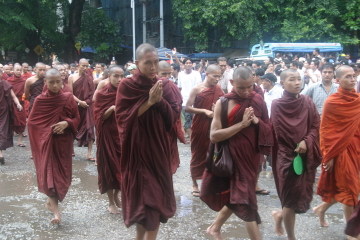
Junta tries to shut down internet and phone links
The Burmese junta was last night desperately trying to shut down internet and telephone links to the outside world after a stream of blogs and mobile phone videos began capturing the dramatic events on the streets.
In the past 24 hours observers monitoring the flow of information have noticed a marked downturn, with the reported closure of cybercafes and the disconnection of mobile telephones.
"I was getting emails three days ago but now I seem to have lost contact," said Vincent Brussels, head of the Asian section of Reporters Without Borders. "Those who can still access the internet are finding it very slow and hard to send pictures."
Although less than 1% of the population has access to the internet, and only 25,000 people have email addresses, witnesses have been finding loopholes.
Skilled bloggers evaded the official firewalls and, according to knowledgable sources, people with videos sought access to embassies, foreign businesses or non-governmental organisations whose internet access is not so strictly controlled.
The London-based blogger Ko Htike told the BBC: "I have about 10 people inside, in different locations. All my people are among the Buddhists; they are walking along with the march and as soon as they get any images or news they pop into internet cafes and send it to me."
The main websites providing up-to-the-minute information are run by Burmese exiles. The Democratic Voice of Burma, originally just an opposition shortwave radio station, operates out of Norway. Its news editor said from Oslo last night: "We had been getting information through mobile phones but these have been cut off. Then our reporters used cybercafes but the traffic has really slowed down in the last few hours. Some of the landlines we used have also been closed, so we cannot get in touch with our people."
Mizzima News, established in 1998 by a group of Burmese journalists, is based in Delhi, with a news bureau in Thailand. From humble beginnings, three journalists started an online news service with a laptop and no telephone. It now runs an email news service and an online video site with half-hourly updates on its main news site, often from eyewitnesses.
A third source is the online Irrawaddy magazine run by Burmese exiles in Thailand, with hourly reports from all over the country. It has heralded the emergence of the new "citizen reporters". And from the Asia-Pacific People's Partnership on Burma come daily exhortations: "Tomorrow will be the BIG DAY as the monks have called on the people from all walks of life to join them the protest movement ... Dear friends, please continue to be vigilant and be prepared to take solidarity actions that we will post for you very soon."
According to Reporters Without Borders, Burma ranks 164 out of 168 states on press freedom. The group says: "The Burmese government's internet policies are even more repressive than those of its Chinese and Vietnamese neighbours ... It keeps a very close eye on internet cafes, in which the computers automatically execute screen captures every five minutes, in order to monitor user activity."
A detailed study of the internet in Burma by the OpenNetInitiative - run by Oxford, Cambridge, Harvard and Toronto universities - reported: "Internet access is costly and the state uses software-based filtering techniques to limit significantly the materials Burma's citizens can access online. Most dial-up internet accounts provide access only to the limited Myanmar internet, not to the global network."
Extract
Dawn, a young woman living in Rangoon, has been blogging on Yahoo. Here are extracts from her journal on Tuesday.
A lot of rumours are flying around Yangon. I am getting awfully paranoid. What I heard:
The military has been ordered to shoot ... The hospital has been ordered to be cleared, and that they are going to shoot today ... I'll let you know when I've been shot. (I'll ask someone before I die to blog about it. If it was an instant death, I'll come to my sister in my dream and tell her to blog about it, or I won't rest in peace)
The actress and singer Htun Aindra Bo has been captured last night, along with the comedian Zar Ga Nar, and the actor Kyaw Thu for participating in the demonstration.
The recent raining in Yangon have been because of the fake rain bombs dropped by the military.
Internet connections in Myanmar will be shut down tonight.
What I saw: some shops downtown closed down early, and some companies released their employees early. Internet connection was down from 11:20am to 3:40pm. I don't know if it's an isolated case, or just in my office.
Protesters of a large number gathered in front of City Hall, carrying posters, and banners. Holding their party's Peacock flag, NLD [National League for Democracy] members also joined the protest, along with university students.
I am just reporting the current events in Yangon. I doubt that I will be captured and questioned just for writing this, but then.. you never know.
Saturday, September 01, 2007

Subscribe to:
Posts (Atom)
