
Showing posts with label Election 2008. Show all posts
Showing posts with label Election 2008. Show all posts
Monday, September 22, 2008


Tuesday, June 17, 2008
If the Left Debated the Campaign Issues
If the Left Debated the Campaign Issues
On foregin policy
By Lydia Sargent
and Michael Albert
(View Original)
An interview with Michael Albert by Lydia Sargent
SARGENT: In the last session you established that presidential elections are mostly a PR campaign and that, sincere or not, the campaign has little to do with truth or with fundamental changes in existing institutions and a lot to do with getting elected, with the help of elite funding and false promises to voters. Let's turn to a few specific issues, starting with foreign policy. How would the left or a left candidate go about exposing U.S. foreign policy?
ALBERT: I don't think what the candidates say about foreign policy means much at all. They seek to appeal to funders, media, and various constituencies. They say what their pollsters tell them to say. At times they say what they believe while at other times they say what they don't believe. They sell themselves in the same way Proctor and Gamble sells toothpaste—by saying whatever needs to be said to find a way to get support.
To find out about candidates, the way to go about it is not by looking at what they say, but by looking at the history of American foreign policy. Since the logic of it changes barely at all, there's no reason to suspect it's going to change now—unless, of course, large constituencies force it to change.
As to what their foreign policy is it's relatively simple: U.S. foreign policy is elites in the United States— the Pentagon, the White House, the corporations—pursuing policies designed to enhance their own power, their own options, and their own wealth. So the policies are designed to extract wealth from other places in the world, whether by actual coercive behavior or, more often, just the power of threats.
A case in point is that the United States isn't in Iraq to take Iraqi oil and benefit from it directly, it's rather more in Iraq to be in control of Iraqi and Mideast oil and to be able to use that power, that threat, that position of dominance over a critical resource to coerce outcomes around the world that it wants. It's always been our policy to behave in that way.
So when candidates say that the U.S. should promote democracy and human rights around the world, what do they mean?
I have no idea what's in their heads, but it's a little bit like saying Iran should promote democracy and human rights around the world. It makes no sense. It's like saying domestically the Mafia should promote human rights and democracy in major urban areas of the United States.
The United States doesn't care what polls show the Iraqi people want; the United States doesn't care what polls show the population of any country in the world wants. When Turkey was going to oppose the war in Iraq because the Turkish population was so against war that the Turkish elites were afraid not to, American media described Turkey as a backward country, not a country that was exhibiting democratic behavior— which it was. And the same went for countries throughout Europe. The countries that opposed the war in Iraq, that were critical of it in response to overwhelming sentiments of their populations, the United States treated as somehow backward, peculiar, misbehaving. The countries that ignored their populations and supported the U.S. role in Iraq, the United States was happy about, describing them as enlightened. That's what American foreign policy is all about. The gap between reality and rhetoric is so huge that you can say things that are incredible. So to talk about the United States imposing democracy is like talking about the Mafia imposing non-violence or peace.
What kind of a foreign policy would you present and how should America behave toward the rest of the world?
I think a good leftist—my saying it doesn't mean much—but a good leftist who might be running for office would say something like, "As president, here are some of the things I would do: close American military bases around the world; reorient the funds that would be saved and spend some in parts of the world that have suffered due to policies of the United States and other wealthy first world countries; spend some of it inside the United States—raising the consciousness and a sense of solidarity with others—and improving the life of people in the United States."
I would simply remove from the docket of American behavior occupying, invading, or otherwise using violence to coerce other nations in any way whatsoever. I would make clear that there are several ways to deal with "terrorism" in the world. One is to pursue it, to actually be terrorists. That's what the United States does as its primary policy. That is, the United States engages in coercive violence around the world to pursue its own interests regardless of its effect on populations.
The second thing that the U.S. does is provoke terrorism. We have a foreign policy that is so callous toward, so dismissive of, and so denigrating to, people around the world that people naturally react hostilely. And then we have created an environment in which the only thing that matters is power. If the only thing that matters is power, and you're a third world country, you can't exercise power via a gigantic military apparatus like the United States, you have to do it via terrorism. It's the only avenue open.
I should clarify that terrorism is a real issue. It is possible for there to be a terrorist apparatus that exacts gigantic horror.
Besides the U.S., you mean?
Yes. The U.S. is first in nuclear weapons, first in violence, first in coercion. But you could imagine a situation in which some apparatus got possession of nuclear weapons and used them. So how do you prevent that? Well, one way would be Bush's way, by having a gigantic coercive cop on the beat who, ahead of any threat, goes in and exterminates what it takes to be the likely threat. The problem with that approach, aside from being immoral, is the idea that the U.S. should do it. Everybody in the U.S. would laugh if we said that the Iranians or North Koreans should be the cops of the world. Well, for the rest of the world the idea that the U.S. should be the cops of the world is like that. It's ridiculous.
Imagine that six people decide they're going on a rampage and engage in some horrible violent activity against Las Vegas. And surveillance discovers they are from Phoenix, Arizona. So what should we do? We want to prosecute these people, we think they're in Phoenix—let's bomb Phoenix. Let's launch a massive air assault against the entire state, for that matter, because we believe these six terrorists are in Phoenix. What would the result be? Instead of 6 people, there would be 6,000 people hostile toward the rest of the country.
What should we do with the six people in Phoenix? We might try to catch them without killing everyone else in the city. What if Japan or India decided to bomb the U.S. and cut off food and medicine because there's a bunch of terrorists in Washington?
The idea of solving the problem of coercive violence by the exercise of even greater coercive violence has never and probably will never work. These policies are barbaric and they do not deal with terrorism. On the other hand, they aren't meant to deal with terrorism. They're meant to perpetuate and propel the will of America in the world as the chief sovereign that decides what can and can't be done.
So what's the alternative? The alternative would be international law. The alternative would be an environment in which international courts, international law, the UN, really meant something. The alternative would be an environment in which those who have power now—and it doesn't change overnight—would be restrained from and would restrict themselves from exercising it. That's what a left candidate would talk about.
Let's turn specifically to Iraq. In a candidates' debate, what would you say about our foreign policy there?
The United States should withdraw. But more than that, it should pay huge reparations. Why? Because we've destroyed the infrastructure of a country. We have harmed, perhaps irreparably, a society. We owe them reparations. We owe them support to get back to being a functioning polity, economy, and social system. So we should provide that, not just withdraw. But we should certainly withdraw. We are an occupying army.
Another area of concern in the debates is China. The talk there is about human rights violations and lack of democracy. How would a left candidate discuss China?
A left candidate might look and say not just what are the Chinese doing, but what are the Americans doing? For instance, American cigarette manufacturers are addicting the Chinese population to cigarettes. Why? In order to replace European and American populations' diminishing smoking. So we're exporting smoking to China. Let's compare that to cocaine from Colombia to the United States. Cocaine from Colombia to the United States kills about 3,000 Americans a year. Cigarette addiction will kill millions, tens of millions, maybe hundreds of millions of Chinese over decades. That's what American policy does. What is China doing that remotely compares—and remember we're only looking at one industry in the U.S.?
So what I would do first is look at our behavior with respect to China and the rest of the world. Then, if we clean it up, if we begin to behave in a remotely responsible fashion, we would have more justification in criticizing violations elsewhere.
Another country of great concern to the candidates is Cuba. Should we continue the sanctions, should we indict Castro, should we go in and get Castro's ally Chavez?
Again, it's American political culture vs. reality. So what we have in Cuba is a situation where, for decades, the United States has engaged in economic warfare, terrorism as well. The economic warfare is the embargo, the terrorism is the acts of terror committed with the support of, and even engaged in by, U.S. policy toward Cuba. Why? If the Cuban people want to do X and X is dangerous to the United States, it's not allowed. What is X in this case? X is to own their own resources. X is to administer their own society. X is to not have a distribution of wealth like that in the United States where a few percent of the population own the vast majority of the economic assets and the wealth accruing from them. The Cubans don't have that. The Cubans have a society where the tremendous centralization of wealth in the hands of the few was undone.
It's not my idea of an ideal society by a long shot, but that was a gigantic step forward. It's that step forward that makes Cuba anathema to the United States and which causes the U.S. to think that it makes sense to talk about what the future of Cuba should be. What if the Japanese started to talk about what the future of the U.S. should be? We can understand the idea that one nation doesn't have the right to dictate to another how it should function, except in the case of the United States.
And Chavez in Venezuela?
With respect to Chavez, it's even more ridiculous. For the U.S. to talk about Chavez as a dictator is a travesty. It's a travesty in the sense that they've had election after election in Venezuela which he handily wins. Then they have one recently, not about his being in office, but about a set of policies that he was backing, which lost. What was Chavez's response to that? "Okay, I lost." If he was a dictator he wouldn't lose; he wouldn't even have an election.
So why is the U.S. government upset about Venezuela? We're upset for the same reasons as in Cuba. It's because in Venezuela the government is looking around at society and saying, "You know what? We should change things. We should change things such that those who are poorest, those who are suffering, those who are denied their dignity, will get it all back. How will they get it all back? We'll redistribute wealth, we'll redistribute power. We'll think of new ways to organize the political system, new ways to organize the economy." That's what they're doing. But that's a horror from the point of view of the United States. What happens if they succeed?
The worst possible outcome for U.S. elites is not that Chavez is a dictator. In Washington each day the government gets up praying that he'll do something that, in fact, would be dictatorial. The worst conceivable outcome is that the Venezuelans succeed in improving the quality of life of the people of Venezuela and in creating a model that could be emulated elsewhere. That's why we go in and try to create turmoil and try to create a coup. And who knows what we'll try and do in the future.
And a left president would...?
A left president would say, "My gosh, what's going on in Venezuela is quite fascinating. Let's go down there and try to learn something."
On the economy
SARGENT: We've discussed elections and foreign policy. Let's turn to the economy. Some predict a recession, even a depression. The candidates seem to have nothing new to offer, not surprisingly, although Clinton refers at one point to ending corporate welfare or at least affecting it. As a left candidate how would you approach talking about changing the direction of the economy?
ALBERT: When they say that we have too much corporate welfare, that's true. It doesn't suffice to point out that people are doing less well than they might. It might be more informative to say that there are 40 to 50 million people in the United States living below the poverty line. How can there be that many people below the poverty line in a country as wealthy as the United States? Well, only if you have a very skewed distribution of wealth. So a candidate could say, "Look, the problem with the U.S. economy is that it enriches the few and impoverishes the many. Or it enriches the few and allows the many to get by. That's probably 60-70 percent of the population that worries all the time about such things.
So what does this mean? Well, it means the economy is misoriented. It means the economy is oriented toward profit. It's oriented toward the well being of those who are best off. Candidates could say all that, but they don't. The reason they don't say all that is because to say it in that way would cue investors—the people who finance elections and permit candidates to enact policies—that the candidate in question was not an agent of their interests.
When Huckabee was campaigning and doing fairly well, he referred to Wal-Mart as a genius of the marketplace.
And it is. Wal-Mart is a case study in the genius of the marketplace doing what the marketplace is meant to do, which is to maintain power relations and enrich the powerful. The confusion is that the population hears that as if it's genius at production, it's genius at efficiency, it's genius at using resources in a clever and creative way. But that isn't what it's genius at. In fact, it's impoverished and psychotic at those things. It's really effective at marshaling resources in such a way as to enhance the profit of the few.

How do we see that it's bad at the other? Well, how can it be efficient to have 40 or 50 million people living in poverty? That's not efficient. That is wasting 40-50 million people's capacities. If a capitalist were to say "a portion of my productive potential is lying fallow, that's inefficient," what would they mean? They'd mean "it isn't being utilized to make me profits." But when a large portion of the human population is "lying fallow"— unemployed or underemployed or robbed of its capacities by an educational system that basically deskills and deeducates, the capitalist doesn't say that's inefficient. It's not utilizing the productive capacities of a population, but it is enriching the capitalist. So the capitalist is happy with that.
When candidates say they're interested in change you can test it in some ways. You can see whether they are going to tax profits at 80 or 90 or 100 percent. Are they going to raise inheritance taxes? Are they going to redistribute wealth so that poorer communities get a much bigger slice of the wealth in order to redress the imbalances?
Huckabee also said, "Consumerism is addictive but tranquility is immaterial."
I have no idea what that means, except this: the idea that consumerism is addictive has some merit, in the following sense. The economy is organized so the only road, the only avenue to a modicum of fulfillment for people is consumption. When the advertisements that we see use sex, friendship, and dignity to sell all manner of commodities, it's not a lie. This is a big mistake that many people make. They look at this stuff and they say to themselves, "Oh, stupid people being tricked." Nobody's being tricked. It's true. The economy is so skewed and people's opportunities in life are so restricted that to have friends, a sex life, dignity, and respect requires consumerism.
What's crazy is to have an economy organized in such a fashion so that toothpaste and clothing and types of cars and all manner of items are a prerequisite for fulfillment.
Candidates are always making promises about taxes. How would you talk about taxes?
The idea of taxes is not bad. The idea that there are many things in an economy that are collectively consumed, which must be provided in a collective manner—for example, by a government—is true. Anybody who thinks it isn't should ask themselves what they would be doing if they didn't have clean water, electricity (before it was privatized), roads, and all manner of things that are provided in this way.
It isn't just the military for which you need taxes. The fact that so much goes to the military is horrible. And there's a reason for that. The economic system we live under has to produce at a high level. It needs to keep churning. How do you keep it churning? You have to keep pouring out product. You have to keep spending. One way to do this would be to spend on education, infrastructure, rebuilding cities, parks, health care, and all kinds of things that would improve the quality of people's lives.
Another way to do it—a quite different way—is to spend money on missiles and tanks and all manner of things that don't improve people's lives, but are used to enforce unjust hierarchies. Why is that done? Most people think it's because the army is so important to the powers that be. There's some truth in that. It is important. They do want that apparatus of power. But that's not the sole reason. The second reason is that to spend lots of society's productive output on welfare, unemployment insurance, health care for all, decent housing, etc. would empower people. It would cause people currently living threadbare existences to have more confidence and more comfort. It would put them in a position to demand still more.
What else would be important to talk about during a left campaign?
One thing candidates typically won't talk about is the types of people that exist in the United States, understanding them as classes. Of course, there are many different occupations and many different roles in the economy. One way to think about people in the economy is that there are some who own factories, workplaces, etc.—that's about 2 percent of the population. These people are tremendously wealthy. In some cases, so wealthy that it is almost unfathomable. Bill Gates, for instance—not because of how hard he works or how long or how difficult and dangerous the conditions but because he has a piece of paper in his pocket, a deed to Microsoft that is worth more than the entire economies of many third world countries. So that's one class—the owning class or the capitalist class, the class for which our economy is named.
There's another group that largely monopolizes empowering conditions of work. They have workplace conditions that give them a considerable degree of control over their own lives and the lives of the people "below" them. They're managers, lawyers, doctors, engineers. They have the credentials of authority. They have incomes, typically, many times that of the third class—working people, who do mostly rote and onerous work.
Our economy is skewed in such a way that the capitalist class is by far the richest and most powerful (2 percent). The second class—the coordinator class—comes next (20 percent). It is still rich and powerful compared to workers beneath them (about 80 percent). Candidates won't talk about that because their money and their credibility and what policies they are allowed to pursue are a function of support from the first group. The third group is relatively irrelevant except for tallying votes. So candidates speak to the third group to tally votes, but they take the interests of the first group seriously.
Take education. What do we do regarding education in the United States? We spend most of our money on the rich and powerful—the 2 percent and the 20 percent. Those sectors receive education designed to prepare them to play an engaging role in society, to function with a degree of authority and influence over economic outcomes. The other 80 percent goes to school and essentially learns to take orders and endure boredom in order to occupy the slot of a working person in the U.S.
If a candidate is going to have a program about economics and you're serious about what's going to happen in the U.S. economy as a result of your programs, you have to say two things. You have to say not just that "people need more education," but you also have to tell the reason why they don't get it. And the reason is because in this economy if they were to get it, the 80 percent would come into the economy with too high expectations, too much knowledge, and too much confidence. They would likely then demand more out of life than rote and obedient conditions of work.
What kind of an economy would you be proposing, as a left candidate?
For a left candidate to propose the kind of economy I believe in—a participatory economy—wouldn't make much sense unless you could have a campaign in which the candidate was in a position to talk with the American people for a year about what the features of such a thing would be. Otherwise it would sound crazy because it would be from nowhere. People wouldn't even know what it meant.
What I would talk about is altering the economy in a direction that would lead to more justice, solidarity, equity, and people controlling their own lives. What that means is altering the way markets operate, eventually doing away with them. It would mean altering the way we allocate income, eventually making it equitable. It would mean altering the way we make decisions eventually making it self-management. I would...
By self-management, you mean...?
...I mean people having a say over their lives in proportion to the way they're affected. I would alter the way people interrelate—from competition to cooperation. Those kinds of steps entail a different economy. Our economy has institutions that violate all those values. Our economy systematically causes people to be egocentric and anti-social; to get ahead you must ignore the conditions of other people.
Why are markets so objectionable?
To interact in the marketplace you have to buy cheap and sell dear. In other words you have to rip off the person you are engaging with. For you to do better that person has to do worse. It's anti-social. To function at the head of a corporation you have to abide by the interests of those who own it. That means you have to generate profits. If you don't generate profits, your corporation will go out of business.
Even if you you're inclined to be more humane, you have no choice. The American corporation is an institution in which the disparity in power between the top and the bottom is worse than it is in a political dictatorship. There's no political dictator who even entertained the idea of having a say over when people could go to the bathroom.
As a left candidate couldn't you offer some program changes?
I would offer changes that moved in the right direction. Here's some: let's cut the work week from 40—actually from what's probably 60 to 70 hours a week for 80 percent of the population—to 30 hours a week. What do we do with all that "lost productivity?" First of all, we transfer people from producing useless stuff to producing useful stuff that would benefit people. That goes a long way toward making up a lot of that lost labor.
Imagine it was 50 years ago and people said, "What we need is to shorten the work week, and that includes surgeons and doctors. Therefore, we'd have much less doctoring. Where are we going to get it from?" What if someone suggested we get it from the people who weren't previously doing it. The response would probably be, "That's impossible. Those people are incapable of it." Well, 40 years ago, if you had looked you would have seen there were virtually no women doing surgery. It wasn't because they were genetically incapable of it. History shows that was a lie. It was the social structures that precluded their being surgeons. Well, it's also a lie that working people can't do creative work.
So a serious left candidate would say, "Look, our economy is stifling people's capacities. It is not utilizing the capacities of working people. We could all benefit from more output and less labor time—having more time to live a life."
If you accept the skewing of outcomes for the population—the super- haves, the haves, and the have-nots—it becomes difficult to do much. That's what candidates accept. What they're doing is debating over modest alterations—if you take them at their word, which is already a big stretch—while maintaining that basic situation.
Z


Friday, March 21, 2008
Barack Obama’s pastor Wright’s Sermon in Context
The point of Pastor Wright's sermon is that America has been and remains a deeply racist country. Instead of seeing an impassioned African American leader whose message is, well, farily accurate the MSM only sees an angry black man screaming "goddamn America". I think they just proved him right.
Thanks: Lo
Jeremiah A. Wright. No more half truths, see the whole context. Available on ITunes. Added: March 20, 2008
Wednesday, March 05, 2008
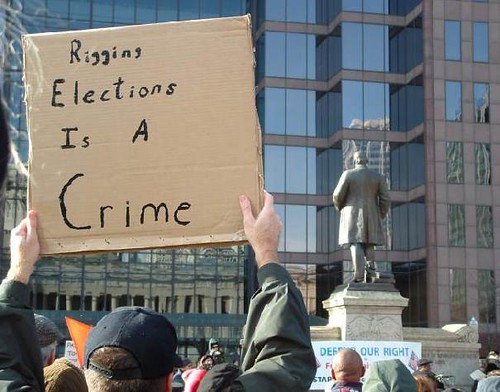
Let’s Call American Elections What They Are: Rigged
 by Jerry D. Rose
(view original)
A recent AlterNet post said “Let’s Call the Superdelegate Process What It is: Election Rigging” Well let’s look at this. What is “rigging” except a process of denying certain individuals a fair opportunity to compete in a contest the outcome of which is already “fixed” before the contest occurs? We need to see this alleged rigging through superdelegates to the Democratic National Convention in the broader context of how American elections actually are rigged. They are rigged, I will argue, in that they deny opportunity for election to four categories of people: (a) the relatively poor; (b) those of relatively extreme political persuasions; (c) those who are challenging a sitting holder of a public office; (d) people of less appealing or charismatic personalities. The wealthy (or those who have access to the resources of wealth), political “centrists”, office incumbents and the personally appealing are able to enjoy advantages that practically “rig” elections in their favors.
I won’t devote too much space to elaborating on these well-known sources of advantage and disadvantage in electoral contests. Political campaigns are so outrageously expensive, and public financing of them is so grievously inadequate, that one must either be independently wealthy or willing and able to accept the contributions of those vested interests who are only too willing to invest in some political influence through contributing to their campaigns. Our quadrennial presidential elections, involving a system of two parties relatively even in voting strength, guarantee that candidates of more purely conservative or progressive political views must, to attract the all-important support of “independents,” tack their political appeals toward the center of political philosophies, hoping only that they won’t so egregiously offend their conservative or progressive “base” that these folks will stay home on election day, or else support 3rd party candidates who are more congenial to their beliefs. As to challenger disadvantage, it’s about as easy to unseat an incumbent legislator as it is to beat the home team in a professional basketball game; the political game is “rigged” in favor of the incumbent because people evaluate their representative in terms of how much he or she “does for” the home district or state, how much for example those much-maligned “earmarks” will come home to the local pork barrel. Finally, the factor of “charisma” or the “likeable” personality is a huge factor in our elections; as was said about G.W. Bush, the average Joe would be more likely to want to “have a beer” with him than either of his opponents, the wooden Gore or the aristocratic Kerry. With the exception of Truman and Ford (both of whom gained their presidencies by constitutional rising from the vice-presidency rather than by election), all our Presidents since FDR have been more or less such charismatics, no matter how disastrous for the country some of their presidencies may have been. I could go on, but I want to get to the superdelegates.
To re-iterate the lament against superdelegates, it is said that they are allowed to substitute their “own” voices for those of the “ordinary” voters who have voted in primaries and caucuses. I have two things to say about these charges. The first is to observe that, if elections generally in this country are “rigged” in the manner I’ve suggested above, these superdelegates will not be immune from the same influences that influenced those sacred “voters” in the primaries and caucuses. They owe their own elections to personal or sponsored wealth, they are raised in the 2-Party culture which defines the preferred candidate as the one must “viable” in competition with the other party, they have been judged and their electoral opponents have been judged in terms of their likeability. In other words, they will use their judgment in the same way “ordinary” voters choose the candidate they think will fare best in the general election; if these judgments are divided in the electorate, they will be divided in the superdelegates; a “wash out” in terms of their supposedly decisive influence, which seems exactly to be happening as Clinton support among superdelegates erodes and that of Obama increases (with, I predict, declines in claims of superdelegate “rigging” from those in the Obama camp).
The second and more “principled” point that I would make about superdelegates is the view that it perhaps is a good thing for “democracy” if these men and women are somewhat independent of the views of “the voters” in making their choices for a nominee. Tocqueville, whose views Noorani likes to quote in his article, is somewhat admiring of the genius of the American Constitution’s “checks and balances” that help to ameliorate what the French aristocrat saw as the tendency toward a “tyranny of the majority” in American life. “Representative” bodies like city, county, state and national legislatures involve a process of “deliberation” prior to votes that commit the given entity to a line of public policy. A member of Congress should, in this view, be able to give a more reasoned consideration to a decision than can typically be done in a political campaign in which, before voters “speak” with their votes, they have been bombarded with the likes of sound bite commercials, bumper stickers and swift boat attacks on candidates. There is a certain genius, I think, in a political party reserving a certain number of seats at a nominating convention for persons who are “uncommitted” and therefore presumably amenable to reasoning and debate. Maybe superdelegates are not the best way to do this; they are, after all, subjected to the same “rigging” influences that I described above. But at least they are men and women with some degree of experience in deliberation on issues that arise in their executive or legislative offices so that, absent another distribution formula, it may be as good a way as any to keep the nomination of a presidential candidate “open” to candidates none of whom have captured a majority of delegates in primaries and caucuses.
I close with the words of an American contemporary of Tocqueville, Henry David Thoreau which, even though they don’t sound so “democratic,” may contain an element of political wisdom when it comes to determining the “virtue” of different presidential candidates. “A wise man will not leave the right to the mercy of chance, nor wish it to prevail through the power of the majority. There is little virtue in the action of masses of men.” (Civil Disobedience).
Jerry D. Rose is a retired professor of sociology from State University of New York at Fredonia, now living in Gainesville Florida. He is editor of his own website and also engaged currently in constructing a list-serve for "uncommitted" dissidents who are seeking ways to enhance progressive influence in the 08 elections and beyond. He may be contacted at: jerrydrose11@yahoo.com. Read other articles by Jerry, or visit Jerry's website.
Friday, February 29, 2008
Don't be a Nader Hater
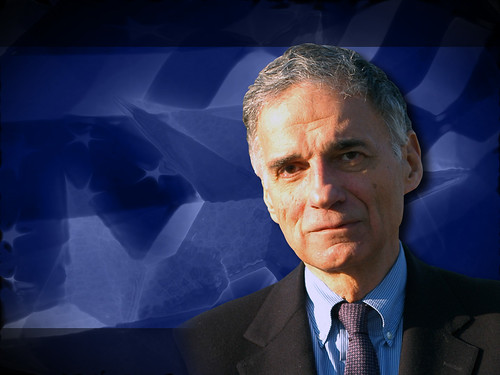
On the day Ralph Nader announced his bid for the White House the subsequent media coverage didn't examine his policy proposals or his lifelong commitment to consumer protection; they didn't mention Ralph, the champion of populism, or Ralph, the corporate dragon-slayer. No, all they cared to squawk about was Ralph, the spoiler.
CNN interviewed one of Al Gore's campaign advisers who suggested we all ignore Nader. So much for John Stuart Mill's concept of a marketplace of ideas. Many Democrats -- that is to say people who vote Democratic -- are buying into the notion that this is "the most important election of our lifetime". No it's not. A case could be made for the Bush/Kerry 2004 contest, but if you think Clinton, Obama or McCain will introduce any sweeping systemic reforms think again.
Clinton and Obama's milquetoast attitudes toward big business are starkly delineated only when measured against Nader's stances. What do you expect from the Corporate World's first and third (respectively) favorite presidential contenders? Neither will call for the death of Corporate personhood, neither seriously supports impeachment, neither can get us out of Iraq by the end of their first year, neither will repeal the Taft/Hartley Act and restore the power of the unions and neither have the mettle to denounce Israel. Unless you're a CEO banking multi-billion dollar profits each quarter I don't see how you can disagree with Nader on any of these issues.
So why vote Democrat? The real question seems to be are you first a Democrat or a Liberal? Liberalism has been responsible for Child Labor laws, Civil Rights, Birth Control, Workers' Rights, Women's Suffrage and so on, sometimes pressuring the establishment through third parties like the Socialist Party. The Democrats on the other hand have a fine tradition of being mealy-mouthed, ankle-grabbing sycophants.
Ralph Nader is nobody's bootlicker. People complain that a vote for a third party is a vote wasted. Not so. In fact, I submit that a vote for either of the two corporate-bought parties is a vote wasted. When you cast your ballot for an Ass or an Elephant you only legitimize what's already a rotting institution which promotes a sense of helplessness. Why do we keep repeating ourselves hoping for a different result? That is the definition of insanity. Nader offers relief from this political tail-chasing. His presence expands the discourse, and draws the other contestants past their vacuous talking points.
Monday, February 25, 2008
Thursday, February 21, 2008
Sunday, February 03, 2008
Saturday, February 02, 2008
Thursday, January 31, 2008
Nader, Ron Paul and the Election
For some reason Ron Paul supporters are angry about Nader's entrance into the race. Take this comment I found on the subject:
Thats it, Nader is a Shill. He promoted and endorsed Edwards, and now wants to take the limelight from Ron Pauls potential "Independant" position
I have to say I don't believe Nader's a "shill" in the slightest. Anything, or anyone, who challenges the current two-party system should be praised for at least injecting another voice into the conversation. Ron Paul, for all his faults (which there are a laundry list to be sure) deserves to be in the Presidential race. I find his economic philosophy of "free markets" akin to mumbo jumbo, a worldview that would collapse under its own destructive avarice over time. For more on the dangers of Paul's Austrian school of economics see the Adam Curtis documentary "The Trap". Ralph Nader has spent a lifetime limiting the cruel effects of unrestrained capitalism. For this great work he should be revered, not maligned. To think many who support Ron Paul for President don't want the competition. How ironic.
Something wrong with this man, I think he is there just to swing votes
Ralph Nader enters US election race
Thu, 31 Jan 2008 12:06:16 US political activist Ralph Nader sets aside memories of previous losses and bows into the presidential race as independent candidate.
Nader, who has come under fire from Democrats for costing them the 2000 election, said he was planning a new bid for the 2008 elections.
Frustrated by the leading democratic candidates Hillary Clinton and Barack Obama, Nader told AFP that he has decided to "jump into the fray."
The 73-year-old hopeful said he is appearing in order to tackle the injustice and deprivation that the candidates are ignoring.
Democrats once pinned the blame on Nader for losing the 2000 election, but Al Gore was edged out in Florida by George W. Bush in a vote count. Nader rejects the "spoiler" title.
Sunday, September 23, 2007
Gravel telling the truth on the Conservative News Network (CNN)
Holy shit! Gravel's my president, is he yours?
Saturday, September 15, 2007
I Like Mike
The reason Kucinich doesn't have the cult following of a Ron Paul isn't because he's inconsistent or a babbler, but due to his lack of "media moments". Those explosive applause-worthy exchanges like the now classic Ron/Rudy horn lock. Mike Gravel is capable of these types of "moments". Take, for example, Gravel's performance at the Democratic Presidential debates when he stated bluntly that nobody who voted to authorize the use of force in Iraq is Presidential material (Hillary, Edwards he's looking at you). The 77-year-old, former Alaskan Senator comes across as a lovable old codger, grizzled with a sense of justice yet sweetly approachable. A few days ago I called for the Republicans to nominate Ron Paul, well, today I'm imploring the Democrats to greet Gravel with their nomination. Otherwise, the two should eschew the corporate system and run on the same ticket.
Paul/Gravel in '08!
Visit Gravel's website
and
contribute to his campaign
Sen. Mike Gravel at SC Debates 04/26/07
Senator Mike Gravel Visits My Dorm Room
Mike Gravel Meets Ron Paul Supporters, Requests a One-On-One Debate
Sunday, June 10, 2007
Ron Paul or Dennis Kucinich in '08?
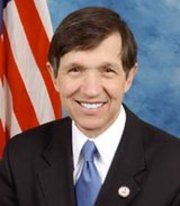
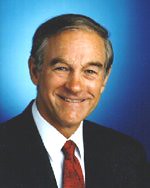
It seemed 2008 election talk began right after Dubya's "victory" in '04. Will it be Hillary or Obama? Guiliani or McCain? I say forget them all and focus on the underdogs. Ron Paul and Dennis Kucinich has accomplished something radical in this time of perpetual media distortion, they've been able to communicate the truth. The truth about why we were attacked, the truth about our civil liberties and the truth about the nature of government. And, predictably, they've made enemies out of the right-wing and center-left Democrats. So, let's say these two, by some act of divine intervention, squared off in 2008...who would I choose? I sat in my thinker pose for a few hours and this is how it breaks down for me if the impossible should happen next year.
Impeachment:
And by impeachment I mean anybody in this administration who deserves it - King George, Cheney, the checkout clerk in the Whitehouse's gift shop. I just want to see some action, anything which breaks from Pelosi's "hands off" approach that's been so unsuccessful this far. With Kucinich it's clear. He has famously introduced articles of impeachment against Dick Cheney, H.R. 333. What about Ron? He doesn't agree with the bill, in fact, he doesn't think there's enough evidence for impeahment at this point. I disagree, we need to winnow down the mountain of evidence. On this one Ron Paul has it wrong.
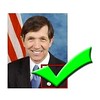
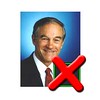
Iraq War/"War on Terror":
This one's a toughy. Dennis Kucinich never voted to support Bush's actions during the lead up to the war or any funding bill thereafter. Pretty impressive. The same can be said of Ron Paul. Both voted against the PATRIOT Act and both have been outspoken critics of this illegal war from the beginning. I do believe this one's a tie. Bravo!
Dennis Kucinich - When Others Were Silent
Ron Paul on Now With Bill Moyers - October 4, 2002

Healthcare:
Kucinich supports universal healthcare, he wants a single-payer system that would ensure every American's medical costs would be covered. On the other hand, Paul, being a libertarian, would support tax credits which would reduce the cost of prescription drugs and hospital expenses. I realize this is supposed to grant relief from "big government" to the middle class but I know people from countries with national healthcare systems and they are proud of the type of care they receive. You show up to a hospital, they patch you up, you leave...that's how simple it could, and should, be here in the states. This round goes to Denny.
Taxes:
Ron Paul wants to eliminate the IRS, income tax and inflation tax lifting a significant burden on the middle class. I like it!
Ron Paul : Stop Dreaming
And what of Kucinich? He's got some pretty good ideas, not great. He believes we should bring tax rates back to that of the Clinton Administration:
"The Clinton period tax rates for the most affluent should be returned, while the tax cuts for those earning less than $405,000 a year should be maintained, for now, until we see how the economy fares."That's a bit too safe for my liking. Who likes paying taxes? Ron Paul's got the right idea.
--Dennis Kucinich, Source
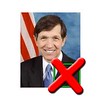
Old fashioned Feather-ruffling:
To my knowledge Dennis Kucinich never had the same kind of smack down with members of his own party like Ron Paul did with Rudy. Anyone who can stick to their guns like Ron even after the rabidly conservative audience attending that Republican Presidential Debate turned on him is bona fide Presidential material in my book.
It seems as though we've reached a stalemate, so I've got to look at the tie-breaker: Elizabeth Kucinich. I'd take four years of her over any of our last four first ladies.
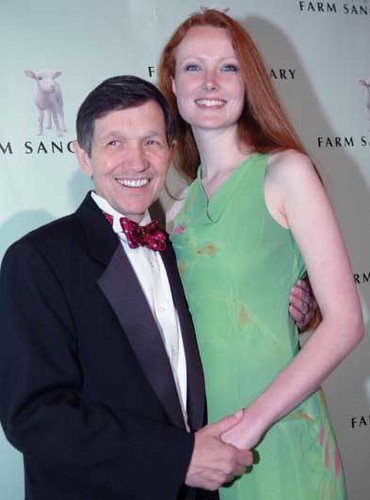
And she's not just a pretty face, she's smart too. She got her bachelor's and master's degrees from the University of Kent and has done charity work with the British Red Cross and the House of Lords. Here's Liz in action:
Overall, either one of these men would make a superb President. Ron Paul is admirably principled and intolerant toward deceit and corruption, but for my money Kucinich, who possesses the same qualities, can contribute something extra to the Oval Office, therefore Kucinich pulls ahead of Ron Paul by a nose.
Subscribe to:
Posts (Atom)
