
Freedom: The Philosophy of Liberation..
Professor Dennis Dalton explores the meaning of freedom, perhaps the most powerful of the ideas that have inspired mankind throughout the ages.
Lecture 1 - Freedom in the Ancient World
Lecture 2 - The Advent of Freedom in the Modern World
Lecture 3 - Hegel's Philosophy of Freedom, God and the State
Lecture 4 - John Stuart Mill's Philosophy of Freedom
Lecture 5 - Emma Goldman and the Anarchist Idea of Freedom
Lecture 6 - Mahatma Gandhi - Personal and Political Freedom
Lecture 7 - Malcolm X's Quest for Liberation
Lecture 8 - Martin Luther King, Jr - Stride Toward Freedom
Watch playlist..
Showing posts with label Mohandas Gandhi. Show all posts
Showing posts with label Mohandas Gandhi. Show all posts
Thursday, October 09, 2008
Freedom: The Philosophy of Liberation..


Saturday, May 17, 2008
Was Gandhi an Anarchist?
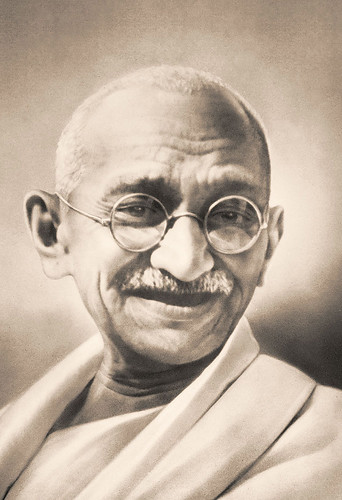
Was Gandhi an Anarchist?
Visionary promoted decentralized, direct democracy as key to peace; power resides in the individual and in self-rule
By Josh Fattal
(View Original)
Anarchy is about abolishing hierarchy. According to the original, Greek meaning of the word, Anarchy stands to create a world where there is no separation between the rulers and the ruled--a place where everyone rules themselves. (An-archy in Greek means without rulers.) An anarchic vision of society is nonviolent, self-managed and non-hierarchical, and Anarchist thinkers hold dear to the ideal of democracy--rule by the people. They suggest political confederations of local organizations; a "commune of communes" was how the 19th century Parisians Anarchists articulated it. Anarchists seek to dissolve power instead of seize it. Therefore, they seek a social revolution instead of a political one. The social revolution throws into question all aspects of social life including family organization, schooling, religion, crime and punishment, technology, political organization, patriarchy, environmental concerns as well as others. Anarchists are identified "as enemies of the State," because they do oppose the existence of a hierarchical, top-down State.
Mohandas Gandhi opposed the State. The State is the military, police, prisons, courts, tax collectors, and bureaucrats. He saw the State as concentrated violence. "The State represents violence in a concentrated and organized form. The individual has a soul, but as the State is a soulless machine, it can never be weaned from violence to which it owes its very existence." Gandhi recognized that the State claims to serve the nation, but he realized that this was a fallacy. "While apparently doing good by minimizing exploitation, [the State] does the greatest harm to mankind."1
According to Dr. Dhawan, Gandhi was a philosophical Anarchist because he believed that the "[the greatest good of all] can be realized only in the classless, stateless democracy."2 While Gandhi advocated democracy, he differentiated between direct democracy and western democracy. Commenting on the parliamentary system, Gandhi says, "If India copies England, it is my firm conviction that she will be ruined. Parliaments are merely emblems of slavery."3 He had no more appetite for majority democracy of America, "It is a superstition and an ungodly thing to believe that an act of a majority binds a minority."4 By centralizing power, western democracies feed into violence. Thus, he thought decentralization was the key to world peace.
In Gandhi’s view all the political power that was concentrated in the State apparatus could be dissolved down to every last individual. He stated "Power resides in the people, they can use it at any time."5 Reiterating the idea of Anarchy, Gandhi said, "In such a state (of affairs), everyone is his own rulers. He rules himself in such a manner that he is never a hindrance to his neighbor."6 Gandhi had no illusions about the enormity of the task, but he took it on anyways. He believed that by reforming enough individuals and communities, society at large will change. Gandhi’s concept of swaraj elucidates the connection between the individual and society.
Swaraj translates into "self-rule" or "autonomy". For Gandhi, every individual had to take steps towards self-rule in their lives; then India would naturally move towards self-rule as a nation. Gandhi insisted, "Everyone will have to take [swaraj] for himself."7 He continued, "If we become free, India becomes free and in this thought you have a definition of swaraj. It is swaraj when we learn to rule ourselves." 8
Gandhi angered some of his cohorts by extending his notion of power and swaraj to the history of colonization. While acknowledging the British Empire’s cynical intentions in India, he places the responsibility of the disaster of colonization on the India people. "It is truer to say that we gave India to the English than that India was lost... to blame them for this is to perpetuate their power."9 Because power resides in the people and they can only lose it by relinquishing their own power (often through coercion by others), petitions to the government get a new meaning with Gandhi. "A petition of an equal is a sign of courtesy; a petition from a slave is a symbol of his slavery." Gandhi will petition the government as an equal and he used love-force to back himself up. "Love-force can thus be stated: ’if you do not concede our demand, we will be no longer your petitioner. You can govern us only so long as we remain the governed; we shall no longer have any dealings with you.’"10
"The individual has a soul, but as the State is a soulless machine, it can never be weaned from violence to which it owes its very existence."
-Mahatma Gandhi
-Mahatma Gandhi
The principle of swaraj ultimately leads to a grassroots, bottom-up, "oceanic circle" of self-ruling communities. In 1946, Gandhi explained this vision:
"Independence begins at the bottom... It follows, therefore, that every village has to be self-sustained and capable of managing its own affairs... It will be trained and prepared to perish in the attempt to defend itself against any onslaught from without... This does not exclude dependence on and willing help from neighbors or from the world. It will be a free and voluntary play of mutual forces... In this structure composed of innumerable villages, there will be every-widening, never ascending circles. Life will not be a pyramid with the apex sustained by the bottom. But it will be an oceanic circle whose center will be the individual. Therefore, the outermost circumference will not wield power to crush the inner circle but will give strength to all within and derive its own strength from it."11
In apparent contradiction to these ideals, Gandhi battled for national liberation and he expressed a lot of patriotism towards Indian civilization. He redefined the terms ’nationalism’ and ’patriotism’ to fit his vision. Nationalism, for instance, meant many different things. Gandhi said, "Every Indian whether he owns up to it or not, has national aspirations--but there are as many opinions as there are Indian Nationalists as to the exact meaning of that aspiration."12 Gandhi’s nationalism stood to disband the Congress Party upon independence, "Its task is done. The next task is to move into villages and revitalize life there to build a new socio-economic structure from the bottom upwards."13 He also understood patriotism differently than his contemporaries, "by patriotism, I mean the welfare of the whole people."14
But Congress did not disband after independence in 1947. Gandhi recognized that there would be a national government, and his anarchic, oceanic circle would not yet be possible. Nevertheless, he used the terms of nationalism to move towards the ideal of Anarchy. He advocated for a minimal level of State organization to fund some education programs and to promote his economic concept of trusteeship. Hence, Gandhi was a compromising Anarchist.
To Gandhi, ideas were worth having. He defended his vision of Anarchy in India on this point, "It may be taunted with the retort that this is all Utopian and, therefore, not worth a single thought... Let India live for the true picture, though never realizable in its completeness. We must have a proper picture of what we want, before we can have something approaching it."15
By trying to understand Gandhi’s worldview, certain questions jump out with contemporary relevance. First off, what is our culturally appropriate "utopian" picture of America or of the communities in which we live? Secondly, what practical steps can we make towards swaraj amidst the current global empire? Finally, if Gandhi is right that all power resides in individuals, and that power is derived from an "indomitable will" than how do we reclaim the latent power within us, both individually and collectively?
References:
Institute for Social Ecology: online library at http://tinyurl.com/8au7e
Guerin, Daniel. Anarchism. http://www.geocities.com/CapitolHill/1931/guerin/contents.html
Bhattacharyya, Buddhadeva. Evolution of the Political Philosophy of Gandhi. Calcutta Book House: Calcutta, 1969.
Jesudasan, Ignatius. A Gandhian Theology of Liberation. Gujarat Sahitya Prakash: Ananda India, 1987.
Murthy, Srinivasa. Mahatma Gandhi and Leo Tolstoy Letters. Long Beach Publications: Long Beach, 1987
Parel, Anthony (ed.) Gandhi: Hind Swaraj and other writings. Cambridge University Press: Cambridge, UK, 1997.
1 Jesudasan, Ignatius. A Gandhian Theology of Liberation. Gujarat Sahitya Prakash: Ananda India, 1987. pp. 236-237.
2 Bhattacharyya, Buddhadeva. Evolution of the Political Philosophy of Gandhi. Calcutta Book House: Calcutta, 1969. p.479
3 Parel, Anthony (ed.) Hind Swaraj and other writings of M.K. Gandhi. Cambridge University Press: Cambridge, UK, 1997. p. 38
4 Ibid. p. 92
5 Jesudasan, Ignatius. A Gandhian Theology of Liberation. Gujarat Sahitya Prakash: Ananda India, 1987. pp. 251.
6 Murthy, Srinivasa. Mahatma Gandhi and Leo Tolstoy Letters. Long Beach Publications: Long Beach, 1987. p. 13.
7 Ibid. p. 112. 8 Ibid. p. 73. 9 Ibid. p. 41. 10 Ibid. p. 85. 11 Ibid. p. 189.
12 Murthy, Srinivasa. Mahatma Gandhi and Leo Tolstoy Letters. Long Beach Publications: Long Beach, 1987. p. 40.
13 Jesudasan, Ignatius. A Gandhian Theology of Liberation. Gujarat Sahitya Prakash: Ananda India, 1987. p. 225.
14 Parel, Anthony (ed.) Hind Swaraj and other writings of M.K. Gandhi. Cambridge University Press: Cambridge, UK, 1997. p. 77.
15 Ibid. p. 189.
Monday, July 16, 2007
The Gandhi Protest
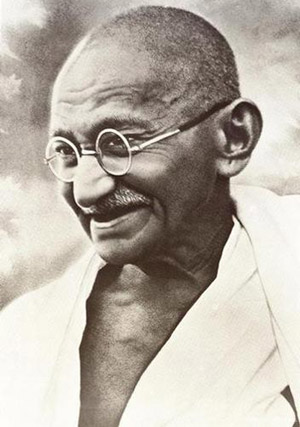 To say Gandhi was ahead of his time is to woefully short change the Mahatma. First there is a resurgence of hunger strikes on college campuses. Now, a flower protest emerges. Those who detract from nonviolent protests think it's lazy, that only those who aren't willing to die for their cause will engage in such tactics. This is exactly backwards. People like Gandhi and Martin Luther King Jr. who chose pacifism were demonstrably braver because they faced imprisonment, even death, armed only with compassion. Too often we carelessly look back on history thinking it was predestined, that it had to turn out in our favor. This is not so. Progress doesn't happen as a result of happy accidents. It is brought to fruition through constant (sometimes over generations) pushing and shoving, charges and retreats.
But take heart in the words of Gandhi who said:
"When I despair, remember that all through history the way of truth and love has always won. There have been tyrants and murderers and for a time they seem invincible but in the end they always fall -- think of it, always".
The Gandhi Protest
Several readers commented on a posting earlier this week about 200 skilled immigrants from India who tried a Gandhi-like tactic and sent flowers to the government's immigration director for help in moving their green card applications along. The U.S. Citizenship and Immigration Services forwarded the flowers to soldiers recovering at Walter Reed Army Medical Hospital, saying it understood the intent of gesture.
Here's a sample:
"I wonder if USCIS really understood why the flowers were sent. It was a symbolic protest by legal immigrants AGAINST the way USCIS treated them. How could they send it in the 'same spirit' to soldiers whom we all empathize with?"
.....
"What an inspirational act. Too bad the message did seem to have gotten lost in translation. Just imagine what would have happened in WWII if the US would have turned away the immigrating sciencists and engineers. How come some 50 years later, the US is struggling to see the value of inviting the world's best and brightest to immigrate here."
.....
"I'm sorry that these people were tricked into coming to America with the promise of a welcome and eventually a Green Card. The fact is that H1-B immigrants were brought here in order to replace US workers."
.....
"Viceroy Lord Wavell and his assistants laughed when M.K. Gandhi told them that one day they will be forced to leave India. What they did not understood that they were not politicians, they were bureaucrats. When the political power behind peaceful civil disobedience was unleashed, a nation took shape, and what Gandhi told Wavell became a reality.
"Something similar repeated in United States recently when thousands of legal immigrants were given a cold shoulder, despite of their merit based claim for an American Green Card. They decided to apply Gandhian way of peaceful protest by sending thousands of flower bouquets to USCIS, an American agency responsible for immigration and citizenship. Instead of offering an apology, USCIS chief decided to again ignore the immigrants and simply issued a statement that the flowers will be forwarded to the injured service members recuperating at Walter Reed Army Medical Center. Once again a bureaucrat miscalculated the power hidden behind a peaceful protest. Now the power behind flowers is becoming a media mainstream story. NY Times, Washington Post, Reuters, Yahoo News are a few to name. Bollywood, has recently issued a statement providing its full support to Immigration Voice, the non profit organization behind the flower campaign.
"An American way of fighting injustice 'A law suit' is on its way, the usual rallies and demonstrations are about to begin. However, in America, its first time after Martin Luther King Jr., that someone has tried to apply Gandhi's way to fight injustice. It is yet not clear that what would be the outcome of this campaign, but there are rumours that USCIS is already discussing internally to reverse the discriminatory decision which caused this embarrassing flower campaign against them.
"It's amazing to witness that 60 years after Gandhi's demise, his ideology is still relevant. We are sure its gonna remain relevant till there are Lord Wavell's in this world. Lord Wavell's can momentarily laugh thinking that unorganized immigrants are helpless, but when the peaceful protest will demonstrate its political power, they surely will realize what Gandhi and Gandhian ways are all about."
By Dan Beyers | July 13, 2007; 6:00 AM ET
Subscribe to:
Posts (Atom)
