Listen To Podcast
(http://wpr.org/hereonearth/archive_090602k.cfm)What can you tell about a person from the way they die? In The Book of Dead Philosophers, Simon Critchley, Professor of Philosophy at the New School in New York, explores death, our last taboo, from a most unusual perspective. He recounts the demise of famous philosophers, revealing how their variously tragic, amusing, and bizarre ends can help us lead richer lives.
GuestRelated Links
- Simon Critchley, author of The Book of Dead Philosophers, Professor and Chair of Philosophy at the New School for Social Research in New York
- Simon Critchley
- The Book of Dead Philosophers (with excerpt)
- New York Times review of the book
- Simon Critchley's interview on NPR
Showing posts with label Philosophy. Show all posts
Showing posts with label Philosophy. Show all posts
Monday, June 08, 2009
The Book Of Dead Philosophers


Monday, January 05, 2009
Friday, October 17, 2008
Thursday, October 09, 2008
Freedom: The Philosophy of Liberation..
Freedom: The Philosophy of Liberation..
Professor Dennis Dalton explores the meaning of freedom, perhaps the most powerful of the ideas that have inspired mankind throughout the ages.
Lecture 1 - Freedom in the Ancient World
Lecture 2 - The Advent of Freedom in the Modern World
Lecture 3 - Hegel's Philosophy of Freedom, God and the State
Lecture 4 - John Stuart Mill's Philosophy of Freedom
Lecture 5 - Emma Goldman and the Anarchist Idea of Freedom
Lecture 6 - Mahatma Gandhi - Personal and Political Freedom
Lecture 7 - Malcolm X's Quest for Liberation
Lecture 8 - Martin Luther King, Jr - Stride Toward Freedom
Watch playlist..
Wednesday, August 20, 2008
Free Will vs. the Programmed Brain
Free Will vs. the Programmed Brain
If our actions are determined by prior events, then do we have a choice about anything—or any responsibility for what we do?
By Shaun Nichols
In a clever new study, psychologists Kathleen Vohs at the University of Minnesota and Jonathan Schooler at the University of California at Santa Barbara tested this question by giving participants passages from The Astonishing Hypothesis, a popular science book by Francis Crick, a biochemist and Nobel laureate (as co-discoverer, with James Watson, of the DNA double helix). Half of the participants got a passage saying that there is no such thing as free will. The passage begins as follows: "'You,' your joys and your sorrows, your memories and your ambitions, your sense of personal identity and free will, are in fact no more than the behavior of a vast assembly of nerve cells and their associated molecules. Who you are is nothing but a pack of neurons."
Many scientists and philosophers are convinced that free will doesn't exist at all. According to these skeptics, everything that happens is determined by what happened before—our actions are inevitable consequences of the events leading up to the action—and this fact makes it impossible for anyone to do anything that is truly free. This kind of anti-free will stance stretches back to 18th century philosophy, but the idea has recently been getting much more exposure through popular science books and magazine articles. Should we worry? If people come to believe that they don't have free will, what will the consequences be for moral responsibility?
The passage then goes on to talk about the neural basis of decisions and claims that "…although we appear to have free will, in fact, our choices have already been predetermined for us and we cannot change that." The other participants got a passage that was similarly scientific-sounding, but it was about the importance of studying consciousness, with no mention of free will.
After reading the passages, all participants completed a survey on their belief in free will. Then comes the inspired part of the experiment. Participants were told to complete 20 arithmetic problems that would appear on the computer screen. But they were also told that when the question appeared, they needed to press the space bar, otherwise a computer glitch would make the answer appear on the screen, too. The participants were told that no one would know whether they pushed the space bar, but they were asked not to cheat.
The results were clear: those who read the anti-free will text cheated more often! (That is, they pressed the space bar less often than the other participants.) Moreover, the researchers found that the amount a participant cheated correlated with the extent to which they rejected free will in their survey responses.
Varieties of Immorality
Philosophers have raised questions about some elements of the study. For one thing, the anti-free will text presents a bleak worldview, and that alone might lead one to cheat more in such a context ("OMG, if I'm just a pack of neurons, I have much bigger things to worry about than behaving on this experiment!"). It might be that one would also find increased cheating if you gave people a passage arguing that all sentient life will ultimately be destroyed in the heat death of the universe.
On the other hand, the results fit with what some philosophers had predicted. The Western conception idea of free will seems bound up with our sense of moral responsibility, guilt for misdeeds and pride in accomplishment. We hold ourselves responsible precisely when we think that our actions come from free will. In this light, it's not surprising that people behave less morally as they become skeptical of free will. Further, the Vohs and Schooler result fits with the idea that people will behave less responsibly if they regard their actions as beyond their control. If I think that there's no point in trying to be good, then I'm less likely to try.
Even if giving up on free will does have these deleterious effects, one might wonder how far they go. One question is whether the effects extend across the moral domain. Cheating in a psychology experiment doesn't seem too terrible. Presumably the experiment didn't also lead to a rash of criminal activity among those who read the anti-free will passage. Our moral revulsion at killing and hurting others is likely too strong to be dismantled by reflections about determinism. It might well turn out that other kinds of immoral behavior, like cheating in school, would be affected by the rejection of free will, however.
Is the Effect Permanent?
Another question is how long-lived the effect is. The Vohs and Schooler study suggests that immediately after people are made skeptical of free will, they cheat more. But what would happen if those people were brought back to the lab two weeks later? We might find that they would continue to be skeptical of free will but they would noThere is no direct evidence on this question, but there is recent evidence on a related issue. Philosopher Hagop Sarkissian of the City Univeristy of New York and colleagues had people from Hong Kong, India, Colombia and the U.S. complete a survey on determinism and moral responsibility. Determinism was described in nontechnical terms, and participants were asked (in effect): whether our universe was a deterministic universe and whether people in a deterministic universe are morally responsible for their actions.
Across cultures, they found that most people said that our universe is not deterministic and also that people in the deterministic universe are not responsible for their actions. Although that isn't particularly surprising—people want to believe they have free will—something pretty interesting emerges when you look at the smaller group of people who say that our universe is deterministic. Across all of the cultures, this substantial minority of free will skeptics were also much more likely to say that people are responsible even if determinism is true. One way to interpret this finding is that if you come to believe in determinism, you won't drop your moral attitudes. Rather, you'll simply reverse your view that determinism rules out moral responsibility.
Many philosophers and scientists reject free will and, while there has been no systematic study of the matter, there's currently little reason to think that the philosophers and scientists who reject free will are generally less morally upright than those who believe in it. But this raises yet another puzzling question about the belief in free will. People who explicitly deny free will often continue to hold themselves responsible for their actions and feel guilty for doing wrong. Have such people managed to accommodate the rest of their attitudes to their rejection of free will? Have they adjusted their notion of guilt and responsibility so that it really doesn't depend on the existence of free will? Or is it that when they are in the thick of things, trying to decide what to do, trying to do the right thing, they just fall back into the belief that they do have free will after all?
Are you a scientist? Have you recently read a peer-reviewed paper that you want to write about? Then contact Mind Matters editor Jonah Lehrer, the science writer behind the blog The Frontal Cortex and the book Proust Was a Neuroscientist.
Thursday, July 31, 2008
Wednesday, July 30, 2008
An All-Too-Brief Introduction to Plato
In the realm of Western thought no other philosopher measures up to the contributions of Plato. Contained in his volumes are the building blocks of modernity. Plato’s dialogues meticulously construct a vision of power, the state, justice, social organization and democracy so complete that every other significant political theorist has been required to confront it in order to etch out their own identity. Not everything Plato wrote can be viewed as advisable on a humanitarian level, some of his proposals, such as his Utopia, appear proto-totalitarian in nature. If nothing else, Plato displayed a variety of fearless honesty that set the standard for cultural examination through the ages. Despite his missteps, Plato’s ideas cover much intellectual terrain and still bare relevance today.
It is unclear where Plato was born although it is generally assumed it was near Athens (Diogenes Laertius 3.4). Young Plato received the most rigorous education available to any Greek child. He was taught music, grammar, philosophy and gymnastics as a part of his early schooling. A student of the famous Greek philosopher, Socrates, Plato recorded the words of his teacher in his dialogues, preserving them as Socrates never penned anything himself. The Apology of Socrates noted that Plato was one of Socrates’ most loyal students. As a matter of record, Plato’s name was used against Socrates during his trial as one of the youths he had corrupted. Plato’s admiration for Socrates is evident through the way Plato presents Socrates as an eloquent sage in all of his works. The treatment of Socrates during his trial as well as Socrates’ ideas themselves would shape Plato’s own thought.
In Plato’s most respected work, The Republic, he sets out to assemble the ideal state. The initial question in Plato’s mind is that of justice. Using Socrates as his mouthpiece, Plato enters into a debate to define the nature of justice. A man named Polemarchus suggests justice is merely “giving everyone the good or evil they deserve.” This is to say return right with right and wrong with wrong. Socrates responds by stating that doing harm to others is never warranted. According to Socrates each person exhibits their own category of goodness called “arete”. To do harm to others is unjust as it diminishes this quality. Thrasymachus offers the next stage of Plato’s argument by denying both Polemarchus’ moral reciprocity and Socrates’ arete with a pre-Machiavellian idea of power as a justification for itself. Thrasymachus states “Listen—I say that justice is nothing other than the advantage of the stronger.” (The Republic, 1.388c). This idea props up the state and its leaders as suspended above the constraints of morality. Socrates refutes Thrasymachus by saying:
“Being a ruler is a craft like being a doctor or a navigator or a wage-labourer. If a man does it, we must pay him, but it is a craft in itself. Men don't want to be called mercenary or over-ambitious, which is why they think it dishonourable to accept command without some pressure and some reluctance; the penalty for refusal being to risk being governed by someone worse than themselves. That is what frightens honest men into accepting power. In a city of good men, there might be as much competition to avoid power as to get it.” (The Republic, 347)
Socrates describes for Thrasymachus the notion of the ruler as physician. It is in a state’s best interest to produce the highest quality citizens, and if each person has his or her own essence which is reduced when harmed then it is not justified for those in power to dilute the arete of those with less authority. In fact, each ruler should have an exceptional knowledge of society and its ailments along with a host of remedies much like a doctor diagnosing a patient. At this point Socrates turns to Glaucon who represents Plato’s third part of his definition of justice. Glaucon agrees with Socrates above Thrasymachus, however, Glaucon poses a dilemma about human nature. Glaucon lays out an thought experiment in which a man finds a ring which can turn him invisible.
“Imagine a just man had such a ring. Would he have such iron will that he could resist taking whatever he wanted? I think not, no man is just of his own will, but only from fear of the law. So much for that, consider how the world views men. The unjust man, if he is skilled, will always appear to be in the right, he'll dishonestly cover up the most monstrous crimes and he'll always have a ready excuse if he's found out. The just man, on the other hand, will act for justice, not just the appearance of justice. And what will happen to him? He'll end up being blamed for others crimes, and like as not scourged and crucified.” (The Republic, 361)
In the eyes of Glaucon human nature displays a fatal flaw -- self-interest. If given unlimited power men would not perform acts of altruism but instead devise ways to feed their avarice. To this Socrates says that Glaucon is only half correct. Each human being has the capacity for limitless greed yet each man and woman is capable of extraordinary compassion. For Socrates the difference between how a population will behave lies in education. People, according to Socrates, need the right type of instruction in order to foster their arete and make just decisions. This reliance on education will be the crux of Plato’s ideal state. Only through proper restraint can the pernicious impulses of people be subverted.
It may be obvious from this view of humanity that Plato did not hold a positive opinion of democracy. He witnessed firsthand, with the execution of Socrates in accord with popular will, what happens when control is handed over to the people. Plato once stated: “Dictatorship naturally arises out of democracy, and the most aggravated form of tyranny and slavery out of the most extreme liberty.” He found democracy promoted “pleasure-seeking” and favored inept rulers. Therefore, his Republic is said to be a reaction against the “anarchy” found inside a democratic state.
The total reconstruction of society needed to occur in three “waves”. The first wave was to give both men and women equal access to power. In ancient Greece women were considered lesser citizens. Plato felt the contributions of women could be valuable and saw the traditional Greek attitude toward women as counterproductive. Plato wanted to build a hierarchy of the best skilled, called a Timocracy, and within this hierarchy women would logically be included. The second wave would abolish private property and the orthodox family of the ruling class. Plato thought leaders in this new society should not be burdened by the distractions of family life therefore he regarded a communal structure to be the most effective arrangement for child-rearing and cementing solid bonds between the members of the elite or “Guardians“. The third and final wave that would transform Plato’s new state is the concept of the philosopher king. In this society only those who can tame their base instincts and nurture their intelligence and arete could rise to the level of a Guardian. The leadership would be required to undergo extensive training and education, demonstrating their superior wisdom (Dennis Dalton, Power Over People: Classical and Modern Political Theory, Lecture 5).
Plato stresses the importance of the role of the philosopher king through the allegory of the cave. Speaking through Socrates, Plato begins:
“I want to go on to picture the enlightenment or ignorance of the human condition as follows: Imagine an underground chamber in which are prisoners who have been chained since childhood with their legs and necks fastened so that they can only look straight ahead. Behind them is a road along which all sorts of men pass behind that a fire so that the prisoners see in front of them the shadows cast by the passers-by and the things they carry.” (The Republic, 515)
To the prisoners in the cave the flickering shadows on the wall is their only reality. It’s not until one of the prisoners breaks his or her chains, finds the surface and returns to inform the others of his or her discovery can the remaining prisoners receive proper guidance. In the allegory, those chained inside the cave represent the majority. They do not question their perception and often become frightened when their assumptions are challenged. The prisoner who journeys to the surface represents the philosopher king. Only someone with exceptional curiosity, aptitude and benevolence is capable of leading those who are unable or unwilling to free themselves. This is the only individual who meets the criteria to helm Plato’s new Republic, a state which will educate, protect and develop every one of its citizens.
To a mind as restless and expansive as Plato’s it is no surprise that he did not limit himself to ideas of social organization. In The Symposium the Greek philosopher focuses on the nature of love. Implementing the same technique found in The Republic, Plato begins the discourse with a dialogue between Socrates and Pausanias. According to Pausanias, love is nothing greater than physical attraction. Aristophanes enters the conversation with his refutation of Pausanias’ proposal.
Aristophanes illustrates his position with a story. There was once a time when both males and females were conjoined into one “third sex”, who didn’t suffer any of the tensions that arise from the friction between the two sexes. Zeus looked down and saw humanity’s bliss and became jealous sending a thunderbolt to tear the human race in two. The feeling of love originates from a yearning to reconnect with the other half of one’s self, not merely physical attraction as Pausanias contended.
Socrates accepted Aristophanes’ definition yet developed it further. In addition, love also pointed to an eternal quality of reality. Through Socrates Plato states: “Love, in reality is of every good, not of the missing half of oneself; desire that it should be ever present with it. It acts as the desire of generation in the beautiful, in relation both to body and soul, a something immortal in mortality as it were; not of the beautiful; but of immortality, necessarily, without which nothing can be ever present.” Plato found that our desire to love implies universal goodness, and that there is a piece of the eternal inside every human being. Evil, Plato said, was an “illusion”. Love symbolizes immutable goodness everyone craves. Thus there is a hierarchy to love, the lowest being physical attraction, the middle wrung occupied by the pursuit of completeness within another person and finally the uppermost level being the love of ultimate reality.
Plato took the influences of his life and produced arguably the most influential body of philosophical works in the Western world. Concerning himself with human welfare and universal truths like justice and love, he recorded and improved upon the teachings of his martyred teacher, Socrates, and laid the groundwork for those who would succeed him, namely Aristotle. The Republic alone has challenged and delighted many hungry minds. Everyone lives in the broad shadow cast by the ideas of this great philosopher because anyone who wishes to appreciate modern society must first labor under his tutelage.
Monday, April 07, 2008
Noam Chomsky: Linguistics & Philosophy (Apr. 12, 1995)
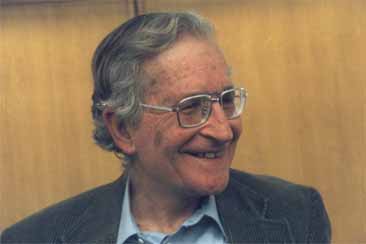
In this 89-minute lecture Noam Chomsky concentrates on his primary scholarly field of Linguistics. He explains his revolutionary theory of Universal Grammar alongwith the philosophical implications inherent in his proposal as well as a heavy helping of Chomsky’s illuminating asides. He even talks about the ape, Coco, who some researchers unsuccessfully tried to teach sign language. For those less familiar with his Linguistic side this talk is a capable summary.
Noam Chomsky: Linguistics & Philosophy (April 12, 1995) 89 mins
Saturday, January 19, 2008
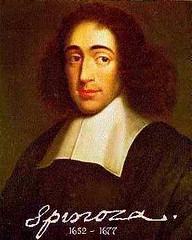
Giants of Philosophy: Baruch Spinoza (Full Audiobook)
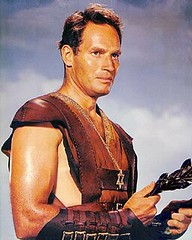
"I do not know how to teach philosophy without becoming a disturber of established religion."
"I call him free who is led solely by reason. "
"I have striven not to laugh at human actions, not to weep at them, nor to hate them, but to understand them. "-- Baruch Spinoza (1632-1677)
Historian Will Durant once said you must first become a Spinozist before becoming a philosopher. Baruch Spinoza applied the rules of logic to the human experience in ways no other thinker had before. He gave us an airtight rational method of thought which resembles mathematical proofs, and after his contributions the mind, social organization and, most importantly, God would never be viewed in the same way again. Spinoza's brand of Western pantheism seduced both men of science, Einstein being the most renown, and starry-eyed poets like Goethe. Here, Chuck Heston of "Damn Dirty Apes" fame leads us through this simple philosopher's life and penetrating ideas with crystal clarity.
Friday, December 07, 2007
Find Happiness Through Philosophy
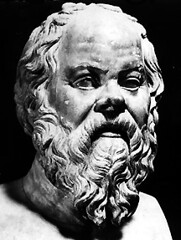
Socrates on Self-Confidence
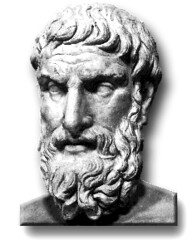
Epicurus on Happiness (Episode 2)
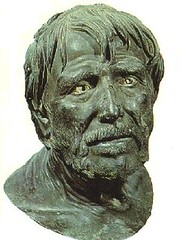
Seneca on Anger (Episode 3)
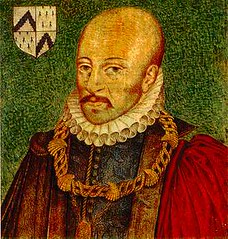
Montaigne on Self-Esteem (Episode 4)
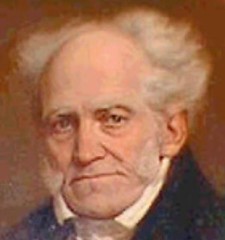
Schopenhauer on Love (Episode 5)
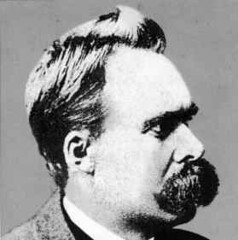
Nietzche on Hardship (Episode 6)
Subscribe to:
Posts (Atom)
