
World's Biggest Corporation is a Welfare Queen
Wal-Mart Has Received More Than $1 Billion in Economic Development Subsidies
(View Source)
Wal-Mart, the world's largest retailer, has benefited from more than $1 billion in economic development subsidies from state and local governments across the United States, according to a new study by Good Jobs First, a Washington, DC-based research center.The study is freely available at www.goodjobsfirst.org. For the executive summary, click here (PDF format).
"Wal-Mart presents itself as an entrepreneurial success story, yet it has made extensive use of tax breaks, free land, cash grants and other forms of public assistance," said Philip Mattera, research director of Good Jobs First and principal author of the study.
The study found more than 240 cases in which the construction of a new Wal-Mart facility was assisted by taxpayers. Apart from 160 retail outlets, the study found subsidies at 84 distribution centers, representing more than 90% of the network of huge warehouses Wal-Mart has built to facilitate its expansion. Mattera stressed that the $1 billion figure is necessarily an understatement, given that public disclosure of subsidies is severely limited.
The value of subsidies for individual distribution centers ranged as high as $48 million (with an average of $7.4 million), while for retail outlets the largest was $12 million (average: $2.8 million). Subsidy deals were found in 35 states, with the most in California, Illinois, Missouri, Texas and Mississippi. In dollar terms, Louisiana, Florida and New York also ranked high.
"That a company with $9 billion in profits can wrest subsidies from state and local governments shows that the candy store game is out of control," said Greg LeRoy, executive director of Good Jobs First. "The subsidies to Wal-Mart are particularly troubling, given that it uses taxpayer dollars to create jobs that tend to be poverty-wage, part-time and lacking in adequate healthcare benefits."
The study recommends that states prohibit subsidies to retailers except in distressed areas that lack adequate retail outlets for necessities such as food. It also recommends that any retailer -- like any corporation -- receiving subsidies should be required to pay a living wage.
----------------------------
Good Jobs First is a non-profit research center promoting corporate and government accountability in economic development.
Friday, October 17, 2008
World's Biggest Corporation is a Welfare Queen


Saturday, October 04, 2008
Big Rattle in Seattle
Direct action video about the protests in Seattle against the World Trade Organisation conference in September 1999. Provides front line coverage of the anti-capitalist and globalisation demonstration, and interviews with participants.
Big Rattle in Seattle

Friday, October 03, 2008
The Miami Model
Indymedia activists shot hundreds of hours documenting the 2003 FTAA (Free Trade Area of the Americas) protests in Miami and shaped it into a documentary that cuts through the mass media blackout to reveal the brutal repression and assault on civil liberties that took place, as well as the inspiring alternatives to capitalist globalization that were also in full effect in Miami.
Wednesday, July 23, 2008
Racism
Racism
- a talk given by Trish on October 19, 1994
(View Original)Any discussion of Racism needs to examine the roots of Racism in order to understand it and to struggle against it effectively. There are basically 3 explanations for the existence of racism.
The dominant view which is rarely expressed as a worked out theory but rather operates at the level of assumptions is that racism is an irrational response to difference which cause some people with white skin to have hateful attitudes to people with black skin which sometimes leads to violent and evil actions. People who have this understanding of racism advocate awareness and education as a way of preventing the practice of racism.
The second view is that racism is endemic in white society and that the only solution is for black people to organise "Themselves separately from whites " in order to defend themselves and to protect their interests.
The third view and the one which I am advocating is an explanation of racism based on a materialist perspective, which views racism as a historically specific and materially caused phenomenon. Racism is a product of capitalism. It grew out of early capitalisms' use of slaves for the plantations of the new world, it was consolidated in order to justify western and white domination of the rest of the world and it flourishes today as a means of dividing the working class between insiders and outsiders, native and immigrants and settled and Travellor in the Irish context.
It is necessary to examine the underlying assumptions about racism in more detail in order to arrive at the materialist analysis of it. Racism is commonly assumed to be as old as society itself. However this does not stand up to historical examination. Racism is a particular form of oppression: discrimination against people on the grounds that some inherited characteristic, for example, colour, makes them inferior to their oppressors.
However, historical references indicate that class society before capitalism was able, on the whole, to do without this particular form of oppression. Bad as the society of classical Greece and Rome were it is historically pretty well proven that the ancient Greeks and Romans knew nothing about race. Slaves were both black and white and in fact the majority of slaves were white. The first clear evidence of racism occurred at the end of the 16th century with the start of the slave trade from Africa to Britain and to America.
CLR James Modern Politics writes that 'the conception of dividing people by race begins with its slave trade. Thus this (the slave trade) was so shocking, so opposed to all the conceptions of society which religious and philosophers had . . .the only justifications by which humanity could face it was to divide people into races and decide that Africans were an inferior race"
So racism was formed as an attempt to justify the most appalling and inhuman treatment of black people in the time of the greatest accumulation of material wealth the world had seen until then.
By the end of the 17th century, racism had become an established, systematic and conscious justification for the most degrading forms of slavery.
The justification of slavery by an ideology of racism started to fade under attack by abolotionists and with the decline of the slave trade. Racism, however took on a new form as a justification for the ideology of imperialism. This racism of empire was dominant for over a century from the 1840's on. Concepts such as the "white man's burden" became fashionable especially in England where British Colonialists liked to cast themselves as father and mother with a clear duty to take responsibility for the material and spiritual well-being of their 'colonial' children. Racism became the ideological justification of capitalism's expansion into conquering countries, plundering their wealth and exploiting the natives.
When white imperialism was at its height, a new expression of racism was taking shape - that is anti-immigrant racism which was typified in England by racist opposition to new immigrants from Ireland. The expansion of capitalism required the importation of foreign workers, a trend which continued in industrialised European countries and in America and Australia up to the 1980's. The long boom of British capitalism after the 2nd world war, for example, encouraged the immigration of West Indians and Asians to Britain. These so called foreign workers provided the employers with the basis for encouraging a split within the workforce.
The same happened in Germany with the immigration of Turkish workers, and the same kind of anti-immigrant agitation emerged in many other European countries and is the main focus of racism in these countries today. Racial attacks on non-white immigrants and on Gypsies have become almost commonplace in parts of Germany and in England. This form of racism has been fueled by economic crisis and by capitalism's need to find a convenient scapegoat for unemployment, housing shortages and every other problem which the current crisis of capitalism has thrown up. Immigration controls, and racist anti-immigration laws have grown up in response to this expression of racism.
On this point, people should be aware that Ireland has the worst immigrant laws in Europe and that they are specifically racist and have been used to exclude non-whites and Jews from this country on many occasions.
Racism and anti semitism
Anti semitism is generally considered to be a variety of racism. It has taken different forms over the centuries, being justified on religious grounds during the middle ages, for example. Ruth Benedict argues "during the middle ages persecutions of the Jews, like all medieval persecutions were religious rather than racial. As racist persecutions replaced religious persecutions in Europe, however, the inferiority of the Jew became that of race".
As recent anti semitism took hold in Europe in the 1890's, Jews started to be attacked not for what they did but for what their forefathers were. This is what racial anti-semitism means. This kind of anti-semitism found an echo in some parts of the working class where Jews were identified as capitalist parasites and userors even though the reality in Britain, anyway, was that most Jews were in fact workers. Racial anti-semitism was a useful way to deflect attacks for the real problems created by capitalism in general.
Facism
Anti semitism and racism are not an essential component of fascism which is essentially a mass movement of the middle class and petit bourgeois built in periods of defeat for the working class when even the most basic trade union organisation is a threat to profits of capital.
In Italy, for example, Jews were encouraged to join the fascist party in its early days.
In Germany, however, the economic condition were ripe for the growth of anti semitism. Leon argues that "the economic catastrophe of 1929 threw the petty bourgeois masses into a hopless situation . . . the petty bourgeois regarded their Jewish competitors with growing hostility." Jewish capital was attacked by the Nazis which appealed to the anti-capitalist instinct of German workers and support for Hitler's Nazi Party rocketed. Anti Semitism was also an important part of a Nazi racial philosophy which justified 'Aryan' supremacy and the need to develop 'Aryan' racial purity.
The Nazi holocaust in which 6 million Jews were murdered alongside an equal number condemned either as political opponents of Hitler or as members of other 'inferior' groups such as Slavs, gays, Gypsies and the mentally ill represented racism and capitalism in their most extreme and barbarous form.
Race and Culture The concept of race or racial difference is essentially an artificial one as all of humanity is actually the one race. In recent times, the concept of culture has been used to discriminate against groups of people when racial discrimination was officially outlawed.
Culture is essentially the way that different group of people acquire a particular world view, a way of making sense of the world from particular social, economic, environmental and demographic conditions. Cultures are not static, they change all the time in response to a wide variety of factors.
Racists sometimes argue "I have nothing against Asians or Blacks as people, it's just that their culture is incompatible with the British/German/French way of life." This is a nonsense argument as all groups of people have a culture and their culture is an essential part of what they are as is their skin colour. Likewise, some anti-racist work especially in schools adopts a "colour blind" approach to the issue and introduce pupils to the more exotic and acceptable aspects of non-white culture while ignoring the materialist nature of racism. This is known as the "saris and samosas" style of anti-racist work and is obviously of very limited use.
Racism which is focussed on a hatred of another groups culture, as it is in the case of Travellors and Gypsies, is sometimes harder to identify clearly as racism because the victims are sometimes white. However, the power relationship which is one of domination and oppression is the key to identifying the reality of racism in these situations.
Response and strategies for fighting racism
The strategies adopted to fight racism depend on the analysis. They basically break down into reformist strategies and revolutionary ones.
The American experience illustrates some of the strategies that have been used. Militant civil rights campaigns such as those which took place in the 1960's in America with leaders such as Martin Luther King succeeded in gaining basic civil rights for black and in forcing the dismantling of the worst forms of institutional racism. It involved mass civil disobedience and voter registration campaigns.
However, the leaders of the movement were middle class with no concept of the need for working class unity. Although many very worthwhile reforms were won, racism remained very mush part of American society. Another more radical strategy associated with Malcolm X was that of black nationalism and black separatism. Racism is defined as endemic to white so like that of the unemployed in the fifties. The Irish National Organisiation of the Unemployed is entirely dominated by Union hacks, poverty pimps, CV tripers and time servers.
We should not be entirely pessemistic. We know that things can change quick, fast and in a hurry. The massive mobilisiation in the case of the autorney general Versus the X case and the climbdown it caused is ample proof of this. We can't afford to throw up our hands and give up on activism. We must not retreat into the realmhe roots of racism in this strategy.
As revolutionaries, we recognise the material basis of racism and its use under capitalism to divide workers, set foreign workers against natives and to provide convenient scapegoats for all the problems capitalism produces. It can only be defeated by a class based strategy which aims to unite non-white and white workers in a struggle for anarchism.
Finally, it is important for us to be aware of the devastating effects of racism at a personal and at a community level. To be black, Asian, a Travellor or a member of an ethnic or cultural minority in most Western countries is a debilitating experience.
Racism shatters individuals self confidence and self image and leads to poor mental and physical health. It can destroy communities subjected to it as it almost has done in the case of Native Americans and Australian Aborigines, for example.
For this reason, it is important to challenge individual acts of racism when we come across them as well as campaigning politically against it.
Wednesday, July 02, 2008
The Bin Man (Garbage Collector)
'Who will do the dirty work?'
(Socialist Standard March 2002)
What would you do if you grew tired of a successful career as a salesman, earning lots of money as you persuade people to part with their readies for things they probably didn't want? Would you fake a smile and carry on, hating every minute of it but realising your suffering puts bread on your kids' table? Probably. One man in my home town did something else. He quit that job and became a dustbin man.
He is quite an energetic guy. He doesn't walk at all, he runs with the bins. Danish labour legislation has thankfully forbidden the old-style bins, without wheels, and law requires easy access to them for the binmen. No more busted backs or falling over gnomes. He and his fellow refuse workers get their job done in next to no time, which means our hero gets lots of hours for canoeing, his favourite hobby. He likes the outdoor life, the pace of the job, feels much happier, and is not concerned that his wage packet is smaller. Whilst it is a physically demanding job, he claimed the sales job was pretty demanding due to the mental tedium of waiting about for the next hard sell.
This little news story was one of those light relief space fillers we have grown accustomed to. However, it was by far the most interesting thing on the news that evening. It raises some intriguing points.
The reporter couldn't understand why someone would turn their back on a big wage placket and become, "of all things" a binman. Why should refuse work be deemed less worthy than salesmanship? Why should anyone have to be asked, and justify, why they want to be a binman? A bin in summer can have a nasty, ripe smell, and it is obvious that public health requires, amongst other things, a clean environment – nothing could be worse than your Nan being plagued by rats, after all. What useful social function does a salesman have? None really, if you think about it. Salesmen are out to sell a product. Once the product is sold, the outlays are paid for and a tidy, little sum is netted in profit for the product's pre-sale owner, who is probably wise enough to use another brand and who isn't the salesman. Salesmen are only necessary in capitalism.
A salesman is, or so it goes, more educated than a binman. There is a social stigma attached. Only Dumbo empties bins. (Our hero is not a Dumbo of course.) It is a rotten snobbishness that overlooks a variety of things. The unemployed watching the news that night would jump at the chance to get a job. Perhaps some of them might be inspired to try a refuse job, even though the thought of rotting chicken and cat crap turns their stomachs. But then they could always change their job to salesmanship if they grow tired of bins, right? You see, what we want to do is pretty much irrelevant. You are employed only if you are exploitable. Jobs are plentiful in booms but come a slump you are put on the dole. You might get tons of papers from school, but does that mean you will get the job you want (and if you do, will the work conditions rapidly change your expectations); or even get educated? In any case schooling does not equate with education.
Hopefully our hero will continue to enjoy his job. Of course the Aarhus refuse workers' strike some five years ago reveals the true nature of work in capitalism. There is a ceaseless struggle between capitalists seeking to up the tempo of work and reduce wages (in these days of permanent inflation, all they need do is freeze wages and workers will feel the pinch) and workers seeking to get their own back (by smoking on the WC and stealing the toilet roll) or organising to improve conditions and pay.
Work should not really be equated with employment. Work will be an essential part of life in socialism; it will be a part of the individual's development and a necessary, healthy expenditure of energy. Employment is wage labour (the ability to work is a commodity the workers are forced to sell – we are all "salesmen" in reality), commodity production instead of production solely for use. As such it has alienating factors associated with it; e.g. Monday to Friday is "their" time, whilst the weekend is your time, where you can enjoy working in the garden or painting. Employment is based on the division of labour. The upshot being workers are tied to one job for years on end, instead of being people able to do all kinds of things, which socialist society – run by conscious decisions instead of blind forces – will allow. (Of course it is a moot point as to how far the division of labour can be removed from socialism; not every one can have the steady hand and requisite knowledge of a surgeon.)
One of the strangest objections to socialism is "who will do the dirty work?" The man of this piece was not entirely motivated by cash. His sales job made him miserable; he loves his new job. We can speculate that there will be people willing to do dirty work in socialism. The hours required will be considerably reduced as the waste of unemployment and salesmanship, amongst many other occupations, will not exist in the moneyless, free access society of socialism; there will simply be more hands to do the unpleasant but necessary stuff. The objector is always a bit strange: "I don't want to live in a world without war and starvation, and where my needs are satisfied, if it means I have to do dirty work once a week." ?! Socialism can do lots of things, but not make crap smell of roses; that is one little fact of life we'll have to put up with.

Monday, May 19, 2008
Capitalism in miniature
Typically, I try not to be regional with my news, but this is an exception. In Northeast Wisconsin there's a popular pizzeria called "Sammy's Pizza" located next to the legendary Lambeau Field. Their pizza, to put it mildly, is a staple of the area. People love Sammy's. However, recently I've learned this business has been steadily raising their menu prices (even before $100-plus barrels of oil) and slashing workers' benefits and wages, all the while the owners purchase gaudy jewelry and buy some of the most gorgeous mansions in the wealthiest neighborhoods.
This information comes from my brother, an employee of Sammy's Pizza for 7 years. He discovered the company hired a person two months prior and had been given a higher wage than him. He confronted his boss.
Now, Sammy's employees do not get health or dental insurance. They only receive a week of vacation regardless of how long they've worked for the company (in some cases, just under two decades) and management steals a portion of the waitress' tips. My brother demanded an adequate increase in his wage along with an extra week of vacation. The boss refused, resorting to intimidation. He pointed to a stack of applications and told my brother he was replaceable. This is untrue, and the manager knew it. Over the course of 7 years my brother had been training new employees, became the night lock-up manager, became one of only a handful of trusted employees who were allowed to make Sammy's famous sauce, obtained his bartending license and had only called in sick once. Still, the boss refused to meet his demands. According to the manager, he was buying a commodity (my brother's labor) and wasn't going to get anything more from a wage increase. The problem, clearly, to even the most cynical observer is that Sammy's needed to catch up to my brother's acquired skills and compensate him for those skills.
This is far from Sammy's first time using worker intimidation. On at least one occasion the manager had shouted across the kitchen that every worker was expendable. Another time, an employee of over 10 years had bought a restaurant of her own. When she told management about her business venture and gave them her two week notice they fired her on the spot saying she was now "the competition". The next day when a local newspaper ran a story about the ex-employee's new restaurant Sammy's clipped every mention of the new business out of each issue.
Between high prices and low wages the family who owns Sammy's lives handsomely off their profits. They own some of the finest jewelry, flashiest cars and choicest property. On the other hand, my brother had been sick for two days before confronting his boss. He told his boss in a moment of complete candor that he couldn't afford to see a doctor on the meager health insurance he was forced to buy due to the pittance the company paid. This did not change the manager's mind. My brother was offered one last deal. He would be promoted to supervisor only if he would conduct surveillance on all the other employees. Let the owners know if anyone steals or isn't working hard enough. My brother denied the offer and turned in his two week notice.
Moments after leaving the manager's office my brother started letting every employee at Sammy's know how badly they are being treated. Four more people are quitting in the following weeks, leaving only one longtime worker left. Everyone who lives in Northeast Wisconsin, I urge you not to tolerate this type of draconian labor practices. Let Sammy's Pizza know you have solidarity with these workers. And please do not patronize their restaurant any longer.
Friday, April 11, 2008
The Capitalist System
THE CAPITALIST SYSTEM
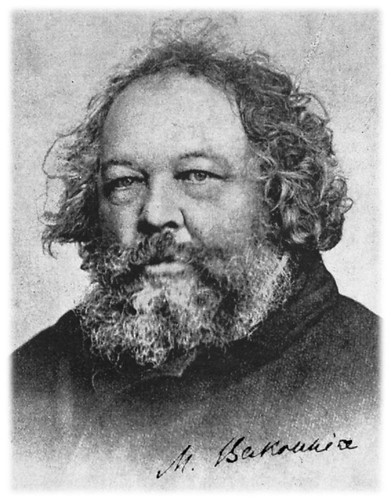
by Michael Bakunin
This pamphlet is an excerpt from The Knouto-Germanic Empire and the Social Revolution and included in The Complete Works of Michael Bakunin under the title "Fragment." Parts of the text were originally translated into English by G.P. Maximoff for his anthology of Bakunin's writings, with missing paragraphs translated by Jeff Stein from the Spanish edition, Diego Abad de Santillan, trans. (Buenos Aires 1926) vol. III, pp. 181-196.
Is it necessary to repeat here the irrefutable arguments of Socialism which no bourgeois economist has yet succeeded in disproving? What is property, what is capital in their present form? For the capitalist and the property owner they mean the power and the right, guaranteed by the State, to live without working. And since neither property nor capital produces anything when not fertilized by labor - that means the power and the right to live by exploiting the work of someone else, the right to exploit the work of those who possess neither property nor capital and who thus are forced to sell their productive power to the lucky owners of both. Note that I have left out of account altogether the following question: In what way did property and capital ever fall into the hands of their present owners? This is a question which, when envisaged from the points of view of history, logic, and justice, cannot be answered in any other way but one which would serve as an indictment against the present owners. I shall therefore confine myself here to the statement that property owners and capitalists, inasmuch as they live not by their own productive labor but by getting land rent, house rent, interest upon their capital, or by speculation on land, buildings, and capital, or by the commercial and industrial exploitation of the manual labor of the proletariat, all live at the expense of the proletariat. (Speculation and exploitation no doubt also constitute a sort of labor, but altogether non-productive labor.)
I know only too well that this mode of life is highly esteemed in all civilized countries, that it is expressly and tenderly protected by all the States, and that the States, religions, and all the juridical laws, both criminal and civil, and all the political governments, monarchies and republican - with their immense judicial and police apparatuses and their standing armies - have no other mission but to consecrate and protect such practices. In the presence of these powerful and respectable authorities I cannot even permit myself to ask whether this mode of life is legitimate from the point of view of human justice, liberty, human equality, and fraternity. I simply ask myself: Under such conditions, are fraternity and equality possible between the exploiter and the exploited, are justice and freedom possible for the exploited?
Let us even suppose, as it is being maintained by the bourgeois economists and with them all the lawyers, all the worshippers and believers in the juridical right, all the priests of the civil and criminal code - let us suppose that this economic relationship between the exploiter and the exploited is altogether legitimate, that it is the inevitable consequence, the product of an eternal, indestructible social law, yet still it will always be true that exploitation precludes brotherhood and equality. It goes without saying that it precludes economic equality. Suppose I am your worker and you are my employer. If I offer my labor at the lowest price, if I consent to have you live off my labor, it is certainly not because of devotion or brotherly love for you. And no bourgeois economist would dare to say that it was, however idyllic and naive their reasoning becomes when they begin to speak about reciprocal affections and mutual relations which should exist between employers and employees. No, I do it because my family and I would starve to death if I did not work for an employer. Thus I am forced to sell you my labor at the lowest possible price, and I am forced to do it by the threat of hunger.
But - the economists tell us - the property owners, the capitalists, the employers, are likewise forced to seek out and purchase the labor of the proletariat. Yes, it is true, they are forced to do it, but not in the same measure. Had there been equality between those who offer their labor and those who purchase it, between the necessity of selling one's labor and the necessity of buying it, the slavery and misery of the proletariat would not exist. But then there would be neither capitalists, nor property owners, nor the proletariat, nor rich, nor poor: there would only be workers. It is precisely because such equality does not exist that we have and are bound to have exploiters.
This equality does not exist because in modern society where wealth is produced by the intervention of capital paying wages to labor, the growth of the population outstrips the growth of production, which results in the supply of labor necessarily surpassing the demand and leading to a relative sinking of the level of wages. Production thus constituted, monopolized, exploited by bourgeois capital, is pushed on the one hand by the mutual competition of the capitalists to concentrate evermore in the hands of an ever diminishing number of powerful capitalists, or in the hands of joint-stock companies which, owing to the merging of their capital, are more powerful than the biggest isolated capitalists. (And the small and medium-sized capitalists, not being able to produce at the same price as the big capitalists, naturally succumb in the deadly struggle.) On the other hand, all enterprises are forced by the same competition to sell their products at the lowest possible price. It [capitalist monopoly] can attain this two-fold result only by forcing out an ever-growing number of small or medium-sized capitalists, speculators, merchants, or industrialists, from the world of exploiters into the world of the exploited proletariat, and at the same time squeezing out ever greater savings from the wages of the same proletariat.
On the other hand, the mass of the proletariat, growing as a result of the general increase of the population - which, as we know, not even poverty can stop effectively - and through the increasing proletarianization of the petty-bourgeoisie, ex-owners, capitalists, merchants, and industrialists - growing, as I have said, at a much more rapid rate than the productive capacities of an economy that is exploited by bourgeois capital - this growing mass of the proletariat is placed in a condition wherein the workers are forced into disastrous competition against one another.
For since they possess no other means of existence but their own manual labor, they are driven, by the fear of seeing themselves replaced by others, to sell it at the lowest price. This tendency of the workers, or rather the necessity to which they are condemned by their own poverty, combined with the tendency of the employers to sell the products of their workers, and consequently buy their labor, at the lowest price, constantly reproduces and consolidates the poverty of the proletariat. Since he finds himself in a state of poverty, the worker is compelled to sell his labor for almost nothing, and because he sells that product for almost nothing, he sinks into ever greater poverty.
Yes, greater misery, indeed! For in this galley-slave labor the productive force of the workers, abused, ruthlessly exploited, excessively wasted and underfed, is rapidly used up. And once used up, what can be its value on the market, of what worth is this sole commodity which he possesses and upon the daily sale of which he depends for a livelihood? Nothing! And then? Then nothing is left for the worker but to die.
What, in a given country, is the lowest possible wage? It is the price of that which is considered by the proletarians of that country as absolutely necessary to keep oneself alive. All the bourgeois economists are in agreement on this point. Turgot, who saw fit to call himself the ..virtuous minister' of Louis XVI, and really was an honest man, said:
"The simple worker who owns nothing more than his hands, has nothing else to sell than his labor. He sells it more or less expensively; but its price whether high or low, does not depend on him alone: it depends on an agreement with whoever will pay for his labor. The employer pays as little as possible; when given the choice between a great number of workers, the employer prefers the one who works cheap. The workers are, then, forced to lower their price in competition each against the other. In all types of labor, it necessarily follows that the salary of the worker is limited to what is necessary for survival." (Reflexions sur la formation et la distribution des richesses)
J.B. Say, the true father of bourgeois economists in France also said: "Wages are much higher when more demand exists for labor and less if offered, and are lowered accordingly when more labor is offered and less demanded. It is the relation between supply and demand which regulates the price of this merchandise called the workers' labor, as are regulated all other public services. When wages rise a little higher than the price necessary for the workers' families to maintain themselves, their children multiply and a larger supply soon develops in proportion with the greater demand. When, on the contrary, the demand for workers is less than the quantity of people offering to work, their gains decline back to the price necessary for the class to maintain itself at the same number. The families more burdened with children disappear; from them forward the supply of labor declines, and with less labor being offered, the price rises... In such a way it is difficult for the wages of the laborer to rise above or fall below the price necessary to maintain the class (the workers, the proletariat) in the number required." (Cours complet d' economie politique)
After citing Turgot and J.B. Say, Proudhon cries: "The price, as compared to the value (in real social economy) is something essentially mobile, consequently, essentially variable, and that in its variations, it is not regulated more than by the concurrence, concurrence, let us not forget, that as Turgot and Say agree, has the necessary effect not to give to wages to the worker more than enough to barely prevent death by starvation, and maintain the class in the numbers needed."1
The current price of primary necessities constitutes the prevailing constant level above which workers' wages can never rise for a very long time, but beneath which they drop very often, which constantly results in inanition, sickness, and death, until a sufficient number of workers disappear to equalize again the supply of and demand for labor. What the economists call equalized supply and demand does not constitute real equality between those who offer their labor for sale and those who purchase it. Suppose that I, a manufacturer, need a hundred workers and that exactly a hundred workers present themselves in the market - only one hundred, for if more came, the supply would exceed demand, resulting in lowered wages. But since only one hundred appear, and since I, the manufacturer, need only that number - neither more nor less - it would seem at first that complete equality was established; that supply and demand being equal in number, they should likewise be equal in other respects. Does it follow that the workers can demand from me a wage and conditions of work assuring them of a truly free, dignified, and human existence? Not at all! If I grant them those conditions and those wages, I, the capitalist, shall not gain thereby any more than they will. But then, why should I have to plague myself and become ruined by offering them the profits of my capital? If I want to work myself as workers do, I will invest my capital somewhere else, wherever I can get the highest interest, and will offer my labor for sale to some capitalist just as my workers do.
If, profiting by the powerful initiative afforded me by my capital, I ask those hundred workers to fertilize that capital with their labor, it is not because of my sympathy for their sufferings, nor because of a spirit of justice, nor because of love for humanity. The capitalists are by no means philanthropists; they would be ruined if they practiced philanthropy. It is because I hope to draw from the labor of the workers sufficient profit to be able to live comfortably, even richly, while at the same time increasing my capital - and all that without having to work myself. Of course I shall work too, but my work will be of an altogether different kind and I will be remunerated at a much higher rate than the workers. It will not be the work of production but that of administration and exploitation.
But isn't administrative work also productive work? No doubt it is, for lacking a good and an intelligent administration, manual labor will not produce anything or it will produce very little and very badly. But from the point of view of justice and the needs of production itself, it is not at all necessary that this work should be monopolized in my hands, nor, above all, that I should be compensated at a rate so much higher than manual labor. The co-operative associations already have proven that workers are quite capable of administering industrial enterprises, that it can be done by workers elected from their midst and who receive the same wage. Therefore if I concentrate in my hands the administrative power, it is not because the interests of production demand it, but in order to serve my own ends, the ends of exploitation. As the absolute boss of my establishment I get for my labor ten or twenty times more than my workers get for theirs, and this is true despite the fact that my labor is incomparably less painful than theirs.
But the capitalist, the business owner, runs risks, they say, while the worker risks nothing. This is not true, because when seen from his side, all the disadvantages are on the part of the worker. The business owner can conduct his affairs poorly, he can be wiped out in a bad deal, or be a victim of a commercial crisis, or by an unforeseen catastrophe; in a word he can ruin himself. This is true. But does ruin mean from the bourgeois point of view to be reduced to the same level of misery as those who die of hunger, or to be forced among the ranks of the common laborers? This so rarely happens, that we might as well say never. Afterwards it is rare that the capitalist does not retain something, despite the appearance of ruin. Nowadays all bankruptcies are more or less fraudulent. But if absolutely nothing is saved, there are always family ties, and social relations, who, with help from the business skills learned which they pass to their children, permit them to get positions for themselves and their children in the higher ranks of labor, in management; to be a state functionary, to be an executive in a commercial or industrial business, to end up, although dependent, with an income superior to what they paid their former workers.
The risks of the worker are infinitely greater. After all, if the establishment in which he is employed goes bankrupt, he must go several days and sometimes several weeks without work, and for him it is more than ruin, it is death; because he eats everyday what he earns. The savings of workers are fairy tales invented by bourgeois economists to lull their weak sentiment of justice, the remorse that is awakened by chance in the bosom of their class. This ridiculous and hateful myth will never soothe the anguish of the worker. He knows the expense of satisfying the daily needs of his large family. If he had savings, he would not send his poor children, from the age of six, to wither away, to grow weak, to be murdered physically and morally in the factories, where they are forced to work night and day, a working day of twelve and fourteen hours.
If it happens sometimes that the worker makes a small savings, it is quickly consumed by the inevitable periods of unemployment which often cruelly interrupt his work, as well as by the unforeseen accidents and illnesses which befall his family. The accidents and illnesses that can overtake him constitute a risk that makes all the risks of the employer nothing in comparison: because for the worker debilitating illness can destroy his productive ability, his labor power. Over all, prolonged illness is the most terrible bankruptcy, a bankruptcy that means for him and his children, hunger and death.
I know full well that under these conditions that if I were a capitalist, who needs a hundred workers to fertilize my capital, that on employing these workers, all the advantages are for me, all the disadvantages for them. I propose nothing more nor less than to exploit them, and if you wish me to be sincere about it, and promise to guard me well, I will tell them:
"Look, my children, I have some capital which by itself cannot produce anything, because a dead thing cannot produce anything. I have nothing productive without labor. As it goes, I cannot benefit from consuming it unproductively, since having consumed it, I would be left with nothing. But thanks to the social and political institutions which rule over us and are all in my favor, in the existing economy my capital is supposed to be a producer as well: it earns me interest. From whom this interest must be taken - and it must be from someone, since in reality by itself it produces absolutely nothing - this does not concern you. It is enough for you to know that it renders interest. Alone this interest is insufficient to cover my expenses. I am not an ordinary man as you. I cannot be, nor do I want to be, content with little. I want to live, to inhabit a beautiful house, to eat and drink well, to ride in a carriage, to maintain a good appearance, in short, to have all the good things in life. I also want to give a good education to my children, to make them into gentlemen, and send them away to study, and afterwards, having become much more educated than you, they can dominate you one day as I dominate you today. And as education alone is not enough, I want to give them a grand inheritance, so that divided between them they will be left almost as rich as I. Consequently, besides all the good things in life I want to give myself, I also want to increase my capital. How will I achieve this goal? Armed with this capital I propose to exploit you, and I propose that you permit me to exploit you. You will work and I will collect and appropriate and sell for my own behalf the product of your labor, without giving you more than a portion which is absolutely necessary to keep you from dying of hunger today, so that at the end of tomorrow you will still work for me in the same conditions; and when you have been exhausted, I will throw you out, and replace you with others. Know it well, I will pay you a salary as small, and impose on you a working day as long, working conditions as severe, as despotic, as harsh as possible; not from wickedness - not from a motive of hatred towards you, nor an intent to do you harm - but from the love of wealth and to get rich quick; because the less I pay you and the more you work, the more I will gain."
This is what is said implicitly by every capitalist, every industrialist, every business owner, every employer who demands the labor power of the workers they hire.
But since supply and demand are equal, why do the workers accept the conditions laid down by the employer? If the capitalist stands in just as great a need of employing the workers as the one hundred workers do of being employed by him, does it not follow that both sides are in an equal position? Do not both meet at the market as two equal merchants - from the juridical point of view at least - one bringing a commodity called a daily wage, to be exchanged for the daily labor of the worker on the basis of so many hours per day; and the other bringing his own labor as his commodity to be exchanged for the wage offered by the capitalist? Since, in our supposition, the demand is for a hundred workers and the supply is likewise that of a hundred persons, it may seem that both sides are in an equal position.
Of course nothing of the kind is true. What is it that brings the capitalist to the market? It is the urge to get rich, to increase his capital, to gratify his ambitions and social vanities, to be able to indulge in all conceivable pleasures. And what brings the worker to the market? Hunger, the necessity of eating today and tomorrow. Thus, while being equal from the point of juridical fiction, the capitalist and the worker are anything but equal from the point of view of the economic situation, which is the real situation. The capitalist is not threatened with hunger when he comes to the market; he knows very well that if he does not find today the workers for whom he is looking, he will still have enough to eat for quite a long time, owing to the capital of which he is the happy possessor. If the workers whom he meets in the market present demands which seem excessive to him, because, far from enabling him to increase his wealth and improve even more his economic position, those proposals and conditions might, I do not say equalize, but bring the economic position of the workers somewhat close to his own - what does he do in that case? He turns down those proposals and waits. After all, he was not impelled by an urgent necessity, but by a desire to improve his position, which, compared to that of the workers, is already quite comfortable, and so he can wait. And he will wait, for his business experience has taught him that the resistance of workers who, possessing neither capital, nor comfort, nor any savings to speak of, are pressed by a relentless necessity, by hunger, that this resistance cannot last very long, and that finally he will be able to find the hundred workers for whom he is looking - for they will be forced to accept the conditions which he finds it profitable to impose upon them. If they refuse, others will come who will be only too happy to accept such conditions. That is how things are done daily with the knowledge and in full view of everyone.
If, as a consequence of the particular circumstances that constantly influence the market, the branch of industry in which he planned at first to employ his capital does not offer all the advantages that he had hoped, then he will shift his capital elsewhere; thus the bourgeois capitalist is not tied by nature to any specific industry, but tends to invest (as it is called by the economists - exploit is what we say) indifferently in all possible industries. Let's suppose, finally, that learning of some industrial incapacity or misfortune, he decides not to invest in any industry; well, he will buy stocks and annuities; and if the interest and dividends seem insufficient, then he will engage in some occupation, or shall we say, sell his labor for a time, but in conditions much more lucrative than he had offered to his own workers.
The capitalist then comes to the market in the capacity, if not of an absolutely free agent, at least that of an infinitely freer agent than the worker. What happens in the market is a meeting between a drive for lucre and starvation, between master and slave. Juridically they are both equal; but economically the worker is the serf of the capitalist, even before the market transaction has been concluded whereby the worker sells his person and his liberty for a given time. The worker is in the position of a serf because this terrible threat of starvation which daily hangs over his head and over his family, will force him to accept any conditions imposed by the gainful calculations of the capitalist, the industrialist, the employer.
And once the contract has been negotiated, the serfdom of the workers is doubly increased; or to put it better, before the contract has been negotiated, goaded by hunger, he is only potentially a serf; after it is negotiated he becomes a serf in fact. Because what merchandise has he sold to his employer? It is his labor, his personal services, the productive forces of his body, mind, and spirit that are found in him and are inseparable from his person - it is therefore himself. From then on, the employer will watch over him, either directly or by means of overseers; everyday during working hours and under controlled conditions, the employer will be the owner of his actions and movements. When he is told: "Do this," the worker is obligated to do it; or he is told: "Go there," he must go. Is this not what is called a serf?
M. Karl Marx, the illustrious leader of German Communism, justly observed in his magnificent work Das Kapital2 that if the contract freely entered into by the vendors of money -in the form of wages - and the vendors of their own labor -that is, between the employer and the workers - were concluded not for a definite and limited term only, but for one's whole life, it would constitute real slavery. Concluded for a term only and reserving to the worker the right to quit his employer, this contract constitutes a sort of voluntary and transitory serfdom. Yes, transitory and voluntary from the juridical point of view, but nowise from the point of view of economic possibility. The worker always has the right to leave his employer, but has he the means to do so? And if he does quit him, is it in order to lead a free existence, in which he will have no master but himself? No, he does it in order to sell himself to another employer. He is driven to it by the same hunger which forced him to sell himself to the first employer. Thus the worker's liberty, so much exalted by the economists, jurists, and bourgeois republicans, is only a theoretical freedom, lacking any means for its possible realization, and consequently it is only a fictitious liberty, an utter falsehood. The truth is that the whole life of the worker is simply a continuous and dismaying succession of terms of serfdom -voluntary from the juridical point of view but compulsory in the economic sense - broken up by momentarily brief interludes of freedom accompanied by starvation; in other words, it is real slavery.
This slavery manifests itself daily in all kinds of ways. Apart from the vexations and oppressive conditions of the contract which turn the worker into a subordinate, a passive and obedient servant, and the employer into a nearly absolute master - apart from all that, it is well known that there is hardly an industrial enterprise wherein the owner, impelled on the one hand by the two-fold instinct of an unappeasable lust for profits and absolute power, and on the other hand, profiting by the economic dependence of the worker, does not set aside the terms stipulated in the contract and wring some additional concessions in his own favor. Now he will demand more hours of work, that is, over and above those stipulated in the contract; now he will cut down wages on some pretext; now he will impose arbitrary fines, or he will treat the workers harshly, rudely, and insolently.
But, one may say, in that case the worker can quit. Easier said than done. At times the worker receives part of his wages in advance, or his wife or children may be sick, or perhaps his work is poorly paid throughout this particular industry. Other employers may be paying even less than his own employer, and after quitting this job he may not even be able to find another one. And to remain without a job spells death for him and his family. In addition, there is an understanding among all employers, and all of them resemble one another. All are almost equally irritating, unjust, and harsh.
Is this calumny? No, it is in the nature of things, and in the logical necessity of the relationship existing between the employers and their workers.
NOTES:
1. Not having to hand the works mentioned, I took these quotes from la Histoire de la Revolution de 1848, by Louis Blanc. Mr. Blanc continues with these words: "We have been well alerted. Now we know, without room for doubt, that according to all the doctrines of the old political economy, wages cannot have any other basis than the regulation between supply and demand, although the result is that the remuneration of labor is reduced to what is strictly necessary to not perish by starvation. Very well, and let us do no more than repeat the words inadvertently spoken in sincerity by Adam Smith, the head of this school: It is small consolation for individuals who have no other means for existence than their labor." (Bakunin)
2. Das Kapital, Kritik der politischen Oekonomie, by Karl Marx; Erster Band. This work will need to be translated into French, because nothing, that I know of, contains an analysis so profound, so luminous, so scientific, so decisive, and if I can express it thus, so merciless an expose of the formation of bourgeois capital and the systematic and cruel exploitation that capital continues exercising over the work of the proletariat. The only defect of this work... positivist in direction, based on a profound study of economic works, without admitting any logic other than the logic of the facts - the only defect, say, is that it has been written, in part, but only in part, in a style excessively metaphysical and abstract... which makes it difficult to explain and nearly unapproachable for the majority of workers, and it is principally the workers who must read it nevertheless. The bourgeois will never read it or, if they read it, they will never want to comprehend it, and if they comprehend it they will never say anything about it; this work being nothing other than a sentence of death, scientifically motivated and irrevocably pronounced, not against them as individuals, but against their class. (Bakunin)
Thursday, March 13, 2008
A rich free-market legacy - for some
 By Henry C K Liu
(View Original)
The financial crisis that broke out in August 2007 has stirred a revival of the latent populism that had been effectively suppressed by blanket anti-left hysteria during the Cold War. Despite residual psycho-political phobia, such indigenous populism has been simmering upward from deep-freeze depths after two decades of debt-driven financial and trade globalization in the post-Cold War era. Globalization of deregulated trade and finance has produced spectacular wealth for an elite minority at the expense of the wage-earning majority even in boom time all over the world.
Income and wealth disparities have been the legacy of free market capitalism, dictated by the call of neo-liberal supply-side economic theory for concentration of wealth to achieve indispensable capital formation. While internationally, the United States has been the clear beneficiary of "free trade" which dilutes the authority of national sovereignty to institute defensive protectionism, stagnant wages in the face of high corporate profits from outsourcing jobs overseas have left US workers in manufacturing worse off than their parents.
Global cross-border wage arbitrage has succeeded in keeping wages low around the world. But the decline in working-class fortune in the US had been masked by an exponential rise is home prices in a debt bubble that provided temporary phantom "wealth effect" to working families suffering the imperceptible real wage decline.
Now with the bursting of the debt bubble, while the culpable financial elite are walking away with equally spectacular severance packages after ringing in billion in market losses, the investing pension funds of helpless workers are unwittingly taking heavy hits and the social service entitlement for the working poor are further squeezed by ruthless corporate restructuring.
Looking for culprits
In a congressional hearing on executive pay held on March 7 by the House Committee on Oversight and Investigations, Republican committee members lined up to defend the extraordinarily high executive pay accumulated during years of handsome corporate profit made possible by the blatant global manipulation of debt.
The Republicans dutifully rationalized that these executives also suffered financial losses in the recent collapse of the debt market, albeit such losses only reduce their departing compensation from high nine figures to low nine figures. No executive has yet been forced to lose their second or third vacation homes, while many working families are forced out of their primary residences by the "bad judgement" of these executives.
The committee chairman, Representative Henry A Waxman, Democrat of California, said in an opening remark: "There seem to be two economic realities operating in our country today. Most Americans live in a world where economic security is precarious and there are real economic consequences for failure. But our nation’s top executives seem to live by a different set of rules. When companies fail to perform, should they give millions of dollars to their senior executives?"
Republicans on the committee reject the very premise of the hearing. Darrell E Issa, Republican of California, asked rhetorically: "This is a hearing in search of bad guys. Are there bad guys in front of me? I’m not seeing it."
Yet while Chuck Prince may not look like a bad guy to Representative Issa, the Citigroup chief executive did tell the Financial Times on July 10 2007, 15 days before the outbreak of the liquidity crisis, that "the party would end at some point but there was so much liquidity it would not be disrupted by the turmoil in the US subprime mortgage market." Prince denied that Citigroup, one of the biggest providers of finance to private equity deals and collateralized debt obligation instruments, was pulling back. "When the music stops, in terms of liquidity, things will be complicated. But as long as the music is playing, you’ve got to get up and dance. We’re still dancing," he said in an interview with the FT in Japan. Things in deed got "complicated" two week later.
Representative Issa failed to understand that if he cannot see "bad guys" among the movers and shakers of the market because they were merely playing according to the rules of the game, then he does not enjoy the luxury of absolving deregulated free market capitalism as the real culprit of massive financial destruction. (Capitalism’s bad apples: It’s the barrel that’s rotten, Asia Times Online, August 1, 2002)
Prince admitted in front of the committee: "Last fall, it became apparent that the risk models which Citigroup, the various rating agencies and the rest of the financial community used to assess certain mortgage backed securities were wrong. As CEO, I was ultimately responsible for the actions of the company, including risk models that eventually proved inadequate."
The error these risk models made was not taking into consideration the possibility of massive market failure, a condition considered too unreal to be taken seriously since it was expected that the Federal Reserve, the nation’s central bank, would step in to keep markets functioning.
In a 1998 testimony before Congress, Greenspan said:
We should note that were banks required by the market, or their regulator, to hold 40% capital against assets as they did after the Civil War, there would, of course, be far less moral hazard and far fewer instances of fire-sale market disruptions. At the same time, far fewer banks would be profitable, the degree of financial intermediation less, capital would be more costly, and the level of output and standards of living decidedly lower. Our current economy, with its wide financial safety net, fiat money, and highly leveraged financial institutions, has been a conscious choice of the American people since the 1930s. We do not have the choice of accepting the benefits of the current system without its costs.The risk of market failure was apparently a conscious choice of monetary policy.
Systemic market failure was alluded to by several witnesses and committee members in the hearing but the issue was deemed out of the jurisdiction of the committee and the particular aim of this hearing, and was categorically brushed aside unanswered.
Tom Davis, the ranking Republican minority member from Virginia, said that even if the executives had been paid nothing, there would still be a housing crisis. And Mr Issa emphasized that all of the executives were primarily rewarded with stock, meaning they have suffered alongside shareholders as the value of financial stocks has plummeted.
Yet it is a commonly known fact that executive compensation tied to annual performance has become an irresistible incentive for top management to take on increased risks for the companies they manage, at the expense of the long-term wellbeing of the company and by extension, of the economy. The system has been designed to push risk to the limit until it fails.
John Finnegan, chairman of Merrill’s compensation committee, when asked why E Stanley O’Neal, former chairman and CEO of Merrill Lynch & Co Inc, was permitted to retire rather than being forced out for cause, replied that if O’Neal had been fired, he would have forfeited the $131 million in stock and options he had earned in prior years. Finnegan added that "cause" involved only unethical behavior, not bad judgment. In other words, the fault was with the system, not the individual who responds to the system’s incentives. "To say you don’t have the tools, it means that even if someone performs badly there are no consequences," Waxman retorted.
Emphasizing that the compensation process at Merrill was "appropriate" and "independent", he said: "It is true that top executives at public companies in the United States, especially in the financial services industry, are highly compensated. But a great percentage of that compensation, certainly for me, was and is at risk. When the business does well, all shareholders do well. But if the business does not do well, the value of that compensation can plummet."
O’Neal of Merrill retained more than $161 million after he "retired" honorably in October on top of the $70 million he took home during his four-year tenure. The bulk of the exit pay was linked to previously earned benefits and exercised stock options. Since his departure was deemed a retirement, O’Neal did not receive any severance pay. Merrill Lynch, meanwhile, had announced write-offs totaling more than $10.3 billion by the time O’Neal left, causing its stock price go into free fall. The write-off was partly funded by profit earned under the four "good" years of O’Neal’s tenure.
Prince of Citigroup collected $110 million while presiding over the evaporation of roughly $64 billion in market capitalization. He left Citigroup in November 2007 with an exit package worth $68 million, including $29.5 million in accumulated stock, a $1.7 million pension, office with an assistant, and a car with driver.
Citigroup’s board also awarded Prince a cash bonus worth about $10 million for 2007, largely based on his performance in 2006 when the bank’s results were better. Citigroup announced write-offs worth roughly $20 billion in 2007 and saw its share plummet over 60% from 2006 high.
Angelo Mozilo of Countrywide had taken home more than $410 million since becoming chief executive in 1999, including several stock sales made under an automatic plan while the company was buying back shares in an apparent conflict of interest. Federal securities regulators are scrutinizing those trades, as is the FBI. And in a report released on March 6, a day before the hearing, congressional investigators found that the use of a flawed peer group and easy bonus targets helped inflate Mozilo’s pay. He also had been entitled to a $37.5 million severance package, though he forfeited that in January, shortly after Congress requested that he testify.
Representative Elijah E Cummings, Democrat from Maryland, noted that, "We’ve got golden parachutes drifting off to the golf course and have people I see every day who are losing their homes and wondering where their kids will do their homework."
And Mozilo, noting that "our stock price appreciated over 23,000%" from 1982 to 2007, said he received performance-based bonuses approved by shareholders and exercised options as he prepared for retirement. "In short, as our company did well, I did well," he said.
Waxman ended the hearing by complimenting the witnesses on their extraordinary individual tales and for their service to their firms. But he added with a straight face, "It seems like everyone is hurting except for you."
No one even on the Democratic side bothered to ask, while working families lost homes that constituted a major part of their total assets accumulated over years of hard work, why these executives who were responsible for such disastrous results should not be made to disgorge their accumulated gains to reimburse the victims of their manipulative perfidy. While populism is in the air, it has obviously not infiltration to congressional committee hearing rooms.
In prepared testimony, Prince focused on his humble beginnings, as the first member of his family to go to college and O’Neal, an African American, revealed that his grandfather was a slave. The two executives personify the admirable socio-economic mobility in the US financial system. Yet one would expect that people of humble origins and minority background to be embedded with sensitivity about the powerlessness of the poor to protect themselves from iniquitous manipulations beyond their comprehension, let alone control. Apparently, social mobility is possible in US society only if one leaves behind one’s populist baggage.
Since last August, when the credit crisis exploded to spread over the entire financial market that now threatens the US economy with a sever recession exacerbated by stagflation that promises to be protracted, populist rhetoric has been growing in volume in the final phase of the year-long presidential nomination campaigns of both political parties, even by the front-running candidates, with an eye to capitalize widespread voter discontent in November.
While the specifics of populist reaction to recurring financial and economic crises over the ages are not congruent, as contentious issues and reactions to them change with evolving new contexts and conditions over time, populism has deep roots in US political and economic history along the theme of the people being unhappy about perpetually getting the short end of the stick from a system run by the elite.
Populism against giantism
Historically, populism in the US emerged as a logical reaction to the emergence over a century ago of industrial capitalism, the abuses of which had left the masses of working people a legacy not much better than slavery. The free market, by not extending itself to include the labor market to equalize market power disparity between capital and labor, has merely commercialized the despicable institution of slavery, despite official emancipation.
Populism began as a movement to actively seek effective government regulation over a pro-capital free market monetary system that discriminated against the weak and the poor through banking monopolies that practiced unequal and unfair distribution of credit, transportation policies that discriminated against small dependent users, particularly with high freight rates that farmers must pay to bring their produce to market, and the unlimited predatory powers of big money trusts and giant market monopolies. The overall populist aim was to limit the growing uneven market power of the combination of big finance and big business.
To achieve this aim, populists realized that common citizens must regain control of the political process to reverse the pervasive influence of big business on government and to restore popular democracy. Both Democrats and Whigs in US political history championed republican principles, but the two parties held conflicting assumptions about the nature of government authority, the correct path to economic development, and true meaning of individual rights. These conflicting assumptions form the ideological struggle behind the sectional conflict that eventually led to the Civil War.
The emphasis on popular democracy by historical populism, with its programs of monetary, financial and political reforms, was resisted by big finance and big business as counterintuitive to the natural needs of modern economic systems and the national security requirement of modern states, let alone the aspiration of a young nation to become a major world power and eventually a superpower.
Yet this utilitarian argument is not supported by historical facts. Economic growth during the Industrial Revolution, and even in today’s sophisticated and complex milieu in the midst of a communication revolution, is driven not by large corporate dinosaurs, but mainly by new small business entrepreneurship through what Austrian economist Joseph Schumpeter (1883-1950) identified as "creative destruction". Alan Greenspan tirelessly applied the concept of "creative destruction" to explain the rise of US market capitalism through internal renewal and the growth in productivity in recent decades.
Yet the concept of "creative destruction" was originally presented by Russian collectivist anarchist Mikhail Alexandrovich Bakunin (1814-76) based on the ideas of Georg Wilhelm Friedrich Hegel (1770-1831) and Karl Marx (1818-1883), whose Communist Manifesto was written with Friedrich Engels (1820-95) in response to the democratic revolutions of 1848.
The case of Microsoft is a perfect modern-day example of a small, home-grown maverick entrepreneur that exploited the growing power of the personal computer through standardization of stand-alone operating system software to outpace IBM, the early giant of the computer age. But in record time Microsoft morphed into a gigantic monster more lethal to technological progress than the monopolistic industrial giants it managed to cut down to size.
An earlier case is Thomas Edison, a self-educated man with little formal scientific education, who gave birth to the modern energy sector not by discovering electricity but by inventing and obtaining a patent for an inexpensive filament for the vacuum light bulb. The Edison Electric Company soon grew into a rapacious monopoly that a century later was broken up by anti-trust legislation into General Electric and Con Edison.
The study of deafness by Alexander Bell, a Scottish immigrant doctor, led him to invent the telephone that became the monopolistic mammoth AT&T, also known as Ma Bell. John D Rockefeller began as a small business accountant and went on to assemble the monopolistic Standard Oil Trust by unfair trade practices. Industrial and financial giants have a long history of creating wealth not from original innovation but by subsequent predatory acquisition of successful smaller competing enterprises.
Further, anti-populist sociologists sponsored by big business argue that with urbanization being a key prerequisite for economic development, the populist ideal of small-town life based on decentralized socio-political organization and local control had been problematic in the age of industrial expansion. By extension, this problem continues into the age of economic and financial globalization that requires suppression of national sovereignty and economic nationalism to facilitate the unimpaired cross-border movement of funds and goods, albeit not of workers.
Yet new advances in communication and data management have made such centralist arguments invalid. Large, complex organizations can now be devised through computerized communication without destroying the individuality of numerous component parts. Mass production of unique one-of-a-kind products is now routinely possible. Decentralized networks of assembly are increasingly practiced for complex products such as aircraft.
For example, the Internet, by providing access to instant communication among countless individuals detached from physical propinquity, has diluted the controlling power of big mass media organizations. The irony is that the privileged and powerful elite have effectively sought refuge from populist threats through the devious exploitation of the constitutional principle of minority rights which originally had been framed for protection of the weak and powerless. The term "minority" was originally intended to denote the less powerful, not merely the smaller number.
Jacksonian populism
The election of 62-year-old populist Andrew Jackson in 1828 as president over incumbent establishmentarian candidate John Quincy Adam (in office 1825-29), son of Federalist president John Adam (in office 1797-1801), the second holder of the nation’s highest office after George Washington (in office 1780-97), marked the revolutionary victory of government by and for the common people, even if, notwithstanding unfounded conservative fear, not quite yet of the people.
The late Arthur Schlesinger Jr (1917-2007), who had been catapulted into instant fame at age 28 by winning the 1945 Pulitzer Prize for his Age of Jackson, and went on to a long, illustrious career as official historiographer of the Kennedy administration, describes that period in US history as one of shifting from sectional conflict to class conflict created by the triumph of the industrial revolution over the agricultural economy. Schlesinger turned history backward to cast Jackson as a reformer in the mold of Franklin D. Roosevelt.
The Jackson-FDR-Kennedy tradition
In a 2006 interview on Public Television, Schlesinger accused Democratic president Bill Clinton (in office 1993-2001) of breaking with the Jackson-FDR-Kennedy liberal tradition of interventionist government to rein in the excesses of market capitalism by adopting neo-liberalism, siding with the Republican ideal of small non-interventionist government. Schlesinger, a quintessential liberal, acknowledged in the interview that the two failures of US liberal capitalism have been unmitigated racial inequality and persistent disparity of income. This criticism was very much on target, albeit that the liberal formula of meliorism had been patently ineffective in correcting these two failures after more than a century of reform.
Schlesinger earlier had accused Noam Chomsky, brilliant linguist and highly respected icon of the intellectual left and activist opponent of the Vietnam War, of "betraying the intellectual tradition", to which Chomsky responded in a 1992 BBC interview by John Pilger by agreeing with undisguised pride, adding that "the intellectual tradition is one of servility to power and if I didn’t betray it I’d be ashamed of myself."
Chomsky added that the members of "the liberal intelligentsia of America are in bed with the US government in some of its more vicious policies around, as they applied around the world." He characterized the liberal intelligentsia of the Kennedy era as "a secular priesthood".
In a February 28, 2007 obituary on Schlesinger written by Douglas Martin, Gore Vidal, a rebellious member of the Democratic aristocracy, was reported to have characterized Schlesinger’s A Thousand Days on the JFK presidency "a political novel". Vidal’s mother, Nina Gore, married Hugh D Auchincloss Jr, later stepfather of Jacqueline Bouvier Kennedy. A fifth cousin of Vidal is Jimmy Carter and a cousin is Al Gore.
Back in the 1824 election, although Jackson received more popular and electoral votes than Adam, neither received a majority in the Electoral College, leaving the final choice of Adam as a minority president being made by the House of Representatives. Four years later, the voice of the people was finally heard with Jackson receiving a plurality in popular vote and a definitive majority of 178 to 83 in electoral votes over incumbent Adam, who lost because of his unresponsive attitude to the rising spirit of popular democracy. It was a replay of the elder Adam’s defeat in 1800 after serving only one term by Thomas Jefferson (in office 1801-09), the father of American popular democracy.
With his background as a leading member of the frontier upper class, Jackson’s personal exposure and innate honesty left him convinced that privileged big business routinely enjoyed the upper hand over the average individual citizen. His main political view was expressed in his farewell address:
Government should be administered for the planter, the farmer, the mechanic and the laborer who form the great body of the people of the United States. These classes all know that their success depends upon their own industry and economy, and that they must not expect to become suddenly rich by the fruits of their toils. Yet they are in constant danger of losing their fair influence as a result of the power which the moneyed interest derived from a paper currency which they are able to control and from the multitude of corporations with exclusive privileges which they have succeeded in obtaining in the different states.Populist battle over banking
In the election of 1832, Jackson won a second term by defeating Henry Clay, the vocal spokesman for US economic nationalism. Clay’s "American System" called for high protective tariff up to 25% to help budding domestic industries, the establishment of a national bank to resist domination by foreign capital and government assistance to private enterprise in the development of a national transportation and communication infrastructure. The main issue in the 1832 campaign was whether the charter of the Second Bank of the United States should be renewed for another 20 years.
The First Bank of the United States had been established by Congress in 1791 as a national bank at the recommendation of Alexander Hamilton, legitimized by the Supreme Court on the doctrine of "implied power" of the Federal government. The Bank had been opposed by Jefferson on constitutional and ideological grounds. Jefferson felt the Bank would give excessive power over the national economy to a small group of private investors who would make unconscionably large profits. He preferred small state banks with moderate inflationary tendency to help small farmers shackled with cyclical debts. He waged his opposition on constitutional grounds that the chartering of it was not specifically authorized by the constitution. But the argument was overruled by the Supreme Court.
In 1811, Congress voted to abandon the First Bank and its charter but the Second Bank was chartered four years later in 1816 to handle sovereign debts from the War of 1812. By 1832, the Second Bank had operated successfully as a national bank to support the development of the US economy for 16 years, providing finance for an economic boom, particularly in agriculture brought about by the devastation of Europe caused by the Napoleonic Wars.
The Second Bank provided easy credit to finance farm land speculation, tripling land prices in a decade. Land sales in 1819 alone totaled over 55 million acres, feeding a speculative bubble froth with fraud. The financial gains of the boom went mostly to speculators rather than farmers. In the summer of 1818, the Bank started to call in loans to reduce risk its exposure and caused the Panic of 1819 that drove many farmers bankrupt from excessive debt.
Although the Bank’s latest charter extension would not expire until 1836, Clay advised the Second Bank to request renewal in the spring of 1832. Clay needed the Second Bank to support his American System of economic nationalism, but he underestimated the unpopularity of the Second Bank throughout the West as a result of the financial crisis of 1819. By preventing the state banks from issuing notes and making loans freely and independently, the Bank limited the supply of money in the Western states and thereby kept their population permanently in debt to Eastern moneyed interests.
But unlike the inflationist farmers, Jackson was not only critical of the concept of a national bank but of the role all banks played in exploiting the financially weak. Jackson believed sound money backed by gold and silver was the only friend of the people as private banks always abuse their power to issue money to encourage and profit from speculation, producing periods of inflation followed inevitably by periods of financial crisis and deflationary depression that would ruin honest citizens trapped by inescapable debt. In their distrust of banks, Jacksonians found validation in ample, visible field evidence, but their resultant faith in specie currency ran against the need of a growing economy for a more elastic currency than could be provided by the comparative static supply of precious metals.
More to the point, Jackson held a populist belief that the concept of a national bank was a threat to popular democracy. His view was validated by the behavior of Nicholas Biddle, a member of the Philadelphian financial elite, who had been president of the Second Bank since 1823, and who, after 1829, with the Jackson White House threatening the future of the Bank, began seeking political support by lending large sums without collateral to key Congressmen and influential newspaper owners and editors without pressing them for repayment.
Jackson then appointed Roger Taney as Treasury Secretary (in office 1833-34) who transferred government funds from the Second Bank of the United States to state banks on ground of the Bank had become a risky institution. The Bank ran on though the remains of its existing charter and restructured as a state banks after the charter expired in 1836.
Tocqueville warning
Alexis de Tocqueville, French sociologist, published Democracy in America in 1836, which observed with clear insight that the "primary fact" behind American democracy was a "general condition of equality". People in America, he observed, were "on a greater equality in point of fortune and intellect, or, in other words, more equal in their strengths than any other country in the world, or any other age of which history has preserved its remembrance."
Tocqueville admired the energy and versatility of the Americans he encountered, their high Protestant moral standards and their willingness and ability to achieve social progress by forming voluntary associations instead of being dependent on government. Such qualities were the natural result of an environment of abundance in which individual self-help could produce a good living without interference from government or private oppression.
Or the other hand, with equal insight, Tocqueville warned of the danger of Americans being pushed into an economic system excessively intent on making money, and that their wholesome founding culture was consequently in danger of being too commercialized. He predicted, with amazing accuracy, that the initial equality among Americans might eventually be endangered by the domination of a new industrialist/financier class.
To Tocqueville, political democracy cannot exist without economic democracy which is always threatened by concentration of wealth. Throughout its history and up to the present time, the disconnection between political democracy and economic democracy remains the weak spot in American society. The problem is not merely a disparity of wealth, but more fundamentally, an unequal gap of opportunities and market power.
The Civil War and big business
Prior to the Civil War which began in July 1861, big business had not enjoyed such clear-cut favoritism from government. The agrarian leaders who controlled the Federal government during 1801 and 1861 had regarded individual property in land as more deserving of government protection than corporate property.
The logic for this belief is that a corporation, by virtue of its nature as an exclusive collection of real persons, is more powerful than any single real person. By granting such an exclusionary collection of select individuals the same protection the Constitution granted to each and every real individual citizen is a distortion of democratic principles of equal protection. It is particularly inequitable when the rights of exclusionary collectivism are protected as the expense of the rights of communal collectivism.
Moreover, the basic raison d’etre of government is its role of protecting the weak, those who could not otherwise protect themselves. Giving powerful corporations the same government protection intended for each powerless private individual separately amounts to a perversion of individual rights as well as the principle of equally before the law, and constitutes a direct threat to the principles of democracy.
After 1835, with Roger Taney (in office 1835-64) appointed by Andrew Jackson (in office 1829-37) to succeed John Marshall as Chief Justice (in office 1801-35), the Supreme Court took a different position to rein in Federalist centralization. Whereas Marshall had extended the "implied power" of the Federal government over the states, Taney ruled to protect those powers of the states that the Constitution had not specifically granted the Federal government, upholding state rights to regulate commerce within their borders and to adopt and enforce economic policies of their own to suit local conditions and traditions for the benefit of citizens within their separate jurisdictions. Whereas Marshal has ruled religiously to uphold the sanctity of contracts and the right of private property, Taney ruled for the right of states to regulate private property rights to promote common welfare.
In 1837, the Charles River Bridge Company, chartered in 1786 by the Commonwealth of Massachusetts, having made enormous profits from tolls on a bridge between Boston and Cambridge, claimed that the terms of its charter forbade the construction of a competitive bridge. The people of Massachusetts authorized a second bridge to relieve traffic congestion and to abolish tolls as the cost of the first bridge had been more than paid for the by its monopolistic tolls. The shareholders of the monopoly brought suit to stop the second bridge.
Taney ruled in an epoch-making decision, declaring that the public interest was more important than the alleged property rights of the private bridge corporation. In his ruling, Taney wrote: "While the rights of private property are sacredly guarded, we must not forget that the community also has rights, and that the happiness and well-being of every citizen depends on their faithful preservation."
Taney died in 1864, the year the Civil War ended, and was replaced by Salmon P Chase, former Treasury Secretary under Lincoln and former leader of the Free Soil Party, which opposed the expansion of slavery into the western territories.
Progress as illegitimate child of politics
Progress is often the illegitimate child of politics. The same ironic metamorphosis would apply to Richard Nixon, lifelong anti-communist, who would be able to achieve as President a historic opening to communist China in 1973 as a grand strategy in superpower geopolitics, after a quarter of a century of ideological estrangement between the two nations, while a similar attempt by a liberal Democrat, such as John F Kennedy, would have to face domestic accusation of being soft on Communism.
It would take anti-abolitionist Abraham Lincoln (in office 1861-1865), who gained attention early in his political career as a pragmatic segregationist cloaked under the high-minded rhetoric of democratic ideals, to finally overcome his previous political rationalization and to make peace with his personal morals to issue the Emancipation Proclamation in 1862.
Lincoln came into national prominence in the Lincoln-Douglas debates during the 1858 Senate campaign by shrewdly trapping his opponent, Stephen A Douglas (1813-1861), into introducing the anti-slavery Freeport doctrine, permitting the new territories to exclude slavery in the name of popular sovereignty. The compromise proposed by Douglas, in spite of the Dred Scott decision by the Taney Supreme Court a year earlier in 1857 ruling that slavery could not constitutionally be excluded from any territory, cost Douglas much popular support, particularly among pro-slavery Southern Democrats, even after his insistence on his personal indifference to the immorality of slavery.
Lincoln, the man who had oppose the exclusion of slavery in the new territories with his perversely righteous and dubiously motivated declaration: "A house divided against itself cannot stand", and who would declare himself to be personally opposed to racial equality, would end up abolishing slavery for the whole nation four years later as a political expedience brought about by a poorly conducted, ongoing civil war, notwithstanding his earlier belief that while "Negroes" should enjoy the right to life, liberty and pursuit of happiness promised to all men by the Declaration of Independence, the extinction of slavery could only be a gradual and lengthy process, with no near-term target date.
American attitude toward the issue of slavery in her history is clouded by a fundamental conflict between its self-image and historical facts. The majority of Americans continue to be abolitionists in public and pro-slavery in private. It shows up in every debate on social issues even today.
War saved the Union, destroyed democracy
The Civil War, which lasted from 1861 to 1865, saved the United States from being partitioned by secession, a fact conveniently overlooked by those in Washington who now support secessionist movements around the world, the latest being the secession of Kosovo from Bosnia.
Still, the Civil War was not followed, as Lincoln had hoped, by fraternal love, mutual forgiveness and reconciliation. Most Southerners at the end of the fighting in 1865 were resigned to the need to accept the supremacy of the Federal government and the abolition of the institution of slavery and to move on to the urgent task of rebuilding their war-torn home region where all the fighting had taken place.
But not withstanding Lincoln’s inspiring words of "with malice towards none; with charity toward all", Southern sentiments of reconciliation were not reciprocated by a hostile North, where an attitude to treat the South as a conquered territory, the root institutions of which required wholesale reconstruction, lasted more than a decade after war ended. It was not until 1877 that the Union was finally restored along a path towards terms that would be both fair and acceptable to the South.
After Appomattox, where Robert E Lee surrendered to Ulysses S Grant on April 9, 1865, with Lincoln assassinated five days later on April 15, the returning Confederate soldiers found their home country in an indescribable state of ruin and disorganization. The communication and transportation infrastructure was totally destroyed by the vengeful armies of Sherman and Sheridan. The final phases of the war had degenerated from a patriotic undertaking on the part of the North to subdue the South’s will to secede, to a frenzied orgy of savage destruction.
The war debt accumulated by the Confederate government that had absorbed all the savings of the South became worthless in defeat and all Southern banks and insurance companies that held such debt instruments were left insolvent.
The devastation of the Southern economy did not end with the war. The Federal Treasury confiscated all properties of the Confederate government. Federal agents, many of whom were dishonest, exploited the confiscation order to loot the Southern agricultural economy to enrich themselves personally while they transferred wealth northward to support the costly transition of the war economy of the North in peace time. With the defeat of the South went the defeat of popular democracy and the triumph of big business corporatism.
