Showing posts with label Labor Movement. Show all posts
Showing posts with label Labor Movement. Show all posts
Monday, September 07, 2009


Sunday, July 26, 2009
What's so great about Agorism?
agora -
n. pl. ag·o·rae (-r
) or ag·o·ras
A place of congregation, especially an ancient Greek marketplace.
As any skinny, ink-spattered punk claiming to be an Anarchist will assert revolutionary violence is the only answer against the toxic tentacles of the state. Albert Einstein, Mohandas K. Gandhi and Martin Luther King Jr. were all woefully wrong. Only the heat from a molotov cocktail or a shattered Starbucks street front window can force Goliath to genuflect. But governments are serpents coiling and squeezing around those who struggle for breath with three heads ready to replace any one that's severed.
From a distance what's a more absurd sight than a handful of hooded vegans taking arms against the largest military power ever amassed. Time to lock away your Schwinns, Mr. & Ms. Anarchist, Lady Liberty is packing heat and she will end you faster than you can say "In God We Trust."
Unless, there's a better way...
In the late '70s and early '80s a germ of an idea wafted through the subterranean corridors of Anarchist philosophy. What if there was a theory of social organization which involved markets that appealed to both the revolutionary left and the revolutionary right. Easier said than done. Right-Libertarians made attempts at reaching across the aisle to their left-wing brothers and sisters for years but alas their arms proved to be much too short. The man responsible for achieving great strides toward bridging this schism was Samuel Edward Konkin III also known as SEK3 on the streets. Konkin devised a concept of Anarchism which brought in the labor-centered, class-intensive focus of the left and married it with the Austrian economics of the right. He named it Agorism after the agora or marketplaces of Ancient Greece.
So, what's so great about Agorism? It recognizes that violence can't be met with violence. Of course by now it's just a cliche but aggression is cyclical. The best way to destroy a rotten idea (i.e. the state) is to replace it with a better one (i.e. voluntary exchange). Never a reformist, SEK3 decided the only logical form this revolution could take would be counter-economic meaning through black and gray markets, barter networks and local currencies. These counter-economies would naturally begin as tiny, grassroots cells then grow organically as they demonstrated they could deliver better quality goods and services cheaper without the burden of state mandated licensure and taxation. Think it's just a pipe dream? Well, think again. Counter-economies existed in the past in the Pacific Northwest in Canada with Indigenous Potlatch Festivals, and are being maintained in the present with Sustainable Communities some of which have their very own monetary system.
Agorism has also refurbished old chestnuts like Marx's and Engels' Class Theory. Everybody knows their views and its faults so they won't be rehashed here. From the ashheap of Marxism, Agorist Class Theory holds on to the two-class divide, yet, where the Communists get a little kookie is when they omit the state as a pestilential force. How odd, it seemed to be right there in front of their noses. The actual partition is between the politically connected and the economically productive. Robber Barons, Military Personnel and Politicians comprise the former while Entrepreneurs and Workers fill the latter. Of course, there are dynamic gradations between the classes all established by one's orientation to the bulbous, dangling teats of the state.
Beyond Agorism's appeal to pragmatism there is a sense of unity between all schools of Anarchist thought as one of its features. Since Anarchism's inception Anarchists haven't even been able to agree on how to change a light bulb let alone agree upon anything else. There are some hardliners on both sides who do readily dismiss this relatively new approach. Little do they realize the serpent cannot be decapitated. Only through non-participation will it eventually starve to death.

Thursday, July 16, 2009
Classical Liberalism and the Fight for Equal Rights
Remembering the forgotten libertarian legacy of American anti-racism
(http://www.reason.com/news/show/134651.html)
In a 1992 speech at Colorado's Metro State College, Columbia University historian Manning Marable praised the black minister and activist Malcolm X for pushing an "uncompromising program which was both antiracist and anticapitalist." As Marable favorably quoted from the former Nation of Islam leader: "You can't have racism without capitalism. If you find antiracists, usually they're socialists or their political philosophy is that of socialism."
Spend time on most college campuses and you're likely to hear something very similar. Progressives and leftists, the conventional narrative goes, fought the good fight while conservatives and libertarians either sat it out or sided with the bad guys. But there's a problem with this simplistic view: It completely ignores the fact that classical liberalism—which centers on individual rights, economic liberty, and limited government—played an indispensable role in the fight for equal rights.
Indeed, from the great abolitionist Frederick Douglass, who championed the natural rights philosophy of the Declaration of Independence and declared "give the negro fair play and let him alone," to the conservative newspaper magnate R.C. Hoiles (publisher of what is now the Orange County Register), who denounced liberal President Franklin Delano Roosevelt's wartime internment of Japanese Americans while most New Dealers (and liberal Supreme Court justices) remained silent, classical liberals have long opposed racism and collectivism in all of its vile forms.
This important yet sadly-neglected history is the subject of Race & Liberty in America (University Press of Kentucky), a superb new anthology edited by Southern Illinois University historian Jonathan Bean, which features carefully selected articles, speeches, book excerpts, newspaper accounts, legal decisions, interviews, and other materials revealing, in Bean's words, that "classical liberals are the invisible men and women of the long civil rights movement." (Full Disclosure: Bean includes one of my articles in a list of recommended readings.)
There's Lysander Spooner, the radical libertarian, legal theorist, and abolitionist who argued that slavery was illegal under both natural law and the U.S. Constitution; Louis Marshall, the "ultraconservative" NAACP attorney and lifelong Republican who won the Supreme Court case Nixon v. Herndon (1927), striking down the "white primaries" favored by racist Southern Democrats; and Zora Neale Hurston, the acclaimed Harlem Renaissance novelist and folklorist who denounced New Deal relief programs as "the biggest weapon ever placed in the hands of those who sought power and votes" and endorsed libertarian Sen. Robert A. Taft (R-Ohio) for president in 1952.
As Bean demonstrates, when it comes to the history of civil rights and racial equality, most of us have only heard one part of the story. Take the NAACP, which was arguably the leading civil rights organization of the 20th century. Why, Bean writes, "do we know so much about W.E.B. DuBois [an NAACP activist and editor] but little about super-lawyer Moorfield Storey"? A founder of both the NAACP and the Anti-Imperialist League, Storey championed free trade, liberty of contract, and the gold standard alongside racial equality and non-interventionism. In 1917 he argued and won the NAACP's first major victory before the Supreme Court, Buchanan v. Warley, relying on property rights to strike down a residential segregation law. As George Mason University law professor David Bernstein argues, "Buchanan almost certainly prevented governments from passing far harsher segregation laws [and] prevented residential segregation laws from being the leading edge of broader anti-negro measures." DuBois credited the decision with "the breaking of the backbone of segregation."
Now contrast that with the racial record of a celebrated leftist such as labor leader and Socialist presidential candidate Eugene V. Debs. While typically lionized as a champion of the poor and downtrodden, Debs also served as head of the American Railway Union, a discriminatory outfit that banned blacks from its ranks. And while he was apparently personally sympathetic to African Americans, during his 1912 presidential campaign Debs simply declared, "We have nothing special to offer the Negro." Yet this was during the era of lynchings, Jim Crow, and other acts of state criminality that specifically targeted the rights of blacks, a situation classical liberals like Storey clearly understood and effectively challenged.
Along similar lines, Race & Liberty in America includes a fascinating 1924 article from Howard University president Kelly Miller arguing that in the battle between labor and capital, blacks should side with the bosses. "The capitalist stands for an open shop which gives to every man the unhindered right to work according to his ability and skill," Miller wrote. "In this proposition the capitalist and the Negro are as one." Try finding that quote in most standard labor histories!
Taken together, the documents collected in this volume present overwhelming evidence that classical liberalism deserves serious attention in any account of the American struggle for civil rights and a colorblind society. Rather than serving as the villains caricatured by Malcolm X, Manning Marable, and others on the left, classical liberals provided essential intellectual, political, moral, and financial firepower in the battles against slavery, Jim Crow, imperialism, and racial classifications. With Race & Liberty in America, these largely unsung heroes are finally getting some of their due.
Damon W. Root is an associate editor of Reason magazine.
Monday, September 08, 2008
The Fighting Bob Fest: A Progressive Microcosm
At the Fighting Bob Fest everyone on the left is welcome to have a moment of catharsis. The Green Party, Jews for Palestinians, the Obama Campaign, 9/11 Truthers, the Freedom from Religion Foundation, Pagans, Anarchists, Socialists, and even Ralph Nader were encouraged to breath some fire. These moments helped edify everyone who attended. In the words of Joe Strummer: anger can be power. But the fest hit too close to home for me. It represented the best and the worst today’s left has to offer.
First of all, for those who don’t know about Fighting Bob Fest, its namesake was a Labor Activist who ran for President as a Progressive Party nominee in 1924 picking up 17% of the nation's popular vote. It's a huge festival filled with exotic food venders ranging from Laotian to Jamaican cuisine (I had my first taste of jerk chicken and it was delectable), an assortment of information booths representing everyone I mentioned and some of the greatest public speakers on the circuit. In years past Amy Goodman, Russ Feingold and Cindy Sheehan all made appearances. This year was no different. On the docket was Phil Donahue, Cynthia McKinney, Jim Hightower, Scott Ritter and an adorable 98-year-old activist named Granny “D” who spoke with a speech impediment like Potius Pilate from Life of Brian (“Cwucify Wumsfeld fow Wa’ Cwimes!”)
It is disappointing to report Granny “D” wasn’t in the minority. The median age of the attendants was around 50. A frustrating revelation. Twenty and thirty somethings were few and far between. Baby Boomers aren’t going to be around forever and it seems the younger generations aren’t engaging the way they should.
Another quite conspicuous omission from the festival was that of the local media. No satellite trucks or roving journalists to interview the giant, cartoon heads of Condi, Bush and Cheney in prison jumpsuits. What makes this so odd is that the Fighting Bob Fest typically sees around 10,000 people enter its gates which makes it bigger than either Wisconsin’s Democratic or Republican conventions. So if the area’s FOX affiliate can cover any old backwater Weenie Carnival why not a grassroots event like Fighting Bob?
To the credit of Progressives they are able to organize without media coverage, relying primarily on word-of-mouth. But the speakers couldn’t quite get out of each another’s way. That is to say there was a political tug of war occurring on stage. When Ralph Nader spoke he inveighed against the two party system reminding the audience of how reforms come when a third party applies pressure on the Washington establishment. A few hours later Milwaukee Congresswoman Gwen Moore spoke. She delivered an explosive speech urging people to forget everything Nader said and rally behind Barack Obama. And so it went back and forth all day. Some saying third parties were the answer others insisting this election was too critical to support anyone other than Obama.
Personally my view is clear. Voting does have an effect, just a microscopic one. So it’s best to send a message by backing a third party candidate who addresses your concerns. Like Eugene Debbs used to say: “I‘d rather vote for something I want and not get it than vote for something I don‘t want and get it.”
When Phil Donahue spoke he went off on a tangent about America’s bloated military budget and how it didn’t stop 19 hijackers with box-cutters from attacking us, that statement got a swift “That’s a lie!” from the 9/11 Truthers. Donahue just paused, chuckled to himself and said that’s what this festival is all about. He was right, and that’s what the modern Progressive movement is all about. Warts and all with such a marketplace of ideas beneath a single mantle it is hard to envision how the left’s long term survival isn’t secure.
Phil Donahue at The Fighting Bob Fest 2008
Scott Ritter speaks on Iran, Citizenship, Disarmament and More
Monday, May 19, 2008
Capitalism in miniature
Typically, I try not to be regional with my news, but this is an exception. In Northeast Wisconsin there's a popular pizzeria called "Sammy's Pizza" located next to the legendary Lambeau Field. Their pizza, to put it mildly, is a staple of the area. People love Sammy's. However, recently I've learned this business has been steadily raising their menu prices (even before $100-plus barrels of oil) and slashing workers' benefits and wages, all the while the owners purchase gaudy jewelry and buy some of the most gorgeous mansions in the wealthiest neighborhoods.
This information comes from my brother, an employee of Sammy's Pizza for 7 years. He discovered the company hired a person two months prior and had been given a higher wage than him. He confronted his boss.
Now, Sammy's employees do not get health or dental insurance. They only receive a week of vacation regardless of how long they've worked for the company (in some cases, just under two decades) and management steals a portion of the waitress' tips. My brother demanded an adequate increase in his wage along with an extra week of vacation. The boss refused, resorting to intimidation. He pointed to a stack of applications and told my brother he was replaceable. This is untrue, and the manager knew it. Over the course of 7 years my brother had been training new employees, became the night lock-up manager, became one of only a handful of trusted employees who were allowed to make Sammy's famous sauce, obtained his bartending license and had only called in sick once. Still, the boss refused to meet his demands. According to the manager, he was buying a commodity (my brother's labor) and wasn't going to get anything more from a wage increase. The problem, clearly, to even the most cynical observer is that Sammy's needed to catch up to my brother's acquired skills and compensate him for those skills.
This is far from Sammy's first time using worker intimidation. On at least one occasion the manager had shouted across the kitchen that every worker was expendable. Another time, an employee of over 10 years had bought a restaurant of her own. When she told management about her business venture and gave them her two week notice they fired her on the spot saying she was now "the competition". The next day when a local newspaper ran a story about the ex-employee's new restaurant Sammy's clipped every mention of the new business out of each issue.
Between high prices and low wages the family who owns Sammy's lives handsomely off their profits. They own some of the finest jewelry, flashiest cars and choicest property. On the other hand, my brother had been sick for two days before confronting his boss. He told his boss in a moment of complete candor that he couldn't afford to see a doctor on the meager health insurance he was forced to buy due to the pittance the company paid. This did not change the manager's mind. My brother was offered one last deal. He would be promoted to supervisor only if he would conduct surveillance on all the other employees. Let the owners know if anyone steals or isn't working hard enough. My brother denied the offer and turned in his two week notice.
Moments after leaving the manager's office my brother started letting every employee at Sammy's know how badly they are being treated. Four more people are quitting in the following weeks, leaving only one longtime worker left. Everyone who lives in Northeast Wisconsin, I urge you not to tolerate this type of draconian labor practices. Let Sammy's Pizza know you have solidarity with these workers. And please do not patronize their restaurant any longer.
Friday, March 28, 2008
Recession, Suppression and the Class Question
Like many Americans I'm experiencing Bush fatigue. I'm just sick of bitching about the guy. We all know he's a useless, malevolent douche-slinger, and nobody's positive why he, Cheney, Condi and the gang haven't been Saddam-ed themselves as their death toll places them amongst the elite mass killers of the modern era. There's already been a substantial amount of commentary written about him and his calamitous presidency, and one of the popular themes of this new genre is a range of comparisons to Presidents past. Nixon and Reagan seem to be the two major touchstones, however, I'd like to submit Hoover to the list.
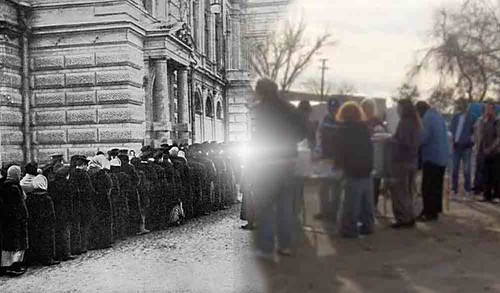
Both executives appeared callous to the needs of the public. Both presided over economic hardship from an icy distance. Both administrations resulted in make-shift shanty towns and tent cities. Hoover used the military to attack homeless Veterans in Washington. Bush leaves veterans on the street to die or in hospital rooms to disintegrate. And I don't want to say Bush might be a transvestite but he was a cheerleader in high school. When failure becomes this ponderous the only response must be defiance.
On April 1, a small grassroots organization of around 1,000 truckers will be striking against the rising cost of diesel. As one driver stated: "Our federal government is subsidizing railroads, airlines, banks and farmers. Meanwhile, we’re being taxed to death." (source)
The strike is largely symbolic and is not expected to result in any significant dip in prices. Yet, it does display two exciting features: 1) it circumvents the Owner-Operator Independent Drivers Association, the truckers' trade union, who actually denounces the pending strike for legal reasons, and 2) the event was organized over the internet -- the future of resistance.
Now, I can't let it go unmentioned that this is an election year a time when the fetishized act of voting gets moved to the front of the national conversation. A lot of time and money goes into convincing us that all of our energy needs to be drained into voting, not conservation or community activism, demonstrating or tax resistance. We're supposed to elect someone to solve our problems with their charming, mega-watt smile. The dirtiest little secret of our age is synergic movements against both business and government, such as striking, trump the suggestion of action, like voting, every time.
With everyone treading water it's no wonder at least one other group, the West Coast Dockworkers, is planning to strike this summer. As more and more of us are pulled under we'll see a ground swell of activism. The spirit of resistance might be atrophied from lying coiled beneath the surface, but it won't take long for more workers to slowdown or stop all together. Like in the 1930s, people recognized their reliance on each other and fought against the police (in some cases, like the Flint, Michigan Sit-Down Strike of 1936, they actually won), launched general strikes which shut down large metropolises like Seattle and San Francisco, and came close to wresting power away from the ownership class until FDR introduced a series of reforms that placated many laborers. And we'll probably see the same type of actions under an Obama or Clinton presidency. Not that I'm a reformophobe. I want people to live better. But let's not lose our radical edge. Let's keep thrusting forward inch by inch, and not settle for what they give us.
Saturday, March 08, 2008
West Coast Dockworkers Dispute Could Paralyze U.S. Economy
 By Matt Smith
(View Original)
Imploding U.S. mortgage markets leave behind trillions of dollars in economic damage. The dollar's slide against the euro and the yuan raises fears of a currency collapse. January job losses portend recession.
To these threats to U.S. economic stability, add a new and severe one that is brewing in the conference rooms of the Cathedral Hill Hotel, a blue-collar establishment on Van Ness. There, West Coast dockworkers' representatives are devising a strategy to renegotiate a unified ports agreement with shipping companies that is scheduled to expire July 1. If the renegotiation is as fractious as it was in 2002 — when shippers attempted to break the union by shutting down 29 West Coast ports for 10 days — an extended dispute could paralyze U.S. economic activity and send financial markets tumbling.
A shutdown like the last one "carries the very real risk of triggering a sudden crisis in international financial markets," U.C. Berkeley professor Stephen Cohen, co-director of the Berkeley Roundtable on the International Economy, wrote in a 2002 paper. When I spoke with him last week, he said he'd be watching the situation this time, too: "I don't think the significance is any different. At some point, you start running out of parts, and the factory stops, and the factory that relies on that factory for components stops, and you have a chain reaction that's really rather a nightmare."
I'm the last person to wish further disaster on America — the newspaper industry, after all, is one of the first casualties in an economic decline. But I still say good on the International Longshore and Warehouse Union (ILWU), the dockworkers' syndicate started 70 years ago in San Francisco by Harry Bridges. Though the union, now representing 25,000 workers, has shrunk since jobs disappeared with mid-century innovations in the shipping industry, it still ranks among America's blue-collar royalty thanks to contracts that give full-time workers typical annual wages in the six figures.
While the upcoming labor negotiations might terrify some economists, they could also inspire victims of America's mirage economy, where decades of apparent stability and growth have been accompanied by greater poverty and uncertainty among those on the bottom rungs. During the coming hard times, America will need a labor movement that can put a scare into Wall Street — even if every once in a while the workers contribute to the risk of economic uncertainty for the rest of us.
Cohen's view isn't shared by everyone. Ken Jacobs, chair of the UC Berkeley Labor Center, says the effects of the short-term shutdown in 2002 were "grossly overstated."
"If you have a lockout that stretches over a long period, you would start seeing an impact," he said. "But the short term is much, much smaller."
The impact, however, of a labor movement emboldened by the ILWU's influence over the first link in the stateside industrial supply chain might be significant: It could provide hope for workers during the coming recession.
The mood was jovial last week at the ILWU Local 10 hiring hall near Fisherman's Wharf, where members had gathered to hear Ken Riley, president of the union local in Charleston, South Carolina. In 2002, members of the S.F. Local 10 had helped Charleston dockworkers rebuff an effort by a Danish shipper to use nonunion workers.
Clerks, crane operators, and other port workers told me they had gathered to give each other support for what they expected to be a nervous period before the spring's West Coast contract negotiations pitting the ILWU against the Pacific Maritime Association, which represents shippers.
Author Suzan Erem, whose book about the 2002 labor dispute, On the Global Waterfront: The Fight to Free the Charleston 5, has just been published, attended the meeting with other union notables to declare that international collaboration among unions could help exploit globalized trade to workers' benefit by using union clout at ports around the world.
In 2000, The New York Times ran a story about how Charleston police violently quelled a union demonstration. Lawrence Thibeaux, then-president of S.F. Local 10, was appalled, and called Riley to offer help. "It was basically what you'd call a cold call," Thibeaux said.
West Coast union members eventually raised $100,000 to help pay for the legal defense of five workers arrested during clashes between picketers and police. Meanwhile, Local 10 executive board member Jack Hayman contacted his friend Julian Garcia, leader of the Spanish dockworkers' union La Coordinadora. The two had known each other since the mid-1990s, when dockworkers worldwide supported a strike in Liverpool, England.
Garcia was glad to lend a hand. His union drafted a letter to officials of Nordana Line, the company seeking to use nonunion labor in Charleston. Hayman recalled the letter as saying, "It's not loaded professionally, and unless it's loaded properly, we won't unload this ship in Spain."
Nordana officials, apparently concerned that their company might become the target of sympathy strikes at ports around the world, decided to negotiate with the Charleston dockworkers. Before long, the union had a contract.
To me, Riley and Hayman's success seemed to raise the question: If international cooperation can bolster laborers' wages in South Carolina, why can't workers who have influence over cargo use their leverage to expand union benefits for other U.S. workers just a few steps up the global supply chain from the Oakland docks?
The modern, just-in-time global economy is often analyzed as a threat to workers, because fluid international markets mean that jobs can be outsourced anywhere. Overlooked is the fact that when companies depend on international logistics, they are at the mercy of workers who run the cargo network. "It's someplace you have great labor power," notes Ken Jacobs of the Labor Center.
The forthcoming negotiations will partly focus on how far the union's influence extends into companies' distribution networks. In the happiest of circumstances, the ILWU's influence might expand further into America's logistics system. The union's success might inspire, or perhaps even provide support for, other workers, such as the great masses of retail and service workers who toil without union protection.
In this column I've criticized unions such as the Service Employees International Union (SEIU), which has cut deals with employers at workers' expense. And I've lambasted Local 38 of the United Association of Journeymen and Apprentices of the Plumbing and Pipe Fitting Industry, which seems to be run as a family fiefdom for the benefit of SF labor boss Larry Mazzola.
But I make these arguments from a pro-union perspective that says America could be stronger with more powerful, honest, democratic, and, yes, wealthy unions such as the ILWU.
Steve Zeltzer, a Bay Area labor activist and videographer, tells me the ILWU is one of the more democratic unions. Hence its "caucuses" at the Cathedral Hill Hotel this week, in which members' representatives discussed which issues to press during the upcoming contract negotiations.
Many analysts nowadays associate weak labor unions with a high U.S. standard of living. This bizarre line of thinking says that cheap, imported tennis shoes, offshore tech support, and vegetables grown by workers paid less than minimum wage allow consumers a relatively high standard of living. Such logic says that if stockers, truck unloaders, and retail clerks were paid well, the rest of us would suffer such a reduced standard of living that it wouldn't be worth the higher wages.
But a paper released in December by U.C. Berkeley's Center for Labor Research and Education found that the impact on shoppers would be minimal if stores such as Wal-Mart increased workers' wages from their current near-minimum-wage status to a mere $10 per hour. The study also found that such an increase would be a bonanza for poor working families.
Additionally, Wal-Mart's status as a wage- and price-setting benchmark means that increased wages there could lift other workers' income as well. Economists love arguing about whether wages raised through collective bargaining encourage employers to hire fewer or more workers. For my part, I'll say that during the 2008 recession, workers will need power from wherever they can find it.
"I think the real challenge for the ILWU is following the work," Jacobs said. "Unions such as the ILWU and the Teamsters really are looking at the supply chain in terms of organizing."
Union organizing director Peter Olney says the talks will focus in part on efforts by shipping and other companies to move their cargo operations inland. This could either be a disaster for unions — as jobs are steadily removed from their orbit — or a boon, as union influence possibly moves deeper into the supply chain.
Plans for a so-called Southern California Logistics Airport in Victorville, which would place rail, air, and other unloading facilities about 100 miles inland from the Port of Long Beach, are part of the shipping industry's intent to relocate work currently done at West Coast ports. Shippers could theoretically use such ports to eliminate union jobs by moving inland work such as freight container dispatching and cross-country train loading. "There's knowledge-based technology work, but there's also good old-fashioned muscling and hustling of cargo," Olney said.
Pacific Maritime Association spokesman Steve Getzug said this year's contract negotiations won't be as contentious as they were six years ago, when shippers sought to reduce portside jobs by streamlining cargo operations. "With an early start, there will be the possibility of finishing without the disruptions of 2002," he said. "We're looking for an agreement that allows us to manage record cargo volumes as efficiently as possible."
ILWU communications director Craig Merrilees, however, is holding off on announcing a labor-management love fest. When I mentioned recent stories in the Journal of Commerce predicting peaceful negotiations, Merrilees said it was far too early to speculate about the outcome: "We won't really know until there's been an effort to sit down and see if we can resolve whether good jobs are going to be a priority."
If not, and if the two sides hold out past July, a port stoppage could create catastrophe. "The first day doesn't cost you much; neither does the third or fourth," Cohen said, adding that there comes a point when factories begin running out of supplies. "By the 30th day, my God: it's a grand snowball, and at some point the snowball becomes an avalanche."
I'm hoping that day never comes. If it does, I'll be rooting for the dockworkers.
Saturday, December 15, 2007
Know Your History: The Homestead Strike of 1892
The Homestead Strike 1892
by Cheri Goldner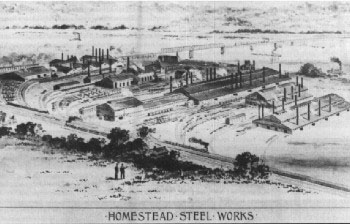
For almost five months in 1892, the Homestead lodges of the Amalgamated Association of Iron and Steel Workers and the Carnegie Steel Company, Limited clashed over contract negotiations in what has become known as The Homestead Strike.
The steel industry was crucial to Homestead, a borough situated on the left bank of the Monongahela River, just seven miles east of Pittsburgh (see map). In 1889, workers had won a strike and negotiated a three-year contract for a sliding scale wage which was determined by the fluctuating market prices of 4 x 4 standard Bessemer steel billets. The contract was to expire on June 30, 1892.
As this expiration date neared, steel baron Andrew Carnegie, who had often publicly communicated union sympathies, departed for Scotland leaving the notorious Henry Clay Frick with managing authority. Frick was known for his ruthless anti-union policy and as negotiations were still taking place he ordered the construction of a solid board fence topped with barbed wire around mill property. The workers dubbed the newly fortified mill "Fort Frick."
Meetings continued through late June but the two sides could not reach an agreement. Workers expressed their discontent by hanging Frick and superintendent J.A. Potter in effigy on mill property and turning the hose on the men sent by Potter to cut the effigies down. With this event as an excuse, the company began to shut down the works on June 28. By the morning of June 30, the day the contract with the Amalgamated expired, the entire work force was locked out.
Union and non-union workers joined forces under the leadership of Hugh O'Donnell and kept guard around the steel works to prevent any blacksheep, or scabs, from entering. Frick meanwhile, had already made arrangements with Pinkerton's National Detective Agency of New York for the arrival of 300 strike-breaking detectives, commonly known as "Pinkertons."
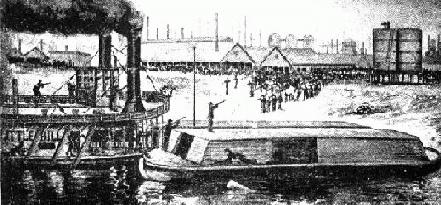
When this army was spotted on the Monongahela in the early morning of July 6, workers sounded alarms and townspeople of all ages gathered to meet the approaching barges. Once it was clear that the detectives planned on docking at and entering mill property, workers tore through a company fence to stop them.
While who fired the first shot remains a mystery, the detectives opened fire on the crowd and wounded several workers. The workers hid behind ramparts of steel, pig iron and scrap iron and returned fire while the women and children retreated out of range. The battle lasted from 4 a.m. on July 6 until 5 p.m., with workers finally agreeing to the surrender of the Pinkertons. Three Pinkertons and seven workers died and many more were wounded in the fight.
Six days later the National Guard of Pennsylvania arrived in Homestead under the orders of Governor Robert E. Pattison. The company then used several tactics to weaken union forces. They evicted workers from company homes, arrested individuals repeatedly just to charge them bail, and involved the workers in a series of costly court cases.
On November 17, the first break in the ranks occurred when day laborers and mechanics voted to return to work. Three days later the lodges of the Amalgamated voted to lift the prohibition on returning to work for the company. The company hired back some of them as non-union workers and blacklisted others. Carnegie, Frick and company had won, helping to prevent the organization of the mills for the next forty years.
Friday, November 23, 2007
Subscribe to:
Posts (Atom)
