
Many think of the market as a mighty, erratic beast capable of transporting continents upon its back when domesticated by the adroit hands of statesmen but if left untamed would raze the defenseless into microscopic particles. This conception of networks of voluntary exchange is a dire mistake on a host of issues none more considerable than the environment. Too much trust is yielded to regulation and oversight while industries holding much ecological promise such as Solid Waste Disposal, Agribusiness and Nuclear Power fall victim to misinformed zealots who end up undermining their cause.The last place one expects to discover eco-centered innovation are smelly eyesores yet within the past thirty years dumps have handily outpaced expectations. Because these rolling hills of refuse are such easy targets a piece of legislation entitled the Resource Conservation and Recovery Act (RCRA) was passed by Congress in 1976 regulating waste materials. Later tighter restrictions on landfills were added through Subtitle D in 1991. After the passage of Subtitle D a measurable decline in Solid Waste Management facilities lead to more privatization and larger sites. By conventional wisdom this paradigm shift should have resulted in catastrophe. What actually occurred was remarkable.
Despite a steady flow of solid waste, landfill capacity actually increased with time. Between 1986-1991 13 states reported their dumps contained under 5 years of capacity. Presently, no states report landfills below 5 years of capacity, and the numbers for national facilities are even more heartening. These sites retained 11 years of capacity in the late-'80s, jumped to 14 years through the mid-'90s and currently maintain around 16 years of capacity. (source) Considering the rate of waste in the U.S. remains relatively constant per capita but swells in relation to population, these statistics become quite astounding. Even though more garbage enter landfills the lifespan of these sites increases. Incineration, improved recycling rates and inter-state capacity sharing assist in controlling landfill volume nationwide. (source)
Even the deleterious consequences of dumps have either been tapered or commuted. The strategic placement of landfills away from densely populated residential areas and waterways largely mitigates ground water contamination. Porous, subterranean fabrics called geotextiles filter hazardous pollutants inhibiting dangerous leakage. Methane gas emissions from decomposing trash can now be harnessed as an energy source. Carpet manufacturer, Interface Inc., decreased natural gas consumption by 20% since implementing this new technique in 2003. (source) Breakthroughs keep refining these technologies year after year ensuring improved safety and performance.Further up the chain of production Agribusiness continually boasts more efficient ways of cultivating crops with clever weather-resistant features. How any conscious, purportedly compassionate person could daunt this agricultural explosion falls beyond censure. The genetic strides engineered by private companies allow third world farmers greater growing flexibility and output, and the simple fact is because of these graciously unnatural modifications more food is generated globally with less land than ever before. Taking the numbers for the U.S. alone, corn harvests have increased by an additional 36%, soybeans by 12% and cotton by 31% thanks to biotechnology. (source) Farmers now use wireless equipment to measure how much water and fertilizer crops require to reduce waste and lower costs. Researchers augmented the plants themselves so they recover more quickly during droughts and floods -- an answered prayer to poor, Asiatic nations; require less tilling decreasing the overall amount of erosion and runoff; rely on 70% less water with equal or greater yields and repel pests diminishing the application of pesticides. Genetically modified seeds currently inaccessible to farmers are projected to be brought to market as soon as 2012.
Strictly "organic" farmers experience none of these benefits and leave behind a larger environmental footprint than Agribusiness. Because local farms deliver to a legion of individual retailers without a primary distribution center or encourage customers to pick-up their goods directly more fossil fuel gets dumped into the atmosphere while Agribusiness ships in bulk to fewer locations and imports their product from all over the world from regions specifically chosen to maximize efficiency for any given commodity. (source) The result is cheaper prices, better quality and less greenhouse gasses.As demonized as Agribusiness and genetically modified foods, or "Frankenfoods," are at present no other industry proves to be a scarier boogieman for nebbish environmentalists than Nuclear Power. Three Mile Island and Chernobyl cast long shadows over the legacy of this safe, clean wonder-fuel. To set the record straight, no one died at Three Mile Island and, although tragic, the 56 dead at Chernobyl is dwarfed by the countless dead due to ash coughed up by coal factories annually not to mention the human cost of resource wars launched in the name of oil. When the death tolls are placed side by side the hysteria orbiting Nuclear Power seems rather nitwitted.
Economically, Nuclear Power Plants make sense. They receive fewer subsidies than coal, oil, solar or wind power even though coal and oil are far bigger polluters, and by the most recent estimates solar and wind power at their peak could only satisfy 20% of demand while Nuclear Power could assure 90% of all energy needs. Nuclear power also outperforms the status quo. For instance, a single enriched uranium pellet equals "17,000 cubic feet of natural gas, 1,780 pounds of coal [and] 149 gallons of oil." (source) Despite a deficit in funding, Nuclear Plants cover the total cost of externalities and the decommissioning of outdated facilities. (source) No other clean power source produces more for less.
But can it be labeled clean or safe? When measuring the output of hazardous material nuclear power barely charts next to coal. The American coal industry unleashes more physical waste every few hours than Nuclear Power's entire history. This distressing quantity factors into the question of radioactivity. Not many people realize coal ash is radioactive although Uranium has greater intensity the disparity in the waste ratio between coal and nuclear power crowns coal ash the more worrisome environmental threat. Because of the diminutive amount of waste Nuclear Plants leave behind it can be altered into a watertight material, locked into steel-reinforced containers and buried well away from any underground water sources. (source)
As for the matter of safety, Chernobyl-style facilities have long since been decomissioned. In newer models, ceramic pellets encase pieces of uranium stored inside zirconium alloy tubes forming rods confined behind 30-centimeter thick walls which in turn are housed within a 1-meter thick barrier. During the burning process safety features slow efficiency if the water becomes too warm and several models of power plants depend upon physical forces such as gravity to halt the process altogether instead of mechanized components, and system redundancies double check the internal operations. (source) To further illustrate the safety of Nuclear Power Plants, during the Cold War neither the United States nor the Soviet Union aimed warheads at these complexes because the damage would have been negligible at best.
The collapse of Soviet Russia left an ecological moonscape as public proprietorship typically disintegrates into ruin. By contrast, thousands of largely private, collaborative hands shed elbow grease to manufacture sustainable technology inconceivable to any dark breed of central planner. The alacrity, plasticity and innovatory brawn behind markets can be overwhelming but this stupefying creature functions best when left unyoked.
Showing posts with label Environmentalism. Show all posts
Showing posts with label Environmentalism. Show all posts
Tuesday, August 18, 2009
A Green Thumb on an Invisible Hand: Can Markets Improve the Environment?
Sunday, July 26, 2009
Philosophy of Technology and Development
by Scott Hughes
(http://onlinephilosophyclub.com/philosophical-look-at-technology-and-development.php)
I think we all find ourselves awed by the exponentially increasing rate of technological advancement. I would guess that we have made more technological development in the past 500 years than we have in the 5,000 years prior to that, more in the past 100 years than the 500 prior to that, and more in the last 10 to 20 years than in the 100 years prior to that. It not only seems we continue to make technological advancements, but we do it faster.
But are the advancements in technology advancements in general? Sure we make stronger, more powerful tools and machines that do more jobs with less work and resources. But is advancing our power a general advancement for us when we use that power for our own disadvantage? In the end, will we say that our technological development helped us or destroyed us?
We cannot ignore some obvious immediate luxuries of technology that at least some of us enjoy. Most of us surely prefer using a mattress and a toilet more than using the ground instead of both. We can harvest more food and energy which some of us get to use for great luxuries from air conditioning to transportation.
But how do those needless luxuries usually only for some compare to the massive dangers, risks and damages imposed usually on all? How many personal luxuries for some are worth the dropping of two nuclear bombs on hundreds of thousands of civilians? What about the significant threat of a nuclear holocaust? Medical technology has increased our longevity, but we neglect our elderly, stuff them in facilities and ignore the fact that they commit suicide more than anyone else. We produce more food than could feed the whole world, but we still let thousands of children die from hunger daily and let more than a billion suffer in poverty. We live as far away from work and food sources as we want, but we destroy our environment by polluting it with mass-transportation, let alone the thousands who die in automobile accidents each month. We each hoard and compulsively use modern, personal luxuries without holding ourselves responsible for each of our individual contribution to collectively caused problems like the destruction of our environment or the depletion of finite resources. We invented an ever-advancing television system and an even more impressive information highway, so that we can fuel our ever-increasing addiction to internet porn, gossip news and commercialized media.
I see our technology as not only incredibly amazing but incredibly disgusting.
But I would not recommend that we avoid development.
We need to balance our development. We need to balance technological development by also developing our interpersonal skills, our self-control and our respect for the consequences of our actions including the consequences of our collective activities. In an analogy, perhaps guns and cars can be helpful, but how stupid would it be to give a 10-year-old child a loaded real live gun or let him zoom around recklessly in a real live car? We need to balance the power of technological development with maturity.
I love to imagine what ever-increasing technological advancements would hold for a mature, warless, poverty-less global society built on freedom, fairness, self-control and interpersonal caring. But to think of the same ever-increasing technological advancement for a society as immature and self-destructive as our current one, I find myself fighting to hold onto a sad, deep fear as opposed to the bland cynical knowledge that we will destroy ourselves with our own technologically-empowered foolishness.

Monday, July 20, 2009
Locally Grown Produce
(http://skeptoid.com/episodes/4162#)
Today we're going to be politically incorrect again and point our skeptical eye at another sacred cow: Locally grown produce. Particularly in the United States, but in many other countries as well, one of the newest and fastest growing market segments is locally grown produce. The claims are that locally grown produce is less wasteful of fuel because it doesn't need to be delivered over long distances; it's fresher for the same reason; and it supports a small local organic farmer instead of an immoral megacorporation that sources food from cheap overseas producers.
I discussed one of these claims, about local delivery burning less fuel, in a May 2009 entry on SkepticBlog.org. It must have been pretty inflammatory, because it generated a huge number of comments. Most of them followed this pattern: The commenter begrudgingly agreed with the mathematics of the delivery question, but then claimed that I missed the point completely because the real reason to like locally grown produce has nothing to do with a low carbon footprint of minimal delivery miles. I'm not sure I buy that — virtually everyone I've ever asked says that's what locally grown is all about — but hey, I'm fair, we'll give them all a voice here.
Maybe this guy's climate can produce a better, cheaper, lower footprint pineapple than your local climate
(Photo credit: Wikimedia)First, let's give a brief overview of the mathematics of local delivery. Think of the traveling salesman problem. This is where you speckle a map with all sorts of random locations. The traveling salesman's problem is to find the shortest possible driving route, called a tour, that visits each of the locations. It's among the most computationally difficult problems in mathematics. But there's a cool piece of free software by Michael LaLena that finds one efficient solution using a genetic algorithm. Try to stump it with a pattern of hundreds of dots that you think will be hard to connect, and the software blows your mind with a surprisingly simple tour that visits all the locations.
Many years ago I did some consulting for a company that was then called Henry's Marketplace, a produce retailer built on the founding principles of locally grown food. Henry's had evolved from a single family fruit stand into a chain of stores throughout southern California and Arizona that sold produce from small, local farmers. Part of what I helped them with was the management of product at distribution centers. This sparked a question: I had assumed that their "locally grown produce" model meant that they used no distribution centers. What followed was a fascinating lesson where I learned part of the economics of locally grown produce.
In their early days, they did indeed follow a true farmers' market model. Farmers would either deliver their product directly to the store, or they would send a truck out to each farmer. As they added store locations, they continued practicing direct delivery between farmer and store. Adding a store in a new town meant finding a new local farmer for each type of produce in that town. Usually this was impossible: Customers don't live in farming areas. Farms are usually located between towns. So Henry's ended up sending a number of trucks from different stores to the same farm. Soon, Henry's found that the model of minimal driving distance between each farm and each store resulted in a rat's nest of redundant driving routes crisscrossing everywhere. What was intended to be efficient, local, and friendly, turned out to be not just inefficient, but grossly inefficient. Henry's was burning huge amounts of diesel that they didn't need to burn. So, they began combining routes. This meant fewer, larger trucks, and less diesel burned. They experimented with a distribution center to serve some of their closely clustered stores. The distribution center added a certain amount of time and labor to the process, but it still accomplished same-day morning delivery from farm to store, and cut down on mileage tremendously. Henry's added larger distribution centers, and realized even better efficiency. Today their model of distributing locally grown produce, on the same day it comes from the farm, is hardly distinguishable from the model of any large retailer.
Compare the traveling salesman's simplified tour to a tangle of crisscrossing bicycle spokes, and the inefficiency of direct delivery between farm and store becomes acutely clear. If we want to minimize the carbon footprint of the entire food cycle, eliminating direct delivery is the easiest place to make the biggest gains. So, right off the bat, the main reason most people prefer locally grown produce is shot down, and shot down in big flames. But let's turn to the SkepticBlog commenters and see what people had to say.
As did a number of readers, Ian pointed out that you have to consider the total price. Not just the cost of distribution, but also the cost of the retailer's wholesale purchase. Total them all up, and in some cases it might be cheaper to buy from ridiculously far away:
...Wal-Mart [buys] fruit from South Africa, coffee from Kenya, etc. Flying this produce around the world is clearly using more fuel than even an inefficient model for distributing food locally. The efficiency comes not from reducing fuel usage, but from paying significantly less for the produce.
This was underscored by another poster, "Old White Guy":
As someone who spent a good chunk of his life controlling distribution for several large companies, I can say the only thing that matters is getting the product to the point of sale as inexpensively as possible. If that [means] the cheapest wine in the store comes from another continent, so be it.
This suggests that it some cases, huge container-sized purchases might still be cheaper for the large retailer, even though their delivery produces a lot of wasteful emissions, and their production might be with some god-awful third-world high-pollution child-labor dogs-and-cats-living-together environmental disaster. That might be true in some cases, but those would be the exception, not the rule. Most of the time, produce is cheaper from those countries because the native growing conditions are much better for that particular crop. Tomatoes flourish in Spain but require heated greenhouses in the United Kingdom, and so the overall energy efficiency of growing them in Spain and transporting them overseas to the UK is actually better.
A number of people who disagreed with my article repeatedly referenced Michael Pollan's book The Omnivore's Dilemma. Pollan devotes one of the book's four sections to the practices of holistic cattle farmer Joel Salatin. One of Salatin's rules is that, in the interest of a minimum carbon footprint, he won't ship his beef at all; customers have to drive to him to pick it up. While I applaud Salatin for having the right idea and the right motivations, I don't believe he thought through this particular point very critically. Salatin should instead design practices that more directly address his desire: He should allow only shipments that use a minimum amount of fuel per pound of beef delivered. Instead, he adopts a rule that might put hundreds of cars and vans on the road, each delivering only a few pounds of beef. Salatin's solution is emotionally satisfying and makes for a fine sound bite, but its underlying science is flawed and counterproductive to his stated goals.
The elephant in the room on Joel Salatin's farm is that his near-total self-sufficiency methods require an outrageous 550 acres to support only 100 head of cattle and a herd of pigs, plus some turkeys and chickens. Most of the acres are used to grow the feed and raw materials the animals require. I didn't find any valid defense of this, and Pollan's book simply avoids the issue. Typically, pasture-fed cows require half an acre each, so Salatin is using about ten times as much land as he should. Such wasteful land usage might work well in the case of a high-end boutique retailer like Joel Salatin, but it's clearly well beyond the limits of practicality for the world's real food needs.
The overall picture is often a lot more complicated than simply "locally grown". Let's say you want sheep or dairy products, and you live in New York. Where are those products going to come from? Certainly not from anywhere local. If you get them from a state or two away, which is about as local as possible, what went into their production? A lot of feed, for one thing. But spin the globe and look at New Zealand. New Zealand has the world's most efficient sheep and dairy industries, and one big reason is their climate and conditions that allow year-round grazing. According to the New York Times:
Lamb raised on New Zealand's clover-choked pastures and shipped 11,000 miles by boat to Britain produced 1,520 pounds of carbon dioxide emissions per ton while British lamb produced 6,280 pounds of carbon dioxide per ton, in part because poorer British pastures force farmers to use feed. In other words, it is four times more energy-efficient for Londoners to buy lamb imported from the other side of the world than to buy it from a producer in their backyard.
And yet many of the same people who are so vocal about a minimum carbon footprint consider this massive net energy savings to be immoral because it includes overseas transport. Why? Is it a geopolitical preference? Is it a matter of supporting farms from your own country instead of sending money overseas? OK, fine, that's an absolutely valid point of view. But if your true motivations are political, don't greenwash them and claim that you're really interested in environmental science.
If it's support for small business, if you'd rather support someone like Joel Salatin than a megacorporation like Wal-Mart, that's also an absolutely valid point of view. Just call it what it is instead of greenwashing it and claiming environmental awareness. To get the premium boutique experience, Salatin's customers burn way more gas per pound of beef delivered than do Wal-Mart's container ships from New Zealand. If you have other reasons to object to Wal-Mart's New Zealand beef, fantastic; just be aware of what your objections really are. It's more intellectually honest, it's more insightful, you'll learn more, and you're not being disingenuous.
Don't get me wrong, I love farmers' markets. We go to our local one sometimes and it's a fun family event for us. We love the giant, wonderful tomatoes and strawberries that you can't get at the supermarket. But I understand that farmers' markets are more of a community experience than an efficient (or "green") way to buy food. The real reasons to enjoy your farmers' market have nothing to do with it being somehow magically environmentally friendly. Too often, environmentalists are satisfied with the mere appearance and accoutrements of environmentalism, without regard for the underlying facts. Apply some mathematics and some economics, and you'll find that, more often than not, a smaller environmental footprint is the natural result of improved efficiency.


Monday, June 29, 2009
Saturday, December 29, 2007
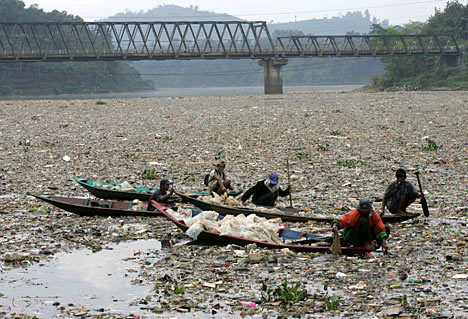
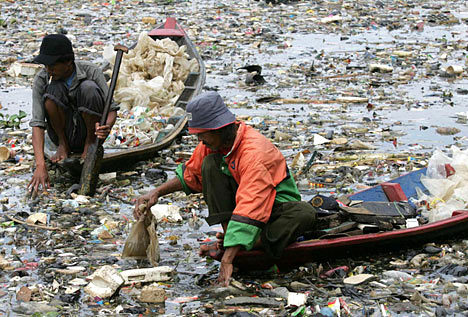
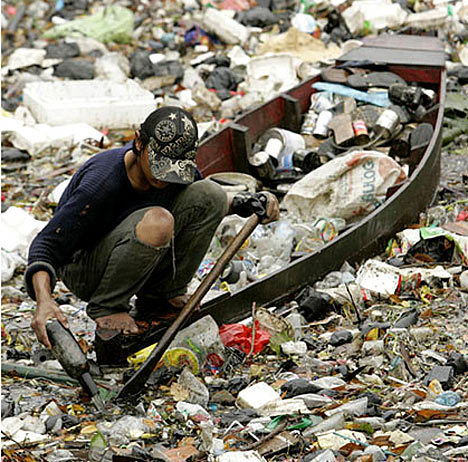
The World’s Most Polluted River
Thanks to: Conspiracy Memes
Citarum, near the Indonesian capital of Jakarta is according to many the world's most polluted river.
A poignant display of human disregard for the environment.
Monday, December 10, 2007
BP Set To Commit ‘The Biggest Environmental Crime in History’
BP Set To Commit ‘The Biggest Environmental Crime in History’
by Cahal Milmo
BP, the British oil giant that pledged to move “Beyond Petroleum” by finding cleaner ways to produce fossil fuels, is being accused of abandoning its “green sheen” by investing nearly £1.5bn to extract oil from the Canadian wilderness using methods which environmentalists say are part of the “biggest global warming crime” in history.
The multinational oil and gas producer, which last year made a profit of £11bn, is facing a head-on confrontation with the green lobby in the pristine forests of North America after Greenpeace pledged a direct action campaign against BP following its decision to reverse a long-standing policy and invest heavily in extracting so-called “oil sands” that lie beneath the Canadian province of Alberta and form the world’s second-largest proven oil reserves after Saudi Arabia.
Producing crude oil from the tar sands - a heavy mixture of bitumen, water, sand and clay - found beneath more than 54,000 square miles of prime forest in northern Alberta - an area the size of England and Wales combined - generates up to four times more carbon dioxide, the principal global warming gas, than conventional drilling. The booming oil sands industry will produce 100 million tonnes of CO2 (equivalent to a fifth of the UK’s entire annual emissions) a year by 2012, ensuring that Canada will miss its emission targets under the Kyoto treaty, according to environmentalist activists.
The oil rush is also scarring a wilderness landscape: millions of tonnes of plant life and top soil is scooped away in vast open-pit mines and millions of litres of water are diverted from rivers - up to five barrels of water are needed to produce a single barrel of crude and the process requires huge amounts of natural gas. The industry, which now includes all the major oil multinationals, including the Anglo-Dutch Shell and American combine Exxon-Mobil, boasts that it takes two tonnes of the raw sands to produce a single barrel of oil. BP insists it will use a less damaging extraction method, but it accepts that its investment will increase its carbon footprint.
Mike Hudema, the climate and energy campaigner for Greenpeace in Canada, told The Independent: “BP has done a very good job in recent years of promoting its green objectives. By jumping into tar sands extraction it is taking part in the biggest global warming crime ever seen and BP’s green sheen is gone.
“It takes about 29kg of CO2 to produce a barrel of oil conventionally. That figure can be as much 125kg for tar sands oil. It also has the potential to kill off or damage the vast forest wilderness, greater than the size of England and Wales, which forms part of the world’s biggest carbon sinks. For BP to be involved in this trade not only flies in the face of their rhetoric but in the era of climate change it should not be being developed at all. You cannot call yourself ‘Beyond Petroleum’ and involve yourself in tar sands extraction.” Mr Hudema said Greenpeace was planning a direct action campaign against BP, which could disrupt its activities as its starts construction work in Alberta next year.
The company had shied away from involvement oil sands, until recently regarded as economically unviable and environmentally unpleasant. Lord Browne of Madingley, who was BP’s chief executive until May, sold its remaining Canadian tar sands interests in 1999 and declared as recently as 2004 that there were “tons of opportunities” beyond the sector. But as oil prices hover around the $100-per-barrel mark, Lord Browne’s successor, Tony Hayward, announced that BP has entered a joint venture with Husky Energy, owned by the Hong Kong based billionaire Li Ka-Shing, to develop a tar sands facility which will be capable of producing 200,000 barrels of crude a day by 2020. In return for a half share of Husky’s Sunrise field in the Athabasca region of Alberta, the epicentre of the tar sands industry, BP has sold its partner a 50 per cent stake in its Toledo oil refinery in Ohio. The companies will invest $5.5bn (£2.7) in the project, making BP one of the biggest players in tar sands extraction.
Mr Hayward made it clear that BP considered its investment was the start of a long-term presence in Alberta. He said: “BP’s move into oil sands is an opportunity to build a strategic, material position and the huge potential of Sunrise is the ideal entry point for BP into Canadian oil sands.”
Canada claims that it has 175 billion barrels of recoverable oil in Alberta, making the province second only to Saudi Arabia in proved oil riches and sparking a £50bn “oil rush” as American, Chinese and European investors rush to profit from high oil prices. Despite production costs per barrel of up to £15, compared to £1 per barrel in Saudi Arabia, the Canadian province expects to be pumping five million barrels of crude a day by 2030.
BP said it will be using a technology that pumps steam heated by natural gas into vertical wells to liquefy the solidified oil sands and pump it to the surface in a way that is less damaging than open cast mining. But campaigners said this method requires 1,000 cubic feet of gas to produce one barrel of unrefined bitumen - the same required to heat an average British home for 5.5 days.
A spokesman for BP added: “These are resources that would have been developed anyway.”
Licenses have been issued by the Albertan government to extract 350 million cubic metres of water from the Athabasca River every year. But the water used in the extraction process, say campaigners, is so contaminated that it cannot be returned to the eco-system and must instead be stored in vast “tailings ponds” that cover up to 20 square miles and there is evidence of increased rates of cancer and multiple sclerosis in down-river communities.
Experts say a pledge to restore all open cast tar sand mines to their previous pristine condition has proved sadly lacking. David Schindler, professor of ecology at the University of Alberta, said: “Right now the big pressure is to get that money out of the ground, not to reclaim the landscape. I wouldn’t be surprised if you could see these pits from a satellite 1,000 years from now.”
Have your say
How can BP be stopped from perpetrating this environmental ‘crime’? Tell us what you think. Email haveyoursay@ independent.co.uk or go to www.independent.co.uk/haveyoursay
Sunday, July 15, 2007
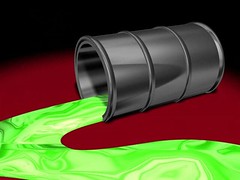
This is why we need environmental regulations
 BP to dump more toxins in Lake Michigan
WHITING, Ind., July 14 (UPI) -- An enormous BP oil refinery in Indiana is planning to pour significantly more ammonia and industrial sludge into Lake Michigan, it was reported.
The move by the British Petroleum oil refinery of Whiting, Ind., runs counter to years of efforts to clean up the U.S. Great Lakes, The Chicago Tribune reported Saturday.
State regulators exempted BP from environmental laws to pave the way for a $3.8 billion expansion to let BP refine heavier Canadian crude oil. Regulators justified the move, in part, by noting the project will create 80 new jobs.
BP, which aggressively markets itself as environmentally friendly, already is one of the largest polluters along the Great Lakes.
Under the new state water permit, BP can release 54 percent more ammonia and 35 percent more sludge into Lake Michigan every day. Ammonia promotes algae blooms that can kill fish and the sludge is dense with heavy metals, the newspaper reported.
The refinery still will meet federal water pollution guidelines, but state and federal officials acknowledge it is the first time in years a company has been approved to dump more toxic waste into Lake Michigan.
© Copyright 2007 United Press International, Inc. All Rights Reserved.
United Press International, UPI, the UPI logo, and other trademarks and service marks, are registered or unregistered trademarks of United Press International, Inc. in the United States and in other countries.
Friday, April 20, 2007
What your car expels in one day
Here's a picture illustrating what an average car exhaust puts into the atmosphere in one day.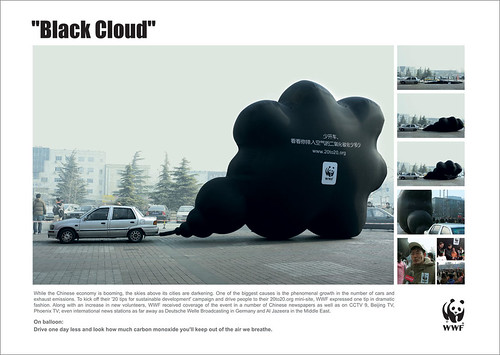
Subscribe to:
Posts (Atom)
