
Eugene V. Debs
and the Idea of Socialism
by Howard Zinn
The Progressive magazine, January 1999
We are always in need of radicals who are also lovable, and so we would do well to remember Eugene Victor Debs. Ninety years ago, at the time The Progressive was born, Debs was nationally famous as leader of the Socialist Party, and the poet James Whitcomb Riley wrote of him:
"As warm a heart as ever beat
Betwixt here and the Judgment Seat."
Debs was what every socialist or anarchist or radical should be: fierce in his convictions, kind and compassionate in his personal relations. Sam Moore, a fellow inmate of the Atlanta penitentiary, where Debs was imprisoned for opposing the First World War, remembered how he felt as Debs was about to be released on Christmas Day, 1921: "As miserable as I was, I would defy fate with all its cruelty as long as Debs held my hand, and I was the most miserably happiest man on Earth when I knew he was going home Christmas."
Debs had won the hearts of his fellow prisoners in Atlanta. He had fought for them in a hundred ways and refused any special privileges for himself. On the day of his release, the warden ignored prison regulations and opened every cell-block to allow more than 2,000 inmates to gather in front of the main jail building to say good-bye to Eugene Debs. As he started down the walkway from the prison, a roar went up and he turned, tears streaming down his face, and stretched out his arms to the other prisoners.
This was not his first prison experience. In 1894, not yet a socialist but an organizer for the American Railway Union, he had led a nationwide boycott of the railroads in support of the striking workers at the Pullman Palace Car Company. They tied up the railroad system, burned hundreds of railway cars, and were met with the full force of the capitalist state: Attorney General Richard Olney, a former railroad lawyer, got a court injunction to prohibit blocking trains. President Cleveland called out the army, which used bayonets and rifle fire on a crowd of 5,000 strike sympathizers in Chicago. Seven hundred were arrested. Thirteen were shot to death.
Debs was jailed for violating an injunction prohibiting him from doing or saying anything to carry on the strike. In court, he denied he was a socialist, but during his six months in prison he read socialist literature, and the events of the strike took on a deeper meaning. He wrote later: "I was to be baptized in socialism in the roar of conflict.... In the gleam of every bayonet and the flash of every rifle the class struggle was revealed."
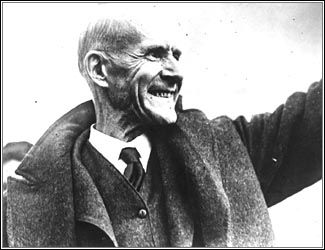
From then on, Debs devoted his life to the cause of working people and the dream of a socialist society. He stood on the platform with Mother Jones and Big Bill Haywood in 1905 at the founding convention of the Industrial Workers of the World. He was a magnificent speaker, his long body leaning forward from the podium, his arm raised dramatically. Thousands came to hear him talk all over the country.
With the outbreak of war in Europe in 1914 and the build-up of war fever against Germany, some socialists succumbed to the talk of "preparedness," but Debs was adamantly opposed. When President Wilson and Congress brought the nation into the war in 1917, speech was no longer free. The Espionage Act made it a crime to say anything that would discourage enlistment in the armed forces.
Soon, close to 1,000 people were in prison for protesting the war. The producer of a movie called The Spirit of '76, about the American revolution, was sentenced to ten years in prison for promoting anti-British feeling at a time when England and the United States were allies. The case was officially labeled The US. v. The Spirit of '76.
Debs made a speech in Canton, Ohio, in support of the men and women in jail for opposing the war. He told his listeners: "Wars throughout history have been waged for conquest and plunder.... And that is war, in a nutshell. The master class has always declared the wars; the subject class has always fought the battles." He was found guilty and sentenced to ten years in prison by a judge who denounced those "who would strike the sword from the hand of this nation while she is engaged in defending herself against a foreign and brutal power."
In court, Debs refused to call any witnesses, declaring: "I have been accused of obstructing the war. I admit it. I abhor war. I would oppose war if I stood alone." Before sentencing, Debs spoke to judge and jury, uttering perhaps his most famous words. I was in his hometown of Terre Haute, Indiana, recently, among 200 people gathered to honor his memory, and we began the evening by reciting those words-words that moved me deeply when I first read them and move me deeply still: "While there is a lower class, I am in it. While there is a criminal element, I am of it. While there is a soul in prison, I am not free."
The "liberal" Oliver Wendell Holmes, speaking for a unanimous Supreme Court, upheld the verdict, on the ground that Debs's speech was intended to obstruct military recruiting. When the war was over, the "liberal" Woodrow Wilson turned down his Attorney General's recommendation that Debs be released, even though he was sixty-five and in poor health. Debs was in prison for thirty-two months. Finally, in 1921, the Republican Warren Harding ordered him freed on Christmas Day.
Today, when capitalism, "the free market," and "private enterprise" are being hailed as triumphant in the world, it is a good time to remember Debs and to rekindle the idea of socialism.
To see the disintegration of the Soviet Union as a sign of the failure of socialism is to mistake the monstrous tyranny created by Stalin for the vision of an egalitarian and democratic society that has inspired enormous numbers of people all over the world. Indeed, the removal of the Soviet Union as the false surrogate for the idea of socialism creates a great opportunity. We can now reintroduce genuine socialism to a world feeling the sickness of capitalism- its nationalist hatreds, its perpetual warfare, riches for a small number of people in a small number of countries, and hunger, homelessness, insecurity for everyone else.
Here in the United States we should recall that enthusiasm for socialism-production for use instead of profit, economic and social equality, solidarity with our brothers and sisters all over the world- was at its height before the Soviet Union came into being.
In the era of Debs, the first seventeen years of the twentieth century-until war created an opportunity to crush the movement-millions of Americans declared their adherence to the principles of socialism. Those were years of bitter labor struggles, the great walkouts of women garment workers in New York, the victorious multiethnic strike of textile workers in Lawrence, Massachusetts, the unbelievable courage of coal miners in Colorado, defying the power and wealth of the Rockefellers. The I.W.W. was born-revolutionary, militant, demanding "one big union" for everyone, skilled and unskilled, black and white, men and women, native-born and foreign-born.
More than a million people read Appeal to Reason and other socialist newspapers. In proportion to population, it would be as if today more than three million Americans read a socialist press. The party had 100,000 members, and 1,200 office-holders in 340 municipalities. Socialism was especially strong in the Southwest, among tenant farmers, railroad workers, coal miners, lumberjacks. Oklahoma had 12,000 dues-paying members in 1914 and more than 100 socialists in local offices. It was the home of the fiery Kate Richards O'Hare. Jailed for opposing the war, she once hurled a book through a skylight to bring fresh air into the foul-smelling jail block, bringing cheers from her fellow inmates.
The point of recalling all this is to remind us of the powerful appeal of the socialist idea to people alienated from the political system and aware of the growing stark disparities in income and wealth-as so many Americans are today. The word itself-"socialism"-may still carry the distortions of recent experience in bad places usurping the name. But anyone who goes around the country, or reads carefully the public opinion surveys over the past decade, can see that huge numbers of Americans agree on what should be the fundamental elements of a decent society: guaranteed food, housing, medical care for everyone; bread and butter as better guarantees of "national security" than guns and bombs; democratic control of corporate power; equal rights for all races, genders, and sexual orientations; a recognition of the rights of immigrants as the unrecognized counterparts of our parents and grandparents; the rejection of war and violence as solutions for tyranny and injustice.
There are people fearful of the word, all along the political spectrum. What is important, I think, is not the word, but a determination to hold up before a troubled public those ideas that are both bold and inviting-the more bold, the more inviting. That's what remembering Debs and the socialist idea can do for use.
Showing posts with label Socialism in America. Show all posts
Showing posts with label Socialism in America. Show all posts
Thursday, August 07, 2008
Eugene V. Debs and the Idea of Socialism


Wednesday, July 23, 2008
Socialist Candidate Brian Moore on WPR

(View Original)
Brian Moore is the 2008 Socialist Party USA presidential candidate. What are his views on the issues? After four, Ben Merens and his guest discuss the Socialist Party USA platform and its 2008 campaign for the presidency.
Socialist Candidate Brian Moore on WPR
Moore/Alexander ’08
Thursday, May 01, 2008
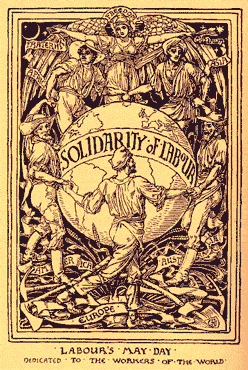
The Brief Origins of May Day
The Brief Origins of May Day
by Eric Chase
(http://www.iww.org/projects/mayday/origins.shtml)
Most people living in the United States know little about the International Workers’ Day of May Day. For many others there is an assumption that it is a holiday celebrated in state communist countries like Cuba or the former Soviet Union. Most Americans don’t realize that May Day has its origins here in this country and is as "American" as baseball and apple pie, and stemmed from the pre-Christian holiday of Beltane, a celebration of rebirth and fertility.
 In the late nineteenth century, the working class was in constant struggle to gain the 8-hour work day. Working conditions were severe and it was quite common to work 10 to 16 hour days in unsafe conditions. Death and injury were commonplace at many work places and inspired such books as Upton Sinclair’s The Jungle and Jack London’s The Iron Heel. As early as the 1860’s, working people agitated to shorten the workday without a cut in pay, but it wasn’t until the late 1880’s that organized labor was able to garner enough strength to declare the 8-hour workday. This proclamation was without consent of employers, yet demanded by many of the working class.
At this time, socialism was a new and attractive idea to working people, many of whom were drawn to its ideology of working class control over the production and distribution of all goods and services. Workers had seen first-hand that Capitalism benefited only their bosses, trading workers’ lives for profit. Thousands of men, women and children were dying needlessly every year in the workplace, with life expectancy as low as their early twenties in some industries, and little hope but death of rising out of their destitution. Socialism offered another option.
A variety of socialist organizations sprung up throughout the later half of the 19th century, ranging from political parties to choir groups. In fact, many socialists were elected into governmental office by their constituency. But again, many of these socialists were ham-strung by the political process which was so evidently controlled by big business and the bi-partisan political machine. Tens of thousands of socialists broke ranks from their parties, rebuffed the entire political process, which was seen as nothing more than protection for the wealthy, and created anarchist groups throughout the country. Literally thousands of working people embraced the ideals of anarchism, which sought to put an end to all hierarchical structures (including government), emphasized worker controlled industry, and valued direct action over the bureaucratic political process. It is inaccurate to say that labor unions were "taken over" by anarchists and socialists, but rather anarchists and socialist made up the labor unions.
At its national convention in Chicago, held in 1884, the Federation of Organized Trades and Labor Unions (which later became the American Federation of Labor), proclaimed that "eight hours shall constitute a legal day’s labor from and after May 1, 1886." The following year, the FOTLU, backed by many Knights of Labor locals, reiterated their proclamation stating that it would be supported by strikes and demonstrations. At first, most radicals and anarchists regarded this demand as too reformist, failing to strike "at the root of the evil." A year before the Haymarket Massacre, Samuel Fielden pointed out in the anarchist newspaper, The Alarm, that "whether a man works eight hours a day or ten hours a day, he is still a slave."
Despite the misgivings of many of the anarchists, an estimated quarter million workers in the Chicago area became directly involved in the crusade to implement the eight hour work day, including the Trades and Labor Assembly, the Socialistic Labor Party and local Knights of Labor. As more and more of the workforce mobilized against the employers, these radicals conceded to fight for the 8-hour day, realizing that "the tide of opinion and determination of most wage-workers was set in this direction." With the involvement of the anarchists, there seemed to be an infusion of greater issues than the 8-hour day. There grew a sense of a greater social revolution beyond the more immediate gains of shortened hours, but a drastic change in the economic structure of capitalism.
In a proclamation printed just before May 1, 1886, one publisher appealed to working people with this plea:
- Workingmen to Arms!
- War to the Palace, Peace to the Cottage, and Death to LUXURIOUS IDLENESS.
- The wage system is the only cause of the World’s misery. It is supported by the rich classes, and to destroy it, they must be either made to work or DIE.
- One pound of DYNAMITE is better than a bushel of BALLOTS!
- MAKE YOUR DEMAND FOR EIGHT HOURS with weapons in your hands to meet the capitalistic bloodhounds, police, and militia in proper manner.
Not surprisingly the entire city was prepared for mass bloodshed, reminiscent of the railroad strike a decade earlier when police and soldiers gunned down hundreds of striking workers. On May 1, 1886, more than 300,000 workers in 13,000 businesses across the United States walked off their jobs in the first May Day celebration in history. In Chicago, the epicenter for the 8-hour day agitators, 40,000 went out on strike with the anarchists in the forefront of the public’s eye. With their fiery speeches and revolutionary ideology of direct action, anarchists and anarchism became respected and embraced by the working people and despised by the capitalists.
The names of many - Albert Parsons, Johann Most, August Spies and Louis Lingg - became household words in Chicago and throughout the country. Parades, bands and tens of thousands of demonstrators in the streets exemplified the workers’ strength and unity, yet didn’t become violent as the newspapers and authorities predicted.
More and more workers continued to walk off their jobs until the numbers swelled to nearly 100,000, yet peace prevailed. It was not until two days later, May 3, 1886, that violence broke out at the McCormick Reaper Works between police and strikers.
For six months, armed Pinkerton agents and the police harassed and beat locked-out steelworkers as they picketed. Most of these workers belonged to the "anarchist-dominated" Metal Workers’ Union. During a speech near the McCormick plant, some two hundred demonstrators joined the steelworkers on the picket line. Beatings with police clubs escalated into rock throwing by the strikers which the police responded to with gunfire. At least two strikers were killed and an unknown number were wounded.
Full of rage, a public meeting was called by some of the anarchists for the following day in Haymarket Square to discuss the police brutality. Due to bad weather and short notice, only about 3000 of the tens of thousands of people showed up from the day before. This affair included families with children and the mayor of Chicago himself. Later, the mayor would testify that the crowd remained calm and orderly and that speaker August Spies made "no suggestion... for immediate use of force or violence toward any person..."
As the speech wound down, two detectives rushed to the main body of police, reporting that a speaker was using inflammatory language, inciting the police to march on the speakers’ wagon. As the police began to disperse the already thinning crowd, a bomb was thrown into the police ranks. No one knows who threw the bomb, but speculations varied from blaming any one of the anarchists, to an agent provocateur working for the police.
Enraged, the police fired into the crowd. The exact number of civilians killed or wounded was never determined, but an estimated seven or eight civilians died, and up to forty were wounded. One officer died immediately and another seven died in the following weeks. Later evidence indicated that only one of the police deaths could be attributed to the bomb and that all the other police fatalities had or could have had been due to their own indiscriminate gun fire. Aside from the bomb thrower, who was never identified, it was the police, not the anarchists, who perpetrated the violence.
Eight anarchists - Albert Parsons, August Spies, Samuel Fielden, Oscar Neebe, Michael Schwab, George Engel, Adolph Fischer and Louis Lingg - were arrested and convicted of murder, though only three were even present at Haymarket and those three were in full view of all when the bombing occurred. The jury in their trial was comprised of business leaders in a gross mockery of justice similar to the Sacco-Vanzetti case thirty years later, or the trials of AIM and Black Panther members in the seventies. The entire world watched as these eight organizers were convicted, not for their actions, of which all of were innocent, but for their political and social beliefs. On November 11, 1887, after many failed appeals, Parsons, Spies, Engel and Fisher were hung to death. Louis Lingg, in his final protest of the state’s claim of authority and punishment, took his own life the night before with an explosive device in his mouth.
The remaining organizers, Fielden, Neebe and Schwab, were pardoned six years later by Governor Altgeld, who publicly lambasted the judge on a travesty of justice. Immediately after the Haymarket Massacre, big business and government conducted what some say was the very first "Red Scare" in this country. Spun by mainstream media, anarchism became synonymous with bomb throwing and socialism became un-American. The common image of an anarchist became a bearded, eastern European immigrant with a bomb in one hand and a dagger in the other.
Today we see tens of thousands of activists embracing the ideals of the Haymarket Martyrs and those who established May Day as an International Workers’ Day. Ironically, May Day is an official holiday in 66 countries and unofficially celebrated in many more, but rarely is it recognized in this country where it began.
Over one hundred years have passed since that first May Day. In the earlier part of the 20th century, the US government tried to curb the celebration and further wipe it from the public’s memory by establishing "Law and Order Day" on May 1. We can draw many parallels between the events of 1886 and today. We still have locked out steelworkers struggling for justice. We still have voices of freedom behind bars as in the cases of Mumia Abu Jamal and Leonard Peltier. We still had the ability to mobilize tens of thousands of people in the streets of a major city to proclaim "THIS IS WHAT DEMOCRACY LOOKS LIKE!" at the WTO and FTAA demonstrations.
Words stronger than any I could write are engraved on the Haymarket Monument:
THE DAY WILL COME WHEN OUR SILENCE WILL BE MORE POWERFUL THAN THE VOICES YOU ARE THROTTLING TODAY.
Truly, history has a lot to teach us about the roots of our radicalism. When we remember that people were shot so we could have the 8-hour day; if we acknowledge that homes with families in them were burned to the ground so we could have Saturday as part of the weekend; when we recall 8-year old victims of industrial accidents who marched in the streets protesting working conditions and child labor only to be beat down by the police and company thugs, we understand that our current condition cannot be taken for granted - people fought for the rights and dignities we enjoy today, and there is still a lot more to fight for. The sacrifices of so many people can not be forgotten or we’ll end up fighting for those same gains all over again. This is why we celebrate May Day.
Saturday, February 23, 2008
Attack on IWW Solidarity March in Providence, RI
Do you think maternity leave, overtime and the 40 hour work week are good ideas? Me too. All of these rights were earned over decades by striking workers who fought and died for a better quality of life, enduring such brutal attacks by the police as seen recently in Rhode Island. That's right, the struggle continues. It's not some dusty memory contained in a Woody Guthrie song, the fight is very real and very imminent. The police state, contrary to what many believe, isn't materializing out of the ether it's always been here. Since the founding of the nation. We just have faster, more accurate reporting, ways of circumventing mainstream propaganda mills, etc..so, we're much more aware of this type of suppression. And it's interesting how the Police always side with the rich and mighty, never the little guy. We owe a huge debt to the IWW, their vision of "One Big Union" and the Socialist movement tied to it at the turn of last century helped workers win their rights, providing for a blueprint for future thrusts forward.

AUG/11/07 - Providence RI, Industrial Workers of the World (IWW) march on Jackies Galaxy, a local restaurant chain supplied by HWH/Dragonland in NYC, a supplier notorious for slave labor conditions and a lack of basic labor rights. A few blocks before finishing the march North Providence police brutally tackled two of the marches after they moved to the sidewalk too slowly, both were arrested and one suffered a badly broken leg in the attack
 Attack on IWW Solidarity March in Providence, RI-Support Needed!
Today at 12pm EST the Providence wobblies organized a march on Jackies Galaxy, which is a restaurant chain that is being supplied by HWH in New York City, a supplier who is notorious for its slave labor conditions of up to 110 hours per week without basic labor rights (minimum wage and overtime).
Roughly 30-40 wobblies and supporters were marching towards a restaurant in North Providence when the police began following them en mass. They told the marches to move to the sidewalk, while this was initially ignored, the marchers listened to the police and began slowly moving to the sidewalk.
The police then surrounded the marchers in their squad cars and began getting out. With the police in full force, they began attacking the marchers, one fellow worker, Alex Svoboda, was pinned down by the police during her arrest and suffered a dislocated leg. Jason, another wob, was also arrested in during the police' attack.
Despite this, the marchers continued on to Jackies Galaxy and eventually spoke with the owner who denies doing business with HWH although he has no documentation to prove this.
The Providence wobblies will continue their pressure on Jackies Galaxy until they stop doing business with the slave labor shop HWH and until their basic rights, including the right to organize, are instated.
In the meantime they need your support! Alex Svoboda is without any health insurance and they need bail for Jaso, so please send in any donation that you, or your branch can afford to the Providence General Membership Branch (address below) or contact Mark Frey at 201-669-0714 or Billy Randel at 646-645-6284.
You can also do your part at pressuring the Mayor and Police Chief of North Providence to at the very least, formally apologizing to the marchers, dropping all baseless charges and paying for the injuries that were unjustly caused, contact info below. We must continue the solidarity as a union so slave shops like HWH don't get away with their practices. For the One Big Union!
Providence GMB:
PO box 5795
Providence R.I.
02903
Email-ProvidenceIWW@riseup.net
North Providence Mayor:
Charles A. Lombardi
North Providence Town Hall
2000 Smith Street
North Providence, RI 02911
Telephone: (401) 232-0900, ext. 226
Fax: (401) 232-3434
Police Chief:
Ernest C. Spaziano
North Providence Police Department
1967 Mineral Spring Ave.
North Providence, R.I. 02904
Business line: 401-233-1433
Fax number: 401-233-1438
Wednesday, October 24, 2007
A new society is possible through empathy

Neuroscience and Moral Politics: Chomsky’s Intellectual Progeny
by Gary Olson
Dissident Voice
October 24th, 2007
Are humans “wired for empathy”? How does this affect what Chomsky calls the “manufacturing of consent”?
Throughout the world, teachers, sociologists, policymakers and parents are discovering that empathy may be the single most important quality that must be nurtured to give peace a fighting chance.
—Arundhati Ray
The official directives needn’t be explicit to be well understood: Do not let too much empathy move in unauthorized directions.
—Norman Solomon
The nonprofit Edge Foundation recently asked some of the world’s most eminent scientists, “What are you optimistic about? Why?” In response, the prominent neuroscientist Marco Iacoboni cites the proliferating experimental work into the neural mechanisms that reveal how humans are “wired for empathy.”Iacoboni’s optimism is grounded in his belief that, with the popularization of scientific insights, these recent findings in neuroscience will seep into public awareness and “… this explicit level of understanding our empathic nature will at some point dissolve the massive belief systems that dominate our societies and that threaten to destroy us.” (Iacoboni, 2007, p. 14)
While there are reasons to remain skeptical (see below) about the progressive political implications flowing from this work, a body of impressive empirical evidence reveals that the roots of prosocial behavior, including moral sentiments such as empathy, precede the evolution of culture. This work sustains Noam Chomsky’s visionary writing about a human moral instinct, and his assertion that, while the principles of our moral nature have been poorly understood, “we can hardly doubt their existence or their central role in our intellectual and moral lives.” (Chomsky, 1971, n.p., 1988; 2005, p. 263)
In his influential book Mutual Aid (1972, p. 57; 1902), the Russian revolutionary anarchist, geographer, and naturalist Petr Kropotkin, maintained that “… under any circumstances sociability is the greatest advantage in the struggle for life. Those species which willingly abandon it are doomed to decay.” Species cooperation provided an evolutionary advantage, a “natural” strategy for survival.
While Kropotkin readily acknowledged the role of competition, he asserted that mutual aid was a “moral instinct” and “natural law.” Based on his extensive studies of the animal world, he believed that this predisposition toward helping one another—human sociality—was of “prehuman origin.” Killen and Cords, in a fittingly titled piece “Prince Kropotkin’s Ghost,” suggest that recent research in developmental psychology and primatology seems to vindicate Kropotkin’s century-old assertions (2002).
The emerging field of the neuroscience of empathy parallels investigations being undertaken in cognate fields. Some forty years ago the celebrated primatologist Jane Goodall observed and wrote about chimpanzee emotions, social relationships, and “chimp culture,” but experts remained skeptical. A decade ago, the famed primate scientist Frans B.M. de Waal (1996) wrote about the antecedents to morality in Good Natured: The Origins of Right and Wrong in Humans and Other Animals, but scientific consensus remained elusive.
All that’s changed. As a recent editorial in the journal Nature (2007) put it, it’s now “unassailable fact” that human minds, including aspects of moral thought, are the product of evolution from earlier primates. According to de Waal, “You don’t hear any debate now.” In his more recent work, de Waal plausibly argues that human morality—including our capacity to empathize—is a natural outgrowth or inheritance of behavior from our closest evolutionary relatives.
Following Darwin, highly sophisticated studies by biologists Robert Boyd and Peter Richerson posit that large-scale cooperation within the human species—including with genetically unrelated individuals within a group—was favored by selection. (Hauser, 2006, p. 416) Evolution selected for the trait of empathy because there were survival benefits in coming to grips with others. In his book, People of the Lake (1978) the world-renowned paleoanthropologist Richard Leakey unequivocally declares, “We are human because our ancestors learned to share their food and their skills in an honored network of obligation.”
Studies have shown that empathy is present in very young children, even at eighteen months of age and possibly younger. In the primate world, Warneken and colleagues at the Max Planck Institute at Leipzig, Germany, recently found that chimps extend help to unrelated chimps and unfamiliar humans, even when inconvenienced and regardless of any expectation of reward. This suggests that empathy may lie behind this natural tendency to help and that it was a factor in the social life of the common ancestor to chimpanzees and humans at the split some six million years ago (New Scientist, 2007; Warneken and Tomasello, 2006). It’s now indisputable that we share moral faculties with other species (de Waal, 2006; Trivers, 1971; Katz, 2000; Gintis, 2005; Hauser, 2006; Bekoff, 2007; Pierce, 2007). Pierce notes that there are “countless anecdotal accounts of elephants showing empathy toward sick and dying animals, both kin and non-kin” (2007, p. 6). And recent research in Kenya has conclusively documented elephant’s open grieving/empathy for other dead elephants.
Mogil and his team at McGill University recently demonstrated that mice feel distress when they observe other mice experiencing pain. They tentatively concluded that the mice engaged visual cues to bring about this empathic response (Mogil, 2006; Ganguli, 2006). De Waal’s response to this study: “This is a highly significant finding and should open the eyes of people who think empathy is limited to our species.” (Carey, 2006)
Further, Grufman and other scientists at the National Institutes of Health have offered persuasive evidence that altruistic acts activate a primitive part of the brain, producing a pleasurable response (2007). And recent research by Koenigs and colleagues (2007) indicates that within the brain’s prefrontal cortex, the ventromedial prefrontal cortex or VMPC is required for emotions and moral judgment. Damage to the VMPC has been linked to psychopathic behavior. This led to the belief that as a rule, psychopaths do not experience empathy or remorse.
A study by Miller (2001) and colleagues of the brain disorder frontotemporal dementia (FTD) is also instructive. FTD attacks the frontal lobes and anterior temporal lobes, the site of one’s sense of self. One early symptom of FTD is the loss of empathy.
We know from neuroscientific empathy experiments that the same affective brain circuits are automatically mobilized upon feeling one’s own pain and the pain of others. Through brain imaging, we also know that separate neural processing regions then free up the capacity to take action. As Decety notes, empathy then allows us to “forge connections with people whose lives seem utterly alien from us” (Decety, 2006, p. 2). Where comparable experience is lacking, this “cognitive empathy” builds on the neural basis and allows one to “actively project oneself into the shoes of another person” by trying to imagine the other person’s situation (Preston, in press), Preston and de Waal (2002). Empathy is “other directed,” the recognition of the other’s humanity.
***
So where does this leave us? If morality is rooted in biology, in the raw material or building blocks for the evolution of its expression, we now have a pending fortuitous marriage of hard science and secular morality in the most profound sense. The technical details of the social neuroscientific analysis supporting these assertions lie outside this paper, but suffice it to say that progress is proceeding at an exponential pace and the new discoveries are persuasive (Decety and Lamm, 2006; Lamm, 2007; Jackson, 2004 and 2006).
That said, one of the most vexing problems that remains to be explained is why so little progress has been made in extending this empathic orientation to distant lives, to those outside certain in-group moral circles. Given a world rife with overt and structural violence, one is forced to explain why our deep-seated moral intuition doesn’t produce a more ameliorating effect, a more peaceful world. Iacoboni suggests this disjuncture is explained by massive belief systems, including political and religious ones, operating on the reflective and deliberate level. These tend to override the automatic, pre-reflective, neurobiological traits that should bring people together.
Here a few cautionary notes are warranted. The first is that social context and triggering conditions are critical because, where there is conscious and massive elite manipulation, it becomes exceedingly difficult to get in touch with our moral faculties. Ervin Staub, a pioneering investigator in the field, acknowledges that even if empathy is rooted in nature, people will not act on it “… unless they have certain kinds of life experiences that shape their orientation toward other human beings and toward themselves (Staub, 2002, p. 222). As Jensen puts it, “The way we are educated and entertained keep us from knowing about or understanding the pain of others” (2002). Circumstances may preclude and overwhelm our perceptions, rendering us incapable of recognizing and giving expression to moral sentiments (Albert, n.d.; and also, Pinker, 2002). For example, the fear-mongering of artificially created scarcity may attenuate the empathic response. The limitation placed on exposure is another. As reported recently in the New York Times, the Pentagon imposes tight embedding restrictions on journalist’s ability to run photographs and other images of casualties in Iraq. Photographs of coffins returning to Dover Air Base in Delaware are simply forbidden. Memorial services for the fallen are also now prohibited even if the unit gives its approval.
The second cautionary note is Hauser’s (2006) observation that proximity was undoubtedly a factor in the expression of empathy. In our evolutionary past an attachment to the larger human family was virtually incomprehensible and, therefore, the emotional connection was lacking. Joshua Greene, a philosopher and neuroscientist, adds that “We evolved in a world where people in trouble right in front of you existed, so our emotions were tuned to them, whereas we didn’t face the other kind of situation.” He suggests that to extend this immediate emotion-linked morality—one based on fundamental brain circuits—to unseen victims requires paying less attention to intuition and more to the cognitive dimension. If this boundary isn’t contrived, it would seem, at a minimum, circumstantial and thus worthy of reassessing morality (Greene, 2007, n.p.). Given some of the positive dimensions of globalization, the potential for identifying with the “stranger” has never been more robust.
Finally, as Preston (2006-2007; and also, in press) suggests, risk and stress tend to suppress empathy whereas familiarity and similarity encourage the experience of natural, reflexive empathy. This formidable but not insurmountable challenge warrants further research into how this “out-group” identity is created and reinforced.
It may be helpful, as Halpern (1993, p. 169) suggests, to think of empathy as a sort of spark of natural curiosity, prompting a need for further understanding and deeper questioning. However, our understanding of how or whether political engagement follows remains in its infancy and demands further investigation.
***
Almost a century ago, Stein (1917) wrote about empathy as “the experience of foreign consciousness in general.” Salles’ film The Motorcycle Diaries addresses empathy, albeit indirectly. The film follows Ernesto Guevara de la Serna and his friend Alberto Granada on an eight-month trek across Argentina, Peru, Columbia, Chile and Venezuela.
When leaving his leafy, upper middle-class suburb (his father is an architect) in Buenos Aires in 1952, Guevara is 23 and a semester away from earning his medical degree. The young men embark on an adventure, a last fling before settling down to careers and lives of privilege. They are preoccupied with women, fun and adventure and certainly not seeking or expecting a life-transforming odyssey.
The film’s power is in its depiction of Guevara’s emerging political awareness that occurs as a consequence of unfiltered cumulative experiences. During their 8,000-mile journey, they encounter massive poverty, exploitation, and brutal working conditions, all consequences of an unjust international economic order. By the end, Guevara has turned away from being a doctor because medicine is limited to treating the symptoms of poverty. For him, revolution becomes the expression of empathy, the only effective way to address suffering’s root causes. This requires melding the cognitive component of empathy with engagement, with resistance against asymmetrical power, always an inherently political act. Otherwise, empathy has no meaning. (This roughly parallels the political practice of brahma-viharas by engaged Buddhists.) In his own oft-quoted words (not included in the film), Guevara stated that, “The true revolutionary is guided by a great feeling of love.”
Paul Farmer, the contemporary medical anthropologist, infectious-disease specialist and international public health activist, has adopted different tactics, but his diagnosis of the “pathologies of power” is remarkably similar to Guevara. He also writes approvingly of Cuba’s health programs, comparing them with his long work experience in Haiti. Both individuals were motivated early on by the belief that artificial epidemics have their origin in unjust socioeconomic structures, hence the need for social medicine, a “politics as medicine on a grand scale.” Both exemplify exceptional social outliers of engaged empathy and the interplay of affective, cognitive and moral components. For Farmer’s radical critique of structural violence and the connections between disease and social inequality, see (Farmer, 2003; Kidder, 2003). Again, it remains to be explained why there is such a paucity of real world examples of empathic behavior? Why is U.S. culture characterized by a massive empathy deficit of almost pathological proportions? And what might be reasonably expected from a wider public understanding of the nature of empathy?
Hauser posits a “universal moral grammar,” hard-wired into our neural circuits via evolution. This neural machinery precedes conscious decisions in life-and-death situations, however, we observe “nurture entering the picture to set the parameters and guide us toward the acquisition of particular moral systems.” At other points, he suggests that environmental factors can push individuals toward defective moral reasoning, and the various outcomes for a given local culture are seemingly limitless. (Hauser, 2006) For me, this discussion of cultural variation fails to give sufficient attention to the socioeconomic variables responsible for shaping the culture.
“It all has to do with the quality of justice and the availability of opportunity.” (2006, p. 151). Earlier, Goldschmidt (1999, n.p.) argued that, “Culturally derived motives may replace, supplement or override genetically programmed behavior.”
Cultures are rarely neutral, innocent phenomena but are consciously set up to reward some people and penalize others. As Parenti (2006) forcefully asserts, certain aspects of culture can function as instruments of social power and social domination through ideological indoctrination. Culture is part and parcel of political struggle, and studying culture can reveal how power is exercised and on whose behalf.
Cohen and Rogers, in parsing Chomsky’s critique of elites, note that “Once an unjust order exists, those benefiting from it have both an interest in maintaining it and, by virtue of their social advantages, the power to do so.” (Cohen, 1991, p. 17) (For a concise but not uncritical treatment of Chomsky’s social and ethical views, see Cohen, 1991.) Clearly, the vaunted human capacity for verbal communication cuts both ways. In the wrong hands, this capacity is often abused by consciously quelling the empathic response. When de Waal writes, “Animals are no moral philosophers,” I’m left to wonder if he isn’t favoring the former in this comparison. (de Waal, 1996b, n.p.)
One of the methods employed within capitalist democracies is Chomsky’s and Herman’s “manufacture of consent,” a form of highly sophisticated thought control. Potentially active citizens must be “distracted from their real interests and deliberately confused about the way the world works.” (Cohen, 1991, p. 7; Chomsky, 1988)
For this essay, and following Chomsky, I’m arguing that the human mind is the primary target of this perverse “nurture” or propaganda, in part because exposure to certain new truths about empathy—hard evidence about our innate moral nature—poses a direct threat to elite interests. There’s no ghost in the machine, but the capitalist machine attempts to keep people in line with an ideological ghost, the notion of a self constructed on market values. But “. . . if no one saw himself or herself as capitalism needs them to do, their own self-respect would bar the system from exploiting and manipulating them.” (Kelleher, 2007) That is, given the apparent universality of this biological predisposition toward empathy, we have a potent scientific baseline upon which to launch further critiques of elite manipulation, this cultivation of callousness.
First, the evolutionary and biological origins of empathy contribute hard empirical evidence—not wishful thinking or even logical inference—on behalf of a case for organizing vastly better societies.
In that vein, this new research is entirely consistent with work on the nature of authentic love and the concrete expression of that love in the form of care, effort, responsibility, courage and respect. As Eagleton reminds us, if others are also engaging in this behavior, “. . . the result is a form of reciprocal service which provides the context for each self to flourish. The traditional name for this reciprocity is love.” Because reciprocity mandates equality and an end to exploitation and oppression, it follows that “a just, compassionate treatment of other people is on the grand scale of things one of the conditions for one’s own thriving.” And as social animals, when we act in this way we are realizing our natures “at their finest.” (2007, pp. 170, 159-160, and 173) Again, the political question remains that of realizing a form of global environment that enhances the opportunity for our nature to flourish.
I’ve noted elsewhere, Fromm’s classic book The Art of Loving is a blistering indictment of the social and economic forces that deny us life’s most rewarding experience and “the only satisfying answer to the problem of human existence.” For Fromm, grasping how society shapes our human instincts, hence our behavior, is in turn the key to understanding why “love thy neighbor,” the love of the stranger, is so elusive in modern society.
The global capitalist culture with its premium on accumulation and profits not only devalues an empathic disposition but produces a stunted character in which everything is transformed into a commodity, not only things, but individuals themselves. The very capacity to practice empathy (love) is subordinated to our state religion of the market in which each person seeks advantage in an alienating and endless commodity-greedy competition.
Over five decades ago, Fromm persuasively argued that “The principles of capitalist society and the principles of love are incompatible.” (Fromm, 1956, p. 110). Any honest person knows that the dominant features of capitalist society tend to produce individuals who are estranged from themselves, crippled personalities robbed of their humanity and in a constant struggle to express empathic love. Little wonder that Fromm believed radical changes in our social structure and economic institutions were needed if empathy/love is to be anything more than a rare individual achievement and a socially marginal phenomenon. He understood that only when the economic system serves women and men, rather than the opposite, will this be possible (Olson, 2006).
***
The dominant cultural narrative of hyper-individualism is challenged and the insidiously effective scapegoating of human nature that claims we are motivated by greedy, dog-eat-dog “individual self-interest is all” is undermined. From original sin to today’s “selfish gene,” certain interpretations of human nature have invariably functioned to retard class consciousness. These new research findings help to refute the allegation that people are naturally uncooperative, an argument frequently employed to intimidate and convince people that it’s futile to seek a better society for everyone. Stripped of yet another rationalization for empire, predatory behavior on behalf of the capitalist mode of production becomes ever more transparent. And learning about the conscious suppression of this essential core of our nature should beg additional troubling questions about the motives behind other elite-generated ideologies, from neo-liberalism to the “war on terror.”
Second, there are implications for students. Cultivating empathic engagement through education remains a poorly understood enterprise. College students, for example, may hear the ‘cry of the people’ but the moral sound waves are muted as they pass through a series of powerful cultural baffles. Williams (1986, p. 143) notes that “While they may be models of compassion and generosity to those in their immediate circles, many of our students today have a blind spot for their responsibilities in the socio-political order. In the traditional vocabulary they are strong on charity but weak on justice.”
Nussbaum (1997) defends American liberal education’s record at cultivating an empathic imagination. She claims that understanding the lives of strangers and achieving cosmopolitan global citizenship can be realized through the arts and literary humanities. There is little solid evidence to substantiate this optimism. My own take on empathy-enhancing practices within U.S. colleges and universities is considerably less sanguine. Nussbaum’s episodic examples of stepping into the mental shoes of other people are rarely accompanied by plausible answers as why these people may be lacking shoes—or decent jobs, minimum healthcare, and long-life expectancy. The space within educational settings has been egregiously underutilized, in part, because we don’t know enough about propitious interstices where critical pedagogy could make a difference. Arguably the most serious barrier is the cynical, even despairing doubt about the existence of a moral instinct for empathy. The new research puts this doubt to rest and rightly shifts the emphasis to strategies for cultivating empathy and identifying with “the other.” Joining the affective and cognitive dimensions of empathy may require risky forms of radical pedagogy (Olson, 2006, 2007; Gallo, 1989). Evidence produced from a game situation with medical students strongly hints that empathic responses can be significantly enhanced by increased knowledge about the specific needs of others—in this case, the elderly (Varkey, 2006). Presumably, limited prior experiences would affect one’s emotional response. Again, this is a political culture/information acquisition issue that demands further study.
Third, for many people the basic incompatibility between global capitalism and the lived expression of moral sentiments may become obvious for the first time. (Olson, 2006, 2005) For example, the failure to engage this moral sentiment has radical implications, not the least being consequences for the planet. Within the next 100 years, one-half of all species now living will be extinct. Great apes, polar bears, tigers and elephants are all on the road to extinction due to rapacious growth, habitat destruction, and poaching. These human activities, not random extinction, will be the undoing of millions of years of evolution (Purvis, 2000). As Leakey puts it, “Whatever way you look at it, we’re destroying the Earth at a rate comparable with the impact of a giant asteroid slamming into the planet…” And researchers at McGill University have shown that economic inequality is linked to high rates of biodiversity loss. The authors suggest that economic reforms may be the prerequisite to saving the richness of the ecosystem and urge that “… if we can learn to share the economic resources more fairly with fellow members of our own species, it may help to share ecological resources with our fellow species.” (Mikkelson, 2007, p. 5)
While one hesitates imputing too much transformative potential to this emotional capacity, there is nothing inconsistent about drawing more attention to inter-species empathy and eco-empathy. The latter may be essential for the protection of biotic communities. Decety and Lamm (2006, p. 4) remind us that “… one of the most striking aspects of human empathy is that it can be felt for virtually any target, even targets of a different species.”
This was foreshadowed at least fifty years ago when Paul Mattick, writing about Kropotkin’s notion of mutual aid, noted that “… For a long time, however, survival in the animal world has not depended upon the practice of either mutual aid or competition but has been determined by the decisions of men as to which species should live and thrive and which should be exterminated. … [W]herever man rules, the “laws of nature” with regard to animal life cease to exist.” This applies no less to humans and Mattick rightly observed that the demands of capital accumulation and capitalist social relations override and preclude mutual aid. As such, neuroscience findings are welcome and necessary but insufficient in themselves. For empathy to flourish requires the elimination of class relations (Mattick, 1956, pp. 2-3).
Fourth, equally alarming for elites, awareness of this reality contains the potential to encourage “destabilizing” but humanity-affirming cosmopolitan attitudes toward the faceless “other,” both here and abroad. In de Waal’s apt words, “Empathy can override every rule about how to treat others.” (de Waal, 2005, p. 9) Amin (2003), for example, proposes that the new Europe be reframed by an ethos of empathy and engagement with the stranger as its core value. The diminution of empathy within the culture reduces pro-social behavior and social cohesiveness. Given the dangerous centrifugal forces of ethno-nationalism and xenophobia, nothing less than this unifying motif will suffice, while providing space for a yet undefined Europe, a people to come.
Finally, as de Waal observes, “If we could manage to see people on other continents as part of us, drawing them into our circle of reciprocity and empathy, we would be building upon rather than going against our nature.” (de Waal, 2005, p. 9) An ethos of empathy is an essential part of what it means to be human and empathically impaired societies, societies that fail to gratify this need should be found wanting. We’ve been systematically denied a deeper and more fulfilling engagement with this moral sentiment. I would argue that the tremendous amount of deception and fraud expended on behalf of overriding empathy is a cause for hope and cautious optimism. Paradoxically, the relative absence of widespread empathic behavior is in fact a searing tribute to its potentially subversive power.
Is it too much to hope that we’re on the verge of discovering a scientifically based, Archimedean moral point from which to lever public discourse toward an appreciation of our true nature, which in turn might release powerful emancipatory forces?
Acknowledgement:
A highly abbreviated version of this paper appeared at Zmag (5/20/07). Helpful comments were offered by N. Chomsky, D. Dunn, M. Iacoboni, K. Kelly, S. Preston and J. Wingard. Thanks, per usual, to M. Ortiz.
References
Gary Olson is Professor and Chair of the Department of Political Science, Moravian College, Bethlehem, PA. He can be reached at: olson@moravian.edu. Read other articles by Gary.
Monday, August 27, 2007
Socialism in America Equals Hope for the World
Socialism in America Equals Hope for the World
By Paul A. Donovan
“While there is a lower class I am in it; while there is a criminal element I am of it; while there is a soul in prison, I am not free”
–Eugene Debs, American Socialist
“The only thing most American know about socialism is they don’t like it. They have been led to believe that socialism is something to be either ridiculed as impractical, or feared as an instrument of the devil.”
–Leo Huberman
It is in fact difficult to shed light on what a socialist United States will look like, mostly because many think socialism, or other forms of publicly owned, and democratically controlled economies is an impossible goal to achieve in our country, mostly due to the hyper capitalist mentality of our nation, the strength of our ruling classes, and the overwhelmingly successful propaganda apparatus of the corporate system, which comprises the media, educational system, and many other venues, including the religious and political pulpit, and is reflected in the apathy, alarming confusion, and at times, indifference of our nation’s citizens, many of whom simply don’t know, don’t want to know, or don’t care where this country is headed (for a terrific insight into this puzzling and exasperating mindset I strongly recommend Deer Hunting with Jesus, by Joe Bageant, who also happens to be one of Cyrano’s senior contributing editors).
However, the capitalist systems own irrepressible dynamics and “make up”—which easily translate into a bill of indictment—are bringing about yet another wave of global repulsion and re-awakenings. In this framework, when I speak of this dynamic I am referring not so much to the more technical aspects of this phenomenon, but to its mass-perceived aspects, such as the following (in no particular order):
• the intense class stratification of the capitalist system itself, and the sharp and rising polarization in domestic and global wealth;
• the inherent exploitative nature of business with its constant siphoning off of surplus value from labor, and the system’s parasitic necessity to transform all living nature into commodities with near complete disregard of the environmental consequences;
• the unrelenting wars between capitalist nation states spawned by the age-old compulsion to grab new markets, and which issue from the constant need by the core ” industrialized nations” to meddle in nearly all political and economic affairs of the world’s sovereign “periphery nations” (there has never been a war between socialist states as such, other than those instigated by Western meddling, as in Indochina);
• the extensive commoditization of human culture;
• the implantation of usurious trade institutions, such as the WTO, IMF, and World Bank which serve as a supranational unelected government for the corporate elite , often nullifying local and national policies;
• the despair and ” atomization” felt in the souls of people as a result of pinning human against human in an eternal and inescapable predatory battle for basic subsistence, better jobs or to simply outdo or out perform our neighbors, something that inevitably leads to a sense of depression among many resulting from the loss of community and the working together for the common good;
• the outsourcing of jobs by our so called “American companies” at the first sign of a potential cheap labor market, the corporate crime, and political lobbying of invidious special interest groups, the purchasing of our so-called democratic elections; the alienation people have from the goods they create with their own hands, hearts, and minds, and the constant job insecurity in conjunction with often being over worked and underpaid;
• the outrageous health care costs in all of the medical system’s dimensions, from the extortionate cost of drugs, perhaps the biggest rip-off in the history of the American republic, to the corrosion in hospital care induced by the relentless pursuit of profit instead of the duty to serve the population;
• the booms, busts, and constant recessions of the market, along with the crime brought about by joblessness, a social blight that gives way to helplessness, addiction, domestic violence, ghettos and gang violence, and many other totally avoidable factors and expensive social costs whose burden is borne by the people;
• an educational system that trains and conditions young people to value material success above a humanistic education, something that, as Joe Bageant points out, makes untold numbers of people mere members of the economy, but not citizens of society or the nation in any real sense;
• the unrelenting nuclear proliferation to ensure imperial hegemony, a policy as criminal as it is transparently hypocritical, since we also pick and choose who is to become a new member of this “select club.” as our hysterical denunciations of Iran’s ambitions to go nuclear bear witness.
Incidentally, if you, as an American, or citizen of a developed nation, recognizes the truths in the above litany of ills oozing out of capitalism, imagine how these same features affect the rest of the world where their severity is at least a hundred times more vicious.
The constant state of fear, badly repressed disgust, and anxiety we live in as a global community as a result of these factors, have shaped the conditions in which the consciousness of people is changing in a new direction; people are waking up, starting to talk, vehemently criticizing (much too often in a completely misguided way) existing values and certain institutions. While all of that is extremely encouraging, for nothing can be cured or solved unless recognized, there are still formidable stumbling blocks, and perhaps one of the most serious is the fact that America has been sold on the counterfeit notion that there is no solution to capitalism. As Michael Parenti, Patrice Greanville, Robert McChesney and other media critics have observed, the object has been to sell the public the idea that we have reached the “end of history”, the “end of ideological struggles,” and therefore the “end” of class war. As a consequence, all that we can “reasonably” aspire to is “more and better capitalism”—forever. The fact that the Western media, and especially the American corporate media, are solidly behind this utterly fraudulent construct is evidence enough to discern whose interests are being served
Time to discuss socialism once again
As the saying goes “nothing sensible goes out of fashion”, as it so with the idea of socialism, which is nothing if not a broad rubric for the idea that human beings should live in national and regional communities built upon collaboration and generosity between their members and not one of constant personal warfare.
The idea of Socialism has natural appeal to many groups, essentially just about anyone except those who benefit directly from capitalism—the upper riches of the system, the corporate elite, the plutocracy itself, the so-called small business crowd, and other groups of wealthy professionals—and those millions still mesmerized by its siren song, who often think they are benefiting from capitalism or what the Republican (or Democratic) party is selling them.
Ironically (but logically, given the system’s upside-down hierarchies, which gives the most to those who do the least socially useful work) many of these people are the ones who get the least from the spoils of Capitalism, but who really keep the system afloat: they have little choice but to do as they are told, who shoulder the most egregious indignities in the name of honoring some concept their so called “betters” long ago betrayed, and, most important, traveling the world to shed blood on battlefields, in jungles, cities, and desserts, to fight wars built upon lies all to preserve and further the interests of the world’s minority of greedy elites, who are often only elite because of their enormous bank accounts, which many inherit, but not due to any Darwinian biologically determined superiority, as the people on the top often imply by sheer arrogance. The people of America, who have been manipulated, or forced, as in the case of Vietnam, time and time again, remain to this day, the “boots in the field” that keep capitalism and its organic outgrowth, imperialism, in business. The war in Iraq could not go on without them fighting, and hopefully they won’t have to pound the pavement of Iran anytime soon if we have something to say about.
Further, what about the rest of society, those who do have an instinctual affinity for social change being they are the ones that suffer the indignities of the system most often? These groups I refer to are the working poor, the unemployed and underemployed, idealistic students, many self- employed professionals, a large portion of what we call minorities, a plurality of women, same of intellectuals, and surprisingly many among the elderly and other grossly undervalued or ignored groups.
The idea of social ownership over the goods, services, and institutions we humans create with our own labor is very much alive, and over the course of the 19th, 20th, and now 21st centuries, has been a topic of great controversy, misconceptions, fraudulent propaganda, and at times legitimate criticism. As American socialist leader Eugene Debs once noted in respect to the capitalists’ mode of production “Those who produce should have, but we know that those who produce the most - that is, those who work hardest, and at the most difficult and most menial tasks, have the least.”
Debs could not have possibly known about the miners who recently died at the Sago mines and now Crandall Canyon, in Utah, losing their lives for what is a joke in terms of pay when compared to the obscene rewards received by American CEOs and many other financial “wizards”, who are experts at manipulating the markets, but he certainly was speaking for all of them when he recorded those words for posterity. Debs could “see” into the future because he understood well the irrepressible dynamics of capitalism, which is to constantly exploit labor in the interests of the owner, or capital.
Capitalism is an intrinsically exploitative system, which supposedly relies on the impartial buying and selling of commodities as an indicator for what rational decisions are made in human society, even if many of these “rational” decisions are informed by manipulated facts and an unrelenting barrage of propaganda, or what has come to be known to all as advertising, or even more accurately stated by Robert McChesney & John Bellamy Foster, as the “Commercial Tidal Wave”, in their indispensable Monthly Review essay of the same title. Often when we criticize capitalism we tend to focus on high concentrations of wealth in the hands of the few, and say to ourselves, “well that’s not right that so few should posses so much, in fact it’s outright unjust” but rarely is an explanation provided as to how this process of accumulation is carried out in the production and sale of commodities.
To paint a clearer picture of how this process works in countries where class lines are not as blurry, or in other words, nations with very small middle classes, Charles Kernaghan of Columbia University describes capitalist exploitation at the micro level from a trip he and a group of students took to a Nike plant in the Caribbean:
“One day in the Dominican Republic we found a big pile of Nike’s internal pricing documents. Nike assigns a timeframe to each operation. They don’t talk about minutes. They break the timeframe into ten thousandths of a second. You get to the bottom of all 22 operations; they give the workers 6.6 minutes to make the shirt. It’s $0.70 an hour in the Dominican Republic. 6.6 minutes equals $0.08. These are Nike’s documents. That means the wages come to three tenths of one percent of the retail price. This is the reality. It’s the science of exploitation.”
Capitalism is truly the science and practice of massive exploitation—with impunity. In the period of time the worker’s pay is earned, the capitalist then works you for many more hours, and in this case, even days more to make himself more and more profit, which is correctly defined in technical terms by Marxists as “surplus value”. The Dominican example irrefutably demonstrates this point.
Currently, on the Internet, Nike is advertising one of it’s items called the “No Excuses” T-Shirt for $14.99, which is one of their most modestly priced shirts; maybe it’s time that Nike applied this shirt’s slogan to it’s own labor practices, and corporate entitlements? The retail cost of that one Nike t-shirt is roughly equal to 21.4 hours of work for a Dominican wage slave—but s/he got paid for only 6.6 minutes of that product’s market value. The huge difference, as already mentioned, is all profit that is shoveled upstairs.
Given such framework, Nike can really rake in the bucks using wage slave labor, and as a result, in 2006, Nike’s revenues grew 9% to 15 billion dollars. In that same year Nike former CEO “left the company” with 8 million in severance pay, two years salary totaling 1.4 million a year, plus a bonus of 1.76 million the fiscal year 2006. Furthermore Nike was purchasing Perez’s home for 3.6 million dollars.
I suppose, CEO sympathizers may say that the CEO is entitled to more than an assembly line worker—but do you really think this type of polarization of wealth is fair, and if so, why shouldn’t the worker even make a living wage? To me “wage slave”—as the above example illustrates, is the rule and not the exception around much of the world, hence hardly a hyperbolic term.
When I recently mentioned this labor situation in the Dominican Republic to a friend of mine he thought it was somewhat unfortunate, but sort of dismissed it as the natural order of things, and couldn’t figure out why I really cared so much? I was actually made to feel guilty, or to feel that I said something wrong by raising this point. Naturally, I was a bit perturbed by my friend’s indifference and automatic corporate allegiance, and replied in the words of Jack London, “well the blood is dripping from their (the corporations) rooftops,” which my friend viewed as a fanatical statement, even though I said it very coolly and matter of fact.
Due to indoctrination in pro-capitalist ways of looking at almost any reality, it appears the prison of the mind is a cell many people would rather live in. I just hope that cell is padded, and furnished luxuriously, because it may be a long time before someone or something breaks us free.
Speaking of and to fanatics
The true fanaticism in this country is not emblematic of those opposing the unjust status quo, as the media would have us believe, but rather of those who support it, or even just as guilty, remain complacent in light of it. Those who delude themselves into thinking that turning a blind eye, or making an excuse for exploitation, or iniquity of any kind, is a healthy human response to gross human injustice. I am sure we can assume that if the middle class rug were pulled out from my friend (as it slowly is) and their own ageing parents could not retire, hardly surviving on .70 cents an hour, that they just may at such time raise some timid objections, if not scream to high heaven, but the middle class buffer in America is still robust enough, although the cartilage between our bones is wearing away due to constant systemic weights, and as a result of this weathering, we are starting to hear some of the system’s rusting machinery making that metal on metal sound, with Charlie Chaplin still wedged in the gears of these “Modern Times”, which in reality, should have been history by now.
It still seems that many among the general public would rather take it easy and just see what happens, while relying heavily on doses of beta-blockers to suppress the anxiety of the “daily grind”, while letting the wealthy of the planet, who obviously seem to be lacking basic scruples, decide for us, which path of doom is the shortest to take.
Following this script, the collective weight of our plethora of sins may land on the shoulders of maybe our great grandchildren; by then we will be long gone, and they can’t curse at us directly. In response to those who share the attitudes of some of my cynical associates, Eugene Debs may have said,
“Now my friends, I am opposed to the system of society in which we live today, not because I lack the natural equipment to do for myself but because I am not satisfied to make myself comfortable knowing that there are thousands of my fellow men who suffer for the barest necessities of life. We were taught under the old ethic that man’s business on this earth was to look out for himself. That was the ethic of the jungle; the ethic of the wild beast. Take care of yourself, no matter what may become of your fellow man.”
Here's the rest
Subscribe to:
Posts (Atom)
