(http://www.commondreams.org/view/2009/07/06-8#)
There are things that happen in the world that are bad, and you want to do something about them. You have a just cause. But our culture is so war prone that we immediately jump from, "This is a good cause" to "This deserves a war."
You need to be very, very comfortable in making that jump.
The American Revolution-independence from England-was a just cause. Why should the colonists here be occupied by and oppressed by England? But therefore, did we have to go to the Revolutionary War?
How many people died in the Revolutionary War?
Nobody ever knows exactly how many people die in wars, but it's likely that 25,000 to 50,000 people died in this one. So let's take the lower figure-25,000 people died out of a population of three million. That would be equivalent today to two and a half million people dying to get England off our backs.
You might consider that worth it, or you might not.
Canada is independent of England, isn't it? I think so. Not a bad society. Canadians have good health care. They have a lot of things we don't have. They didn't fight a bloody revolutionary war. Why do we assume that we had to fight a bloody revolutionary war to get rid of England?
In the year before those famous shots were fired, farmers in Western Massachusetts had driven the British government out without firing a single shot. They had assembled by the thousands and thousands around courthouses and colonial offices and they had just taken over and they said goodbye to the British officials. It was a nonviolent revolution that took place. But then came Lexington and Concord, and the revolution became violent, and it was run not by the farmers but by the Founding Fathers. The farmers were rather poor; the Founding Fathers were rather rich.
Who actually gained from that victory over England? It's very important to ask about any policy, and especially about war: Who gained what? And it's very important to notice differences among the various parts of the population. That's one thing were not accustomed to in this country because we don't think in class terms. We think, "Oh, we all have the same interests." For instance, we think that we all had the same interests in independence from England. We did not have all the same interests.
Do you think the Indians cared about independence from England? No, in fact, the Indians were unhappy that we won independence from England, because England had set a line-in the Proclamation of 1763-that said you couldn't go westward into Indian territory. They didn't do it because they loved the Indians. They didn't want trouble. When Britain was defeated in the Revolutionary War, that line was eliminated, and now the way was open for the colonists to move westward across the continent, which they did for the next 100 years, committing massacres and making sure that they destroyed Indian civilization.
So when you look at the American Revolution, there's a fact that you have to take into consideration. Indians-no, they didn't benefit.
Did blacks benefit from the American Revolution?
Slavery was there before. Slavery was there after. Not only that, we wrote slavery into the Constitution. We legitimized it.
What about class divisions?
Did ordinary white farmers have the same interest in the revolution as a John Hancock or Morris or Madison or Jefferson or the slaveholders or the bondholders? Not really.
It was not all the common people getting together to fight against England. They had a very hard time assembling an army. They took poor guys and promised them land. They browbeat people and, oh yes, they inspired people with the Declaration of Independence. It's always good, if you want people to go to war, to give them a good document and have good words: life, liberty, and the pursuit of happiness. Of course, when they wrote the Constitution, they were more concerned with property than life, liberty, and the pursuit of happiness. You should take notice of these little things.
There were class divisions. When you assess and evaluate a war, when you assess and evaluate any policy, you have to ask: Who gets what?
We were a class society from the beginning. America started off as a society of rich and poor, people with enormous grants of land and people with no land. And there were riots, there were bread riots in Boston, and riots and rebellions all over the colonies, of poor against rich, of tenants breaking into jails to release people who were in prison for nonpayment of debt. There was class conflict. We try to pretend in this country that we're all one happy family. We're not.
And so when you look at the American Revolution, you have to look at it in terms of class.
Do you know that there were mutinies in the American Revolutionary Army by the privates against the officers? The officers were getting fine clothes and good food and high pay and the privates had no shoes and bad clothes and they weren't getting paid. They mutinied. Thousands of them. So many in the Pennsylvania line that George Washington got worried, so he made compromises with them. But later when there was a smaller mutiny in the New Jersey line, not with thousands but with hundreds, Washington said execute the leaders, and they were executed by fellow mutineers on the order of their officers.
The American Revolution was not a simple affair of all of us against all of them. And not everyone thought they would benefit from the Revolution.
We've got to rethink this question of war and come to the conclusion that war cannot be accepted, no matter what the reasons given, or the excuse: liberty, democracy; this, that. War is by definition the indiscriminate killing of huge numbers of people for ends that are uncertain. Think about means and ends, and apply it to war. The means are horrible, certainly. The ends, uncertain. That alone should make you hesitate.
Once a historical event has taken place, it becomes very hard to imagine that you could have achieved a result some other way. When something is happening in history it takes on a certain air of inevitability: This is the only way it could have happened. No.
We are smart in so many ways. Surely, we should be able to understand that in between war and passivity, there are a thousand possibilities.
© 2009 The Progressive
Wednesday, July 08, 2009
Untold Truths About the American Revolution


Monday, May 11, 2009
A People's History Of The United States - Howard Zinn
(http://libcom.org/library/peoples-history-of-united-states-howard-zinn)
Howard Zinn's superb history of the US, spanning over 500 years from Columbus's "discovery" of America in 1492 to the Clinton presidency in 1996.
This extensive work is available online thanks to History Is A Weapon, who OCRed the text, though we heartily recommend our readers to buy a hard copy. libcom.org have made a small number of minor corrections.

Thursday, August 07, 2008
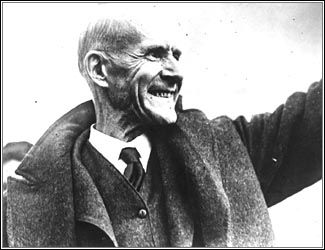
Eugene V. Debs and the Idea of Socialism
Eugene V. Debs
and the Idea of Socialism
by Howard Zinn
The Progressive magazine, January 1999
We are always in need of radicals who are also lovable, and so we would do well to remember Eugene Victor Debs. Ninety years ago, at the time The Progressive was born, Debs was nationally famous as leader of the Socialist Party, and the poet James Whitcomb Riley wrote of him:
"As warm a heart as ever beat
Betwixt here and the Judgment Seat."
Debs was what every socialist or anarchist or radical should be: fierce in his convictions, kind and compassionate in his personal relations. Sam Moore, a fellow inmate of the Atlanta penitentiary, where Debs was imprisoned for opposing the First World War, remembered how he felt as Debs was about to be released on Christmas Day, 1921: "As miserable as I was, I would defy fate with all its cruelty as long as Debs held my hand, and I was the most miserably happiest man on Earth when I knew he was going home Christmas."
Debs had won the hearts of his fellow prisoners in Atlanta. He had fought for them in a hundred ways and refused any special privileges for himself. On the day of his release, the warden ignored prison regulations and opened every cell-block to allow more than 2,000 inmates to gather in front of the main jail building to say good-bye to Eugene Debs. As he started down the walkway from the prison, a roar went up and he turned, tears streaming down his face, and stretched out his arms to the other prisoners.
This was not his first prison experience. In 1894, not yet a socialist but an organizer for the American Railway Union, he had led a nationwide boycott of the railroads in support of the striking workers at the Pullman Palace Car Company. They tied up the railroad system, burned hundreds of railway cars, and were met with the full force of the capitalist state: Attorney General Richard Olney, a former railroad lawyer, got a court injunction to prohibit blocking trains. President Cleveland called out the army, which used bayonets and rifle fire on a crowd of 5,000 strike sympathizers in Chicago. Seven hundred were arrested. Thirteen were shot to death.
Debs was jailed for violating an injunction prohibiting him from doing or saying anything to carry on the strike. In court, he denied he was a socialist, but during his six months in prison he read socialist literature, and the events of the strike took on a deeper meaning. He wrote later: "I was to be baptized in socialism in the roar of conflict.... In the gleam of every bayonet and the flash of every rifle the class struggle was revealed."
From then on, Debs devoted his life to the cause of working people and the dream of a socialist society. He stood on the platform with Mother Jones and Big Bill Haywood in 1905 at the founding convention of the Industrial Workers of the World. He was a magnificent speaker, his long body leaning forward from the podium, his arm raised dramatically. Thousands came to hear him talk all over the country.
With the outbreak of war in Europe in 1914 and the build-up of war fever against Germany, some socialists succumbed to the talk of "preparedness," but Debs was adamantly opposed. When President Wilson and Congress brought the nation into the war in 1917, speech was no longer free. The Espionage Act made it a crime to say anything that would discourage enlistment in the armed forces.
Soon, close to 1,000 people were in prison for protesting the war. The producer of a movie called The Spirit of '76, about the American revolution, was sentenced to ten years in prison for promoting anti-British feeling at a time when England and the United States were allies. The case was officially labeled The US. v. The Spirit of '76.
Debs made a speech in Canton, Ohio, in support of the men and women in jail for opposing the war. He told his listeners: "Wars throughout history have been waged for conquest and plunder.... And that is war, in a nutshell. The master class has always declared the wars; the subject class has always fought the battles." He was found guilty and sentenced to ten years in prison by a judge who denounced those "who would strike the sword from the hand of this nation while she is engaged in defending herself against a foreign and brutal power."
In court, Debs refused to call any witnesses, declaring: "I have been accused of obstructing the war. I admit it. I abhor war. I would oppose war if I stood alone." Before sentencing, Debs spoke to judge and jury, uttering perhaps his most famous words. I was in his hometown of Terre Haute, Indiana, recently, among 200 people gathered to honor his memory, and we began the evening by reciting those words-words that moved me deeply when I first read them and move me deeply still: "While there is a lower class, I am in it. While there is a criminal element, I am of it. While there is a soul in prison, I am not free."
The "liberal" Oliver Wendell Holmes, speaking for a unanimous Supreme Court, upheld the verdict, on the ground that Debs's speech was intended to obstruct military recruiting. When the war was over, the "liberal" Woodrow Wilson turned down his Attorney General's recommendation that Debs be released, even though he was sixty-five and in poor health. Debs was in prison for thirty-two months. Finally, in 1921, the Republican Warren Harding ordered him freed on Christmas Day.
Today, when capitalism, "the free market," and "private enterprise" are being hailed as triumphant in the world, it is a good time to remember Debs and to rekindle the idea of socialism.
To see the disintegration of the Soviet Union as a sign of the failure of socialism is to mistake the monstrous tyranny created by Stalin for the vision of an egalitarian and democratic society that has inspired enormous numbers of people all over the world. Indeed, the removal of the Soviet Union as the false surrogate for the idea of socialism creates a great opportunity. We can now reintroduce genuine socialism to a world feeling the sickness of capitalism- its nationalist hatreds, its perpetual warfare, riches for a small number of people in a small number of countries, and hunger, homelessness, insecurity for everyone else.
Here in the United States we should recall that enthusiasm for socialism-production for use instead of profit, economic and social equality, solidarity with our brothers and sisters all over the world- was at its height before the Soviet Union came into being.
In the era of Debs, the first seventeen years of the twentieth century-until war created an opportunity to crush the movement-millions of Americans declared their adherence to the principles of socialism. Those were years of bitter labor struggles, the great walkouts of women garment workers in New York, the victorious multiethnic strike of textile workers in Lawrence, Massachusetts, the unbelievable courage of coal miners in Colorado, defying the power and wealth of the Rockefellers. The I.W.W. was born-revolutionary, militant, demanding "one big union" for everyone, skilled and unskilled, black and white, men and women, native-born and foreign-born.
More than a million people read Appeal to Reason and other socialist newspapers. In proportion to population, it would be as if today more than three million Americans read a socialist press. The party had 100,000 members, and 1,200 office-holders in 340 municipalities. Socialism was especially strong in the Southwest, among tenant farmers, railroad workers, coal miners, lumberjacks. Oklahoma had 12,000 dues-paying members in 1914 and more than 100 socialists in local offices. It was the home of the fiery Kate Richards O'Hare. Jailed for opposing the war, she once hurled a book through a skylight to bring fresh air into the foul-smelling jail block, bringing cheers from her fellow inmates.
The point of recalling all this is to remind us of the powerful appeal of the socialist idea to people alienated from the political system and aware of the growing stark disparities in income and wealth-as so many Americans are today. The word itself-"socialism"-may still carry the distortions of recent experience in bad places usurping the name. But anyone who goes around the country, or reads carefully the public opinion surveys over the past decade, can see that huge numbers of Americans agree on what should be the fundamental elements of a decent society: guaranteed food, housing, medical care for everyone; bread and butter as better guarantees of "national security" than guns and bombs; democratic control of corporate power; equal rights for all races, genders, and sexual orientations; a recognition of the rights of immigrants as the unrecognized counterparts of our parents and grandparents; the rejection of war and violence as solutions for tyranny and injustice.
There are people fearful of the word, all along the political spectrum. What is important, I think, is not the word, but a determination to hold up before a troubled public those ideas that are both bold and inviting-the more bold, the more inviting. That's what remembering Debs and the socialist idea can do for use.
Sunday, July 06, 2008
Voices of a People's History of the United States
Sandra Oh reads Emma Goldman
Mos Def Reads Malcolm X
Alfre Woodard reads Sojourner Truth
Steve Earle reads Joe Hill
Mark Ruffalo reads Eugene Debs
Kerry Washington reads Maria Stewart
Staceyann Chin reads Cindy Sheehan
The People Speak Trailer
Friday, May 16, 2008
Howard Zinn on Anarchism (Interview)
 By Howard Zinn
 and Ziga Vodovnik
(View Original)
"History shows that whenever people have been living under tyranny,
Ziga Vodovnik is an Assistant Professor of Political Science at the Faculty of Social Sciences, University of Ljubljana, where his teaching and research is focused on anarchist theory/praxis and social movements in the Americas. His new book Anarchy of Everyday Life - Notes on anarchism and its Forgotten Confluences will be released in late 2008.
Wednesday, April 02, 2008
Empire or Humanity?
Thanks: Lo
Empire or Humanity?
What the Classroom Didn’t Teach Me About the American Empire
By Howard Zinn
With an occupying army waging war in Iraq and Afghanistan, with military bases and corporate bullying in every part of the world, there is hardly a question any more of the existence of an American Empire. Indeed, the once fervent denials have turned into a boastful, unashamed embrace of the idea.
However, the very idea that the United States was an empire did not occur to me until after I finished my work as a bombardier with the Eighth Air Force in the Second World War, and came home. Even as I began to have second thoughts about the purity of the "Good War," even after being horrified by Hiroshima and Nagasaki, even after rethinking my own bombing of towns in Europe, I still did not put all that together in the context of an American "Empire."
I was conscious, like everyone, of the British Empire and the other imperial powers of Europe, but the United States was not seen in the same way. When, after the war, I went to college under the G.I. Bill of Rights and took courses in U.S. history, I usually found a chapter in the history texts called "The Age of Imperialism." It invariably referred to the Spanish-American War of 1898 and the conquest of the Philippines that followed. It seemed that American imperialism lasted only a relatively few years. There was no overarching view of U.S. expansion that might lead to the idea of a more far-ranging empire — or period of "imperialism."
I recall the classroom map (labeled "Western Expansion") which presented the march across the continent as a natural, almost biological phenomenon. That huge acquisition of land called "The Louisiana Purchase" hinted at nothing but vacant land acquired. There was no sense that this territory had been occupied by hundreds of Indian tribes which would have to be annihilated or forced from their homes — what we now call "ethnic cleansing" — so that whites could settle the land, and later railroads could crisscross it, presaging "civilization" and its brutal discontents.
Neither the discussions of "Jacksonian democracy" in history courses, nor the popular book by Arthur Schlesinger Jr., The Age of Jackson, told me about the "Trail of Tears," the deadly forced march of "the five civilized tribes" westward from Georgia and Alabama across the Mississippi, leaving 4,000 dead in their wake. No treatment of the Civil War mentioned the Sand Creek massacre of hundreds of Indian villagers in Colorado just as "emancipation" was proclaimed for black people by Lincoln’s administration.
That classroom map also had a section to the south and west labeled "Mexican Cession." This was a handy euphemism for the aggressive war against Mexico in 1846 in which the United States seized half of that country’s land, giving us California and the great Southwest. The term "Manifest Destiny," used at that time, soon of course became more universal. On the eve of the Spanish-American War in 1898, the Washington Post saw beyond Cuba: "We are face to face with a strange destiny. The taste of Empire is in the mouth of the people even as the taste of blood in the jungle."
The violent march across the continent, and even the invasion of Cuba, appeared to be within a natural sphere of U.S. interest. After all, hadn’t the Monroe Doctrine of 1823 declared the Western Hemisphere to be under our protection? But with hardly a pause after Cuba came the invasion of the Philippines, halfway around the world. The word "imperialism" now seemed a fitting one for U.S. actions. Indeed, that long, cruel war — treated quickly and superficially in the history books — gave rise to an Anti-Imperialist League, in which William James and Mark Twain were leading figures. But this was not something I learned in university either.
The "Sole Superpower" Comes into View
Reading outside the classroom, however, I began to fit the pieces of history into a larger mosaic. What at first had seemed like a purely passive foreign policy in the decade leading up to the First World War now appeared as a succession of violent interventions: the seizure of the Panama Canal zone from Colombia, a naval bombardment of the Mexican coast, the dispatch of the Marines to almost every country in Central America, occupying armies sent to Haiti and the Dominican Republic. As the much-decorated General Smedley Butler, who participated in many of those interventions, wrote later: "I was an errand boy for Wall Street."
At the very time I was learning this history — the years after World War II — the United States was becoming not just another imperial power, but the world’s leading superpower. Determined to maintain and expand its monopoly on nuclear weapons, it was taking over remote islands in the Pacific, forcing the inhabitants to leave, and turning the islands into deadly playgrounds for more atomic tests.
In his memoir, No Place to Hide, Dr. David Bradley, who monitored radiation in those tests, described what was left behind as the testing teams went home: "[R]adioactivity, contamination, the wrecked island of Bikini and its sad-eyed patient exiles." The tests in the Pacific were followed, over the years, by more tests in the deserts of Utah and Nevada, more than a thousand tests in all.
When the war in Korea began in 1950, I was still studying history as a graduate student at Columbia University. Nothing in my classes prepared me to understand American policy in Asia. But I was reading I. F. Stone’s Weekly. Stone was among the very few journalists who questioned the official justification for sending an army to Korea. It seemed clear to me then that it was not the invasion of South Korea by the North that prompted U.S. intervention, but the desire of the United States to have a firm foothold on the continent of Asia, especially now that the Communists were in power in China.
Years later, as the covert intervention in Vietnam grew into a massive and brutal military operation, the imperial designs of the United States became yet clearer to me. In 1967, I wrote a little book called Vietnam: The Logic of Withdrawal. By that time I was heavily involved in the movement against the war.
When I read the hundreds of pages of the Pentagon Papers entrusted to me by Daniel Ellsberg, what jumped out at me were the secret memos from the National Security Council. Explaining the U.S. interest in Southeast Asia, they spoke bluntly of the country’s motives as a quest for "tin, rubber, oil."
Neither the desertions of soldiers in the Mexican War, nor the draft riots of the Civil War, not the anti-imperialist groups at the turn of the century, nor the strong opposition to World War I — indeed no antiwar movement in the history of the nation reached the scale of the opposition to the war in Vietnam. At least part of that opposition rested on an understanding that more than Vietnam was at stake, that the brutal war in that tiny country was part of a grander imperial design.
Various interventions following the U.S. defeat in Vietnam seemed to reflect the desperate need of the still-reigning superpower — even after the fall of its powerful rival, the Soviet Union — to establish its dominance everywhere. Hence the invasion of Grenada in 1982, the bombing assault on Panama in 1989, the first Gulf war of 1991. Was George Bush Sr. heartsick over Saddam Hussein’s seizure of Kuwait, or was he using that event as an opportunity to move U.S. power firmly into the coveted oil region of the Middle East? Given the history of the United States, given its obsession with Middle Eastern oil dating from Franklin Roosevelt’s 1945 deal with King Abdul Aziz of Saudi Arabia, and the CIA’s overthrow of the democratic Mossadeq government in Iran in 1953, it is not hard to decide that question.
Justifying Empire
The ruthless attacks of September 11th (as the official 9/11 Commission acknowledged) derived from fierce hatred of U.S. expansion in the Middle East and elsewhere. Even before that event, the Defense Department acknowledged, according to Chalmers Johnson’s book The Sorrows of Empire, the existence of more than 700 American military bases outside of the United States.
Since that date, with the initiation of a "war on terrorism," many more bases have been established or expanded: in Kyrgyzstan, Afghanistan, the desert of Qatar, the Gulf of Oman, the Horn of Africa, and wherever else a compliant nation could be bribed or coerced.
When I was bombing cities in Germany, Hungary, Czechoslovakia, and France in the Second World War, the moral justification was so simple and clear as to be beyond discussion: We were saving the world from the evil of fascism. I was therefore startled to hear from a gunner on another crew — what we had in common was that we both read books — that he considered this "an imperialist war." Both sides, he said, were motivated by ambitions of control and conquest. We argued without resolving the issue. Ironically, tragically, not long after our discussion, this fellow was shot down and killed on a mission.
In wars, there is always a difference between the motives of the soldiers and the motives of the political leaders who send them into battle. My motive, like that of so many, was innocent of imperial ambition. It was to help defeat fascism and create a more decent world, free of aggression, militarism, and racism.
The motive of the U.S. establishment, understood by the aerial gunner I knew, was of a different nature. It was described early in 1941 by Henry Luce, multi-millionaire owner of Time, Life, and Fortune magazines, as the coming of "The American Century." The time had arrived, he said, for the United States "to exert upon the world the full impact of our influence, for such purposes as we see fit, and by such means as we see fit."
We can hardly ask for a more candid, blunter declaration of imperial design. It has been echoed in recent years by the intellectual handmaidens of the Bush administration, but with assurances that the motive of this "influence" is benign, that the "purposes" — whether in Luce’s formulation or more recent ones — are noble, that this is an "imperialism lite." As George Bush said in his second inaugural address: "Spreading liberty around the world… is the calling of our time." The New York Times called that speech "striking for its idealism."
The American Empire has always been a bipartisan project — Democrats and Republicans have taken turns extending it, extolling it, justifying it. President Woodrow Wilson told graduates of the Naval Academy in 1914 (the year he bombarded Mexico) that the U.S. used "her navy and her army… as the instruments of civilization, not as the instruments of aggression." And Bill Clinton, in 1992, told West Point graduates: "The values you learned here… will be able to spread throughout the country and throughout the world."
For the people of the United States, and indeed for people all over the world, those claims sooner or later are revealed to be false. The rhetoric, often persuasive on first hearing, soon becomes overwhelmed by horrors that can no longer be concealed: the bloody corpses of Iraq, the torn limbs of American GIs, the millions of families driven from their homes — in the Middle East and in the Mississippi Delta.
Have not the justifications for empire, embedded in our culture, assaulting our good sense — that war is necessary for security, that expansion is fundamental to civilization — begun to lose their hold on our minds? Have we reached a point in history where we are ready to embrace a new way of living in the world, expanding not our military power, but our humanity?
Howard Zinn is the author of A People’s History of the United States and Voices of a People’s History of the United States, now being filmed for a major television documentary. His newest book is A People’s History of American Empire, the story of America in the world, told in comics form, with Mike Konopacki and Paul Buhle in the American Empire Project book series. An animated video adapted from this essay with visuals from the comic book and voiceover by Viggo Mortensen, as well as a section of the book on Zinn’s early life, can be viewed by clicking here. Zinn’s website is HowardZinn.org.
Monday, March 31, 2008
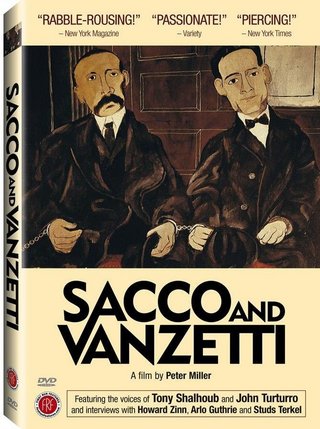
Sacco And Vanzetti (Documentary)
SACCO AND VANZETTI is an 80-minute-long documentary that tells the story of Nicola Sacco and Bartolomeo Vanzetti, two Italian immigrant anarchists who were accused of a murder in 1920, and executed in Boston in 1927 after a notoriously prejudiced trial. It is the first major documentary film about this landmark story.
The ordeal of Sacco and Vanzetti came to symbolize the bigotry and intolerance directed at immigrants and dissenters in America, and millions of people in the U.S. and around the world protested on their behalf. Nearly eighty years later, the story continues to have great resonance, as America once again grapples with issues of civil liberties and the rights of immigrants.
SACCO AND VANZETTI brings to life the personal, political, and legal aspects of this heartbreaking story. The powerful prison writings of Sacco and Vanzetti are read by actors John Turturro and Tony Shalhoub. A chorus of passionate commentators propels the narrative, including a number of older people with personal connections to the story. Artwork, music, poetry, and feature film clips about the case are interwoven into the storytelling.
Through the tragic story of Sacco and Vanzetti, and the inspiring images of those who keep their memories alive, audiences will experience a universal – and very timely – tale of official injustice and human resilience.
BUY THE FILM
http://firstrunfeatures.com/
http://www.willowpondfilms.com/
http://video.google.com/videoplay?docid=1611873062479783306&q=sacco+and+vanzetti+documentary&total=20&start=0&num=10&so=0&type=search&plindex=1
Monday, January 28, 2008
A humble reminder about the Constitution
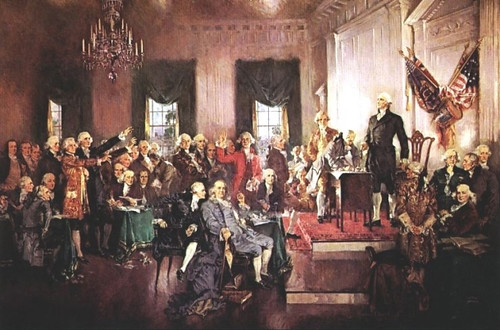
There's a little "trick" interviewers like to play, most recently Stephen Colbert, on right-wingers advocating the display of the Ten Commandments in public spaces. They ask these nearsighted evangelicals to simply name them. All ten. It's a fair enough question. If these precepts are literally gospel truth you shouldn't have too much trouble memorizing them before shopping them around to everyone else. Yet, as Colbert revealed, they can't do it. The same goes with politicians and the Constitution. If a candidate evokes our Nation's most esteemed document in an interview or on the campaign trail one of the first questions that should be asked is can you name the Bill of Rights? I doubt if McCain or Romney could. Obama and Clinton probably, although I doubt if they believe in them. I guess that's the general difference between the two parties in a nutshell. The majority of Democrats pay lip service to the Constitution. The majority of Republicans do not.
But this is a new phenomenon, right? If we take a trip in the way-back machine we'd find a true reverence for the Constitution. Or will we? Was Woodrow Wilson worshiping at the feet of the first amendment when he championed the Espionage Act and the Sedition Act? Or did FDR embody personal freedom when he interned the nation's Japanese-American population (but not Germans or Italians)? How about our third President, John Adams, who, out of paranoia over Irish Immigration and the French Revolution, passed the Alien and Sedition Act of 1798? These are some of the most famous examples, but there are vulgar violations through out history, often committed without remorse.
In fact, the Bill of Rights was a controversial addition to the Constitution in the first place. Alexander Hamilton opposed it saying the Constitution was enough and did not restrict anyone's freedom. But the people fought for its inclusion. Maybe that's why those first amendments have been so flexible in the minds of our leaders. The body of the Constitution, which defines governmental powers, inspires a little more obedience. Freedom of speech and assembly are beautiful concepts with pretty words, but when the Constitution grants the Congress the power to tax or to honor voluntary contracts or to suspend habeas corpus these passages by comparison are divine and immutable.
It was in the interest of the Framers -- white, land-and-slave-owning rich men -- to first liberate themselves from King George then create a solid federal government in order to secure foreign investment. Madison and Monroe, for example, wanted to buy land from the Indians but didn't possess the start-up capital. No foreign investors, such as France, wanted to take the risk of lending money because no mechanism like a judicial branch existed to ensure the cash would be returned. But the Founders couldn't do it alone. They needed to acclimate the middle class to there revolution. They needed soldiers and a buffer from the property-less poor who had carried on a protracted campaign of rebellion against our ruling class. Their solution was to include language of liberty, equality and protection.
Even a cursory glance tells you they didn't mean it. The wealthy doesn't want equality, especially during the time of the Constitution's writing. Black men were property, Indians were something less than human and so were women. You couldn't vote unless you had property which means the interest of renters were rarely represented.
This is why the Constitution provides for a republic and not a democracy. Madison distanced the decision-making powers from the people after looking at how uppity we get when charged exorbitant prices or denied paper money. Madison wrote:
"In England, at this day, if elections were open to all classes of people, the property of landed proprietors would be insecure. An agrarian law would soon take place. If these observations be just, our government ought to secure the permanent interests of the country against innovation. Landholders ought to have a share in the government, to support these invaluable interests and to balance and check the other. They ought to be so constituted as to protect the minority of the opulent against the majority. The Senate, therefore, ought to be this body."
It is obvious who the minority was, and Madison along with many of the Founding Fathers, didn't have any use for the functions of democracy with its system of discussion, proposal, counter-proposal, decision and dissent. They preferred an electoral college and representation of the remaining number of men who were allowed to participate in the system.
It took centuries of blood to enjoy the luxuries of today. The Bill of Rights set the standard and we have yet to achieve its ideals. A great companion to the Constitution is the Universal Declaration of Human Rights. The language of the Constitution may have been insincere but it remains a terrific destination. Remember, no piece of paper gave you your rights, no matter how many times you're told just that in the year to come.
See also:
A People's History of the United States by Howard Zinn
Friday, January 18, 2008
Emma Goldman: A Dangerous Woman (Full Lecture)
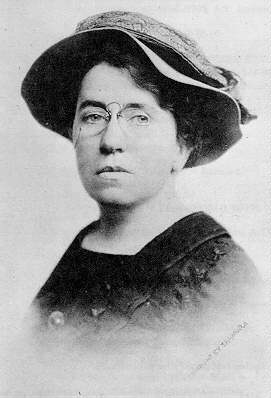
Howard Zinn gives a whistle stop tour of feminist anarchist Emma Goldman's life. Zinn does a superb job of introducing Emma's personality and commitment to her principles to the uninitiated as well as holding the attention of those more familiar with her work. By the end it is evident that Goldman was uncompromising, ungovernable and unrivaled - and rarely wrong. She advocated free thought, birth control (when it was illegal) and direct action. It is easy to see how Goldman was the most dangerous woman of her age.
1. Historical Education
2. Finding Anarchism
3. Make Some Connection
4. Cigar Strikes and the Gilded Age
5. Haymarket
6. Manhattan Cafes
7. Homestead
8. Direct Action
9. Assassin
10. I'll Talk When I Damn Please
11. In Love With The King Of The Hobos
12. On Trial
13. In Prison and the U.S.S.R.
14. Exile
Tuesday, December 11, 2007
Howard Zinn’s ‘History’ Comes to TV
I hope they do a good job with this, maybe they'll put it together in the styles of Ken Burns, Errol Morris or Scorcese. In any case, Network television is finally showing something both edifying and entertaining, and that's a reason to sit up and take notice.
--------- Howard Zinn’s ‘History’ Comes to TV
Documentary Miniseries to feature Damon, Vedder
by Michael Schneider
Production is finally set to begin on a long-delayed TV version of Howard Zinn’s landmark 1980 tome “A People’s History of the United States." The four-hour documentary miniseries — titled “The People Speak” — will include performances by Matt Damon, Marisa Tomei, Viggo Mortensen, Danny Glover, Josh Brolin, David Strathairn, Kerry Washington, Eddie Vedder and John Legend.
Zinn will host the longform project, which begins shooting next month in Boston. Project, to be exec produced by Zinn, Anthony Arnove and First Tuesday Media’s Chris Moore, has not yet been sold to a network.
Damon and Moore have been looking to adapt “A People’s History of the United States” on television for nearly a decade.
Damon, who lived next door to Zinn as a child, and Ben Affleck included a reference to Zinn and “A People’s History” in their Academy Award-winning “Good Will Hunting.” Soon thereafter, the scribes and Moore (also a “Good Will Hunting” producer) sold a 10- to 12-hour miniseries to Fox based on the book.
“A People’s History” was slated to run on Fox in 1999, but that didn’t happen; later, HBO developed a three-part version but eventually passed as well.
The new adaptation will draw from both “A People’s History,” and sequel tome “Voices of A People’s History of the United States,” which Zinn wrote with Arnove. Miniseries will center on the actors and musicians as they read from the books or perform music related to their themes: the struggles of women, war, class and race.
The longform will mix the performances with photos, interviews and archival footage.
“This project is about Howard Zinn, his books and using that body of work to remind and inspire us all that this is a country built on dissidence,” Moore said. “Howard’s work deserves to be on film, and it is time that we paid tribute and captured the struggles of the people.”
Zinn, whose books chronicle the struggles of Native Americans, women, workers and other Americans, said he’d like to continue to inspire activists.
“Our hope is that these words from the past will speak passionately and clearly to the needs of the present,” he said.
Cinetic Media is handling domestic sales for “The People Speak,” which is also being readied for a DVD release after its initial TV run. Artfire Films’ Art Spigel, Ara Katz and Dan Fireman are on board as producers; David Baerwald will provide the music score.
© 2007 Variety.com
Wednesday, November 07, 2007
Zinn Renews Call To End ‘Sham’ War
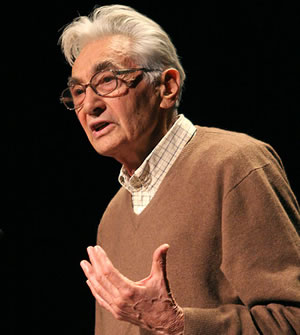 by Vivian Ho
Former Boston University professor and political activist Howard Zinn last night said Americans need to “withdraw our obedience from our government” in response to what he called government deception surrounding modern wars.
“The war on terrorism is a sham,” Zinn said at Morse Auditorium. “Terrorism is an idea that exists all over. You can’t make war on it. If terrorism is the killing of innocent people for some presumed important purpose, then making a war on people is terrorism. War is terrorism. The terrorism of our war in Iraq has killed far, far more people than were killed in the twin towers.”
Zinn said a revolution is the only option Americans have to bring about change and charged his audience of more than 200 to form a “people’s” movement toward a “different world.”
The longtime professor also said government hype must be combated with a discussion of history.
“If you know some history that is outside the establishing view of history, you will not be fooled by the things you hear from the White House, or from members of Congress, or from leaders of political parties,” he said in his lecture, organized by BU Students for a Democratic Society, Boston Youth and Student Anti-War Movement.
The study of the history of government deception in wartime needs a closer look, Zinn said.
“What’s being told is that we are fighting in Iraq for democracy. We are occupying in order to bring democracy and freedom to the Iraqi people,” he said. “If you look at the history of American occupations, look at the history of U.S. interventions in other parts of the world - where have we brought democracy? There’s no evidence of America bringing democracy to the countries that we occupy.”
Zinn said the turnout was encouraging. Attendees said they reserved spots beforehand, and many filled in balcony seating.
“It was a lot of things people need to hear,” said College of Arts and Sciences junior Haley Ott. “There’s a stigma against activism, [so] for someone like him [to speak], it’s useful to have people inside like that.”
Zinn stressed the necessity of citizen involvement, a sentiment BU Anti-War Coalition member Alek Drobnjak said he strongly supports.
“He made a point on people getting involved, which was very important,” the College of Engineering sophomore said. “We need more people to join our clubs and participate in our government.”
Zinn will be speaking again this weekend with BU professor Elie Wiesel in a nonpartisan regional conference called “Race to 2008,” a discussion meant to revive political involvement among campuses in the Northeast.
“If you want something done, it happens when people come together,” said SDS President Farah Mohammadzadeh, a CAS junior. “It’s a revolution. It’s possible.”
© 2007 The Daily Free Press

